A woman watches her husband reading and wonders what is happening behind his thoughtful expression. She has been considering their temperaments, their differences, the mysteries of attraction. When she asks what he is thinking, he starts to answer about fishing bait. Her disappointment breaks into laughter. His kindness is real; so is the distance between their minds.[1]
This domestic misfire belongs to “A Cross Line,” the opening story of George Egerton's Keynotes. Published by Elkin Mathews and John Lane in 1893, the collection quickly became a commercial success. It also became an argument about the woman who could write such things. Egerton was the pen name of Mary Chavelita Dunne, later Bright; her debut brought celebrity and hostile attention together.[2]
The controversy is more interesting when we keep the book open beside it. Its heroine fishes, smokes, desires, and thinks. But she also makes distinctions that publicity tends to flatten: between affection and understanding, between wanting freedom and wanting a particular man. Following what happened to those distinctions helps explain both the scandal and the book's continuing difficulty.
This essay discusses the ending of “A Cross Line.” Quotations follow the 1894 Boston edition digitized by Project Gutenberg.
A book already dressed for an argument
Before readers reached a sentence, Aubrey Beardsley's cover and title-page supplied an interpretation. Their provocative imagery helped associate Keynotes with the daring literature of the Bodley Head. The Grolier Club's exhibition account stresses the distance between Beardsley's visual preoccupations and Egerton's writing. The packaging had a personality of its own.[3]
That matters because a cover can teach a reader what to look for. Arrive expecting sexual audacity and a woman's cigarette becomes evidence before her conversation has begun. Attend to the conversation and something less easily advertised emerges: a person discovering that tenderness does not necessarily make her intelligible to someone else.
The success produced a further transformation. The publishers launched a whole “Keynotes Series,” and Beardsley developed its recurring key designs around individual authors' initials.[3] A title attached to one woman's stories became a recognizable promise about other books. Egerton's literary name now belonged partly to a market category.
Whitney Standlee's account for Yellow Nineties 2.0 records sales of more than 6,000 copies in a short period. It also describes Egerton's reluctance to join literary factions, despite her identification with the New Woman and Decadent movements.[2] A readership had formed around her faster than she could determine what it meant to represent it.
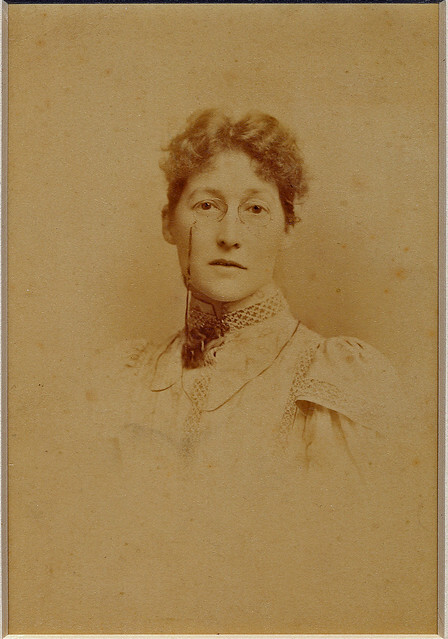
The woman who will not become a solution
“A Cross Line” introduces a fisherman who prides himself on studying women. He regards encounters as opportunities to collect information. The woman he meets knows the local water better than he does; while he assesses her attractiveness, she advises him about flies. His grand interest in female mystery has brought him face to face with practical expertise.[1]
Egerton makes the mismatch funny without making the attraction disappear. The two continue meeting. Later, he offers an imagined voyage on his yacht: books chosen for her, unfamiliar cities, music, the sea. When he asks which part of this picture she dislikes, she answers, “You!”[1]
The little word punctures the assumption that her desire for a different life must be a desire for its proposed provider. He has pictured himself as the answer to her restlessness. She can enjoy much of the picture while withholding that conclusion.
Her own imagination is no less theatrical. Lying beside a bog stream, she pictures herself dancing before an enthralled audience. The narration repeatedly returns to what she fancies, sees, and feels. The dance takes place within the consciousness of a woman still lying in the Irish landscape.[1] Its movement gives duration and intensity to an experience that an observer could easily miss.
This distinction helps locate the story's provocation. A fantasy can matter before it becomes an action. Egerton gives imagined pleasure room on the page without requiring it to become an elopement, a confession, or an immediately punishable event. The reader spends time inside a possibility.
The ending that Punch rearranged
The reception often made that room feel intolerable. In 1894, Punch published two parodies under the name “Borgia Smudgiton,” calling them “She-Notes.” The following year, Hugh E. M. Stutfield attacked Egerton's fiction in Blackwood's Edinburgh Magazine through the language of hysteria and degeneration. Standlee documents both responses.[2] The criticism turned literary experiments into symptoms, making the writer herself a problem to diagnose.
Punch also changed the story's distribution of attention. As Lisa Hager explains in her study of Egerton, its parody sends the maid away with her mistress's lover. The women become competitors, and the man regains his importance. Hager reads that revision as a response to the original's movement away from heterosexual courtship toward a relationship between women.[4]
The change is revealing because Egerton had already supplied an ending. Her heroine realizes she is pregnant, learns that her maid Lizzie has lost a child, and shares a moment of tenderness over the child's surviving things. She prepares to signal the end of her meetings with the fisherman.[1] The story's emotional destination has shifted. A man who seemed likely to organize its future no longer does.
The parody makes that departure into another episode of pursuit. Read beside the original, it shows how a familiar plot can act as a corrective: if women are made to compete for the man, their attention becomes reassuringly legible again.
What the tender ending leaves unresolved
Egerton's ending, however, asks for scrutiny as well as defense. The mistress questions Lizzie about motherhood with “an almost cruel steadiness.” Lizzie's ringless hand is explicitly noticed. Her answer exposes a bereavement she has not chosen to bring into the room.[1]
Then the two women examine the small garments and a lock of hair. Their intimacy has material weight: a box must be unlocked, keepsakes unfolded, something long protected shown. The scene moves from interrogation toward care, but the earlier pressure remains part of how that care becomes possible.
Hager's objection is precise: shared maternal feeling does not undo the difference between a married employer and her unmarried servant. The heroine's increased freedom leaves Lizzie's subordinate position in place.[4] This later critical response asks a different question from the scandalized reviewers. Whose independence has the story actually enlarged?
We can follow that question into the last exchange without dismissing the tenderness. The mistress is sorting her own fine garments for conversion into baby clothes. Lizzie answers her calls. The household's familiar pattern of command and response continues inside the apparent transformation.[1] Egerton has changed what these women know about each other; she has not shown a corresponding change in who serves whom.
Keeping the private life complicated
The competing readings make Keynotes worth returning to. Its first audience could buy a fashionable provocation, recognize previously unspoken feelings, or laugh at a parody that restored an expected plot. A later reader can value its experiments while noticing the unequal access to freedom within them.
The heroine herself resists being understood too quickly. When the fisherman asks whether he understands her a little, she replies, “You do not misunderstand me.”[1] It is a wonderfully exact adjustment. She allows him a limited success while keeping a larger claim out of reach.
That exchange also offers a way to read through the book's reputation. “New Woman,” “Decadent,” scandal, feminist recovery: each can direct attention to something consequential. Each can also encourage us to stop looking. Egerton's best moments reward another look—at a husband thinking about bait, a fantasy mistaken for a declaration, a servant's keepsake box opened under pressure. The private life becomes visible in these details, and remains harder to settle than the argument around it.
Sources
- George Egerton, Keynotes, Boston: Roberts Brothers, 1894, Project Gutenberg — “A Cross Line,” from the opening fishing encounter through the final exchange with Lizzie; primary text for all quotations and scene analysis.
- Whitney Standlee, “George Egerton [Mary Chavelita Dunne Bright] (1859–1945),” Yellow Nineties 2.0 (2022) — publication, early sales, literary affiliations, and the responses in Punch and Blackwood's.
- Grolier Club, “At the Bodley Head,” Aubrey Beardsley, 150 Years Young (2022) — Beardsley's designs, the Keynotes Series, and Russell & Sons' circa-1894 albumen cabinet photograph of Egerton.
- Lisa Hager, “A Community of Women: Women's Agency and Sexuality in George Egerton's Keynotes and Discords,” Nineteenth-Century Gender Studies 2.2 (Summer 2006) — paragraph 1 on the parody's revised ending; paragraphs 14–15 on class, maternity, and Lizzie's constrained agency.