A fly dies in a business office. Moments later, after a frightening spasm of wretchedness, the boss orders fresh blotting paper. That command is the most revealing action in Katherine Mansfield's “The Fly.” It turns a death into a planned supply reset: the body discarded, the stained sheet slated for replacement, the work surface prepared for renewal.
The story is often remembered as a symbolic puzzle. Is the fly the boss's son, killed in the First World War? Is it the boss himself, repeatedly trying to master grief? Does it represent Mansfield, then gravely ill, or a generation exposed to arbitrary destruction? Each resemblance catches something. None explains why the scene unfolds as a sequence of office actions.
A closer reading should therefore follow the verbs before solving the symbol. The boss displays, unlocks, pours, dismisses, schedules, rescues, tests, commands, discards, orders—and forgets. Mansfield makes mourning pass through the habits of management until an unbearable loss can be handled like used stationery.[1][2]
A room built to prove that nothing can shake it
The first thing “The Fly” gives the boss is not a name but an office. Old Woodifield admires the room, and the boss enjoys being admired inside it. New carpet, massive furniture and electric heat surround him; their purpose is less comfort than confirmation. Planted behind his desk opposite a frailer man, he feels “deep, solid satisfaction.”[1]
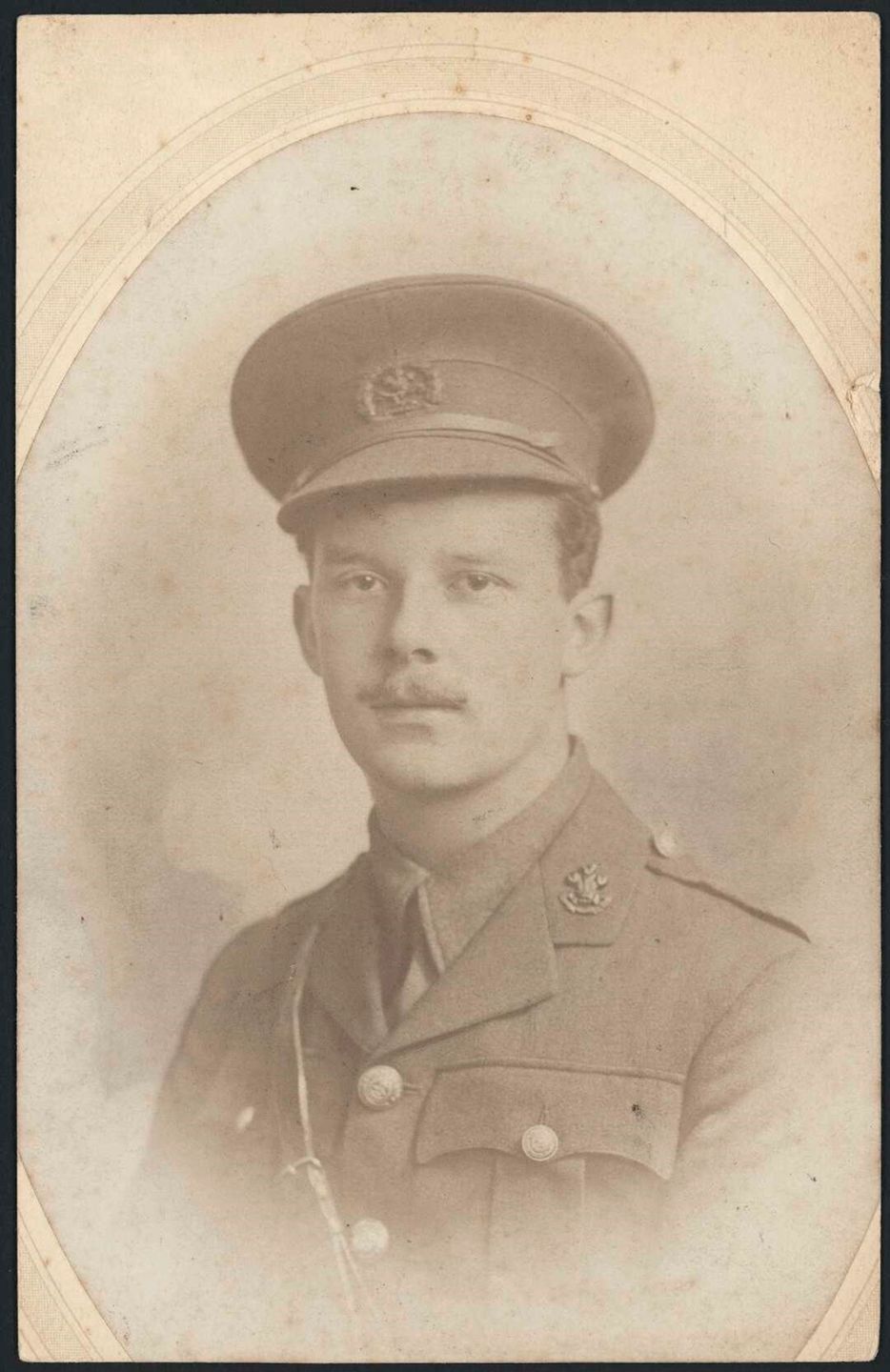
One object does not join the sales pitch. A photograph of the boss's dead son hangs over the table, unchanged for more than six years. The furniture is new; the photograph is not. The boss points out everything that proves renewal while leaving the image that disproves it unmentioned.
Even the two men's memories initially seem to support the hierarchy. Woodifield has forgotten what he came to say. A drink from the boss's locked cupboard restores the thought: his daughters saw both men's sons' graves in Belgium. He describes the cemetery as orderly and garden-like, then veers into outrage over an expensive pot of jam. The movement can sound bathetic, but it is also one way ordinary life survives catastrophe. Grief, tourism, flowers and a hotel bill occupy the same conversation.[1]
The boss believes himself different. Woodifield wanders; he commands. Woodifield is managed at home by his family; the boss remains at the helm of his firm. Yet the story has already put the same pressure on both men: each must remember a son through a mediated object or report, and neither can keep memory in a pure, solemn form.
He schedules the tears before discovering they will not come
Once Woodifield leaves, the boss orders Macey, his messenger, to admit nobody for half an hour. He then covers his face. Mansfield's syntax exposes the plan inside the feeling: “he had arranged to weep.”[1] Grief has an appointment, a closed door and a thirty-minute allocation.
This does not mean the boss is consciously pretending. The memory of his son's death once overwhelmed him, and he expects the old response to return. What fails is his belief that emotion remains available on command. The tears do not arrive because he has created the correct conditions for them.
The photograph fails him too. Its studio pose seems cold and unlike the lively son he remembers. Katherine Mansfield House & Garden notes a pointed biographical echo: Mansfield's brother Leslie was also photographed in uniform against an artificial outdoor backdrop. He had worked in a business before joining the army, and his death devastated the Beauchamp family.[4][5] But an echo is not an equation. The fictional boss is not a coded transcript of Mansfield's father, nor is the fictional son simply Leslie under another name.
What the echo clarifies is the story's distrust of memorial surfaces. The grave has been reported by somebody else's daughters. The photograph preserves the wrong expression. The office contains the son's image without restoring his presence. When direct grief will not obey, the boss turns toward a smaller body he can control.
A rescue becomes a three-part experiment
The boss first saves the fly. He lifts it from the inkpot with his pen and places it on blotting paper. Mansfield slows down as the insect cleans itself: legs work across wings, pauses divide the effort, and the body gradually becomes ready for life again. Rescue establishes both the fly's vulnerability and the boss's power to help.[1]
Then he has an idea. He loads the pen again and drops ink onto the newly cleaned body.
That first deliberate blot changes the meaning of everything that follows. The boss is not observing adversity; he is manufacturing it. When the fly struggles back, he admires the courage elicited by his own cruelty. The slogan that occurs to him—“Never say die”—turns survival into a moral performance while hiding the hand that keeps making survival necessary.[1]
He repeats the test. The second recovery is slower. He decides the third drop will be the last, as though a private limit made the procedure merciful. By the end, the insect's legs no longer answer. The story's three descents of ink are not interchangeable symbols for one large sorrow. They form an experiment in domination: impose a crisis, watch the subject work, praise its spirit, increase the burden.
That structure gives the office setting its bite. The boss understands effort as something visible from above. He can admire endurance without sharing risk, and he can call the outcome character while controlling the conditions. His praise is real. So is the violence that makes the praised quality legible.
One command crosses from the fly to the clerk
At the moment the fly stops moving, the boss tells it, “Look sharp!”[1] The phrase is absurdly managerial. It treats death as tardiness, as if the insect could meet the deadline by trying harder.
Mansfield then carries the same command back into the office hierarchy. Macey is summoned to bring replacement paper quickly. Earlier, the messenger had hovered near his cubbyhole like a dog waiting to be taken out; now he is recalled when the boss, after a jolt of wretchedness, turns toward resetting the scene. Fly and clerk are not equivalent victims, but the repeated imperative places them inside the same grammar of authority. Both are smaller lives expected to answer when the boss speaks.
The repetition also reveals what the boss recovers from the experiment. He cannot recover his son or command his tears. He can still make something move. First the fly works under his gaze; then Macey does. Authority returns as an imperative even while memory is failing.
This is why the boss's tenderness toward the fly does not soften the scene. He rescues it, encourages it and feels relief when it stirs. Care and coercion come from the same hand. The story is not contrasting a kind self with a cruel self; it shows how easily care becomes another name for control when the powerful person alone decides what counts as help, courage and enough.
The order for fresh paper completes the act of forgetting
After the fly dies, the boss lifts the body on a paper knife and throws it away. A “grinding feeling of wretchedness” then seizes him so forcefully that he is frightened. He presses the bell and asks for “fresh blotting-paper.”[1] The adjective matters. The office can procure freshness for the desk even though it is impossible for the life just ended and impossible for the grief that brought the boss to the desk.
Blotting paper exists to absorb a mark so the page can continue. In this scene it also absorbs the evidence of the boss's experiment. The requested replacement would not heal anything; its function is to restore a clean working surface. The corpse goes into the wastebasket; the stained sheet is immediately superseded by an order for fresh paper, while the office's capacity to process the next task remains intact.
Only then does the boss try to recover his previous thought. Mansfield ends with a failure that echoes Woodifield's opening lapse but cannot be repaired by whisky: “For the life of him he could not remember.”[1] The idiom makes forgetting sound total, yet its mention of life arrives immediately after a death the boss caused. He has regained the office and lost the reason he closed its door.
The story does not tell us whether this forgetting is a chosen repression, an involuntary defense or a momentary blank. Avishek Parui's study places the scene within postwar memory, mourning and a crisis of masculine self-command, while Oxford's Elleke Boehmer emphasizes the older generation's moral emptiness and inability to mourn the war it sustained.[2][3] Those frames illuminate the ending without exhausting it. Mansfield supplies no diagnosis that would release the boss from moral responsibility or reduce him to a clinical case.
The fly is strongest when it will not hold still as a symbol
A one-to-one reading makes the scene tidier than the office deserves. The fly resembles the dead son because a larger force destroys its young life. It resembles the boss because it struggles under a weight that keeps returning. It can evoke a soldier praised for courage by people who impose the ordeal, an employee watched by management, or Mansfield herself enduring an exhausting treatment while trying to write.[3][4]
But the fly is also a fly. Its minute labor matters before it represents anyone. The boss's act is horrifying because a living creature nearly escapes and he chooses to renew its danger. If the insect becomes only a code for a human character, its small literal death disappears—the same kind of disappearance the boss performs when he converts the body into waste.
The symbol's instability is therefore an ethical design, not a riddle Mansfield failed to solve. It allows the boss to occupy more than one position at once. He is wounded by war and powerful at his desk; he is unable to command his own grief and able to command another body; he recognizes courage and destroys its bearer. Victimhood does not prevent him from becoming an agent of harm.
Written during Mansfield's painful X-ray treatment in Paris in February 1922, “The Fly” was first published on March 18 and entered The Doves' Nest and Other Stories after her death.[1][4] Its context invites autobiographical reading, but its endurance comes from formal precision. The war never enters the office as battle. It returns as a photograph, a cemetery report, a managerial slogan, repeated blows, a corpse and an order for a clean replacement sheet.
That ordered sheet is the story's coldest absent object. Macey has not brought it back when the story ends, but the boss has initiated the office's supply routine. He is not renewed; he has merely begun an administrative reset. Mansfield leaves the desk awaiting its clean surface and the loss displaced beyond recall. In “The Fly,” forgetting is not the opposite of grief. It is what grief looks like after the boss has set the office to processing it.
Sources
- Katherine Mansfield, The Doves' Nest, and Other Stories (Project Gutenberg HTML edition of the 1923 collection, including “The Fly” and John Middleton Murry's dated introduction).
- University of Oxford Faculty of English, “‘The Fly’ by Katherine Mansfield” (Ten-Minute Book Club full text, introduction and discussion by Elleke Boehmer).
- Avishek Parui, “‘For the life of him he could not remember’: Post-war Memory, Mourning and Masculinity Crisis in Katherine Mansfield's ‘The Fly,’” in Katherine Mansfield and Psychology, Edinburgh University Press, 2016, pp. 113–124 (hosted by Cambridge Core).
- Katherine Mansfield House & Garden, “Introduction to ‘The Fly’ by Katherine Mansfield” (2023 transcript on composition, publication, family context and recurring fly imagery).
- Katherine Mansfield House & Garden, “In Memory of Leslie Heron Beauchamp” (archival account of Mansfield's younger brother, his First World War service and his death in 1915).
- Alexander Turnbull Library, “Leslie Heron Beauchamp” (catalogue record and provenance for the circa-1914 archival portrait, reference PAColl-6826-1-48).