“The world's first named author” is a magnificent label and a dangerous reading shortcut. It invites us to imagine Enheduana doing something reassuringly modern: placing her name on a finished literary work and claiming it as her own. The Exaltation of Inana does something stranger.
The poem does not begin with its attributed author's name. It begins with Inana—radiant, terrifying, armed with divine powers—and sustains that address for dozens of lines. Only then does a first-person singer announce her task. Her title and name arrive together; near the climax, composition becomes childbirth; in the epilogue, “I” becomes “her” and another singer is asked to repeat the song.[1][2]
Those changes are not incidental packaging around an ancient celebrity. They are the poem's account of how a voice acquires authority and how that voice leaves its first speaker. Translation can preserve the sequence or flatten it. Render speaking as writing, a doubled self-declaration as a signature, or birth as mere recitation, and a very old theory of authorship starts to resemble our own.
Before the name, there is an address
The ancient work is often identified by its opening words, nin-me-šara; “The Exaltation of Inana” is a modern descriptive title. Its first large movement praises and fears the goddess through images of radiance, storm, flood, battle, and ruin. The speaker is grammatically present in “my lady,” but she does not initially stand forward as the active maker of the song.[1][4]
That changes around lines 63–65 in Sophus Helle's annotated edition. The first active “I” promises a holy song. Yet even the apparently simple verb is a translation decision. Helle notes that Sumerian du₁₁ is the ordinary verb “to speak”; he renders it “sing” when its object is a hymn or song. The Electronic Text Corpus of Sumerian Literature often chooses “recite.”[1][2]
“Sing,” “speak,” and “recite” create different rooms. “Speak” keeps the utterance broad. “Recite” can suggest a text already composed. “Sing” makes vocal performance the act happening now. Annette Zgoll's recent study presses the last possibility furthest: she argues that the poem presents creation as part of a ritual sequence—purification, preparation of Inana's temple, then the making of the song through singing—not as silent writing at a desk.[4]
This distinction matters before Enheduana ever names herself. The voice becomes authorial by doing something to an addressee. Its first claim is not “this is mine” but “I will perform this for you.” Inana is not the subject matter waiting to be shaped; she is the dangerous listener whose response gives the performance its stakes.
A title unfolds into a name
Then comes one of the poem's most arresting lines:
en-me-en en-he₂-du₇-an-na-me-en
“I am the high priestess, I am Enheduana.”[1]
The sonic and grammatical construction is tighter than the English can show at a glance. En-me-en declares “high priestess-am-I”; Enheduana-me-en repeats the first-person ending while expanding the title into the name. Helle observes that Enheduana—usually understood as “high priestess, ornament of heaven”—seems to emerge from the office in the very act of self-identification.[1]
The ETCSL translation smooths the line into “I, En-hedu-ana the en priestess.”[2] That is lucid English. It also changes the drama. An appositive gives us a person plus a job title; the repeated “I am … I am …” makes identity occur as a verbal event. The second half does not merely supply the proper noun missing from the first. It lets institutional role, ritual fitness, and personal name sound as though each confirms the other.
This is not quite a signature. A signature sits outside or after a work and authenticates it. Enheduana's name appears inside the supplication, at the point where the singer recounts entering the sacred residence, carrying the offering basket, and losing her place. The name belongs to the pressure of the scene.
The named voice immediately breaks
Self-naming does not produce instant mastery. Directly after it, the poem remembers a ritual life turned inside out: offerings appropriate to the dead appear as though the priestess no longer lives there; light scorches; shade becomes storm; the “honeyed mouth” is spoiled; the capacity to soothe vanishes. The speaker petitions Inana after Lugal-Ane has driven her from office and the moon god Nanna has failed to decide her case.[1][2]
It is tempting to read this as transparent autobiography. The safer description is that the poem constructs an autobiographical persona out of office, expulsion, bodily distress, and failed speech. The historical Enheduana is well attested by objects and inscriptions from the Akkadian period, but the surviving poem tablets are Old Babylonian copies made centuries later. Scholars therefore disagree about how directly the transmitted composition belongs to the historical priestess and how much its authorial figure was shaped by later ritual and scribal communities.[3][4][6]
That uncertainty does not make the first person empty. It tells us where to locate the strongest claim. Whatever the exact history of composition, the poem's “I” is not a modern private self who happens to have a public job. Her authority and her wound share the same vocabulary: priestly office enables the song, removal from office corrupts the mouth, and restored speech becomes the means of appeal.
The sequence also prevents the famous name from becoming a victory lap. “I am Enheduana” is followed by evidence that the name alone cannot compel a hearing. The voice must make itself effective.
“I gave birth” or “I recited”?
Near the climax, after coals have been heaped and purification performed, Helle translates:
im-ma-si im-ma-diri-ga-ta … ma-ra-du₂-ud
“My heart was filled, overfilled … I gave birth to it for you.”[1]
The bodily force lies in the edition's choice of du₂, “to give birth.” That choice is not uncontested bedrock. Helle's apparatus records the last verb differently across nine manuscripts: four use du₁₁, to speak or sing; three use du₃, to create; one uses du₂, to give birth; and one uses du₈, to release. Because the verbs sound alike and all fit the scene, he treats the variation as potentially meaningful and follows Zgoll in defending the birth reading.[1]
The English still has to make decisions after that editorial choice. “It” is supplied because the thing born is understood from context; “for you” keeps Inana as recipient. The image can support a thrilling modern slogan—literary authorship born from a named woman's body—but neither the grammar nor the manuscript record isolates creation from ritual address. This is not simply one stable Sumerian word acquiring several loose English equivalents. It is a transmitted crossroads at which the editor and translator must choose how the poem imagines its own making.
The older ETCSL rendering makes a different bargain: “Since it was full, too full for me … I have recited this song for you.”[2] “Song” states the object; “recited” states a recognizable act. The line becomes easy to place in the surrounding performance, but the reproductive verb disappears. Helle's version preserves the metaphor and its uncertainty; the ETCSL version preserves the pragmatic sense while reducing the shock.
Neither choice is neutral. If the line only says “recited,” authorship can look like delivery of something already available. If it only becomes a free-standing declaration of poetic motherhood, the coals, shrine, goddess, and coming singer recede. Zgoll reads the “birth” as creation through ritual singing and cautions against separating it from the sequence of priestly acts. Penn Museum curator Erhan Tamur foregrounds motherhood and creative process in the poem's modern exhibition history.[4][6] The two emphases are not identical, but together they reveal what the line can hold: bodily making, cult performance, and a gift whose destination is named in its grammar.
The poem has prepared that convergence. Just before the first active “I,” Inana is described as born from a holy womb. Later, Enheduana's overfilled interior produces the song addressed to her. Birth travels from goddess to speaker without making them equivalent. Creative authority is neither wholly human possession nor disembodied divine dictation; it passes through a relationship.
After “I,” the poem says “her”
The next move is even less compatible with the solitary-genius story. A cult singer is asked to repeat at noon what Enheduana performed at night. Then the epilogue shifts into third person: Inana receives “her” prayer. In Helle's reading, that grammatical change suggests that the repeating singer may now be narrating. Soon even some pronouns become difficult to assign securely between goddess and priestess.[1]
The authorial voice has not simply vanished. It has changed custody. Night performance becomes noon repetition; a first-person crisis becomes a third-person account; later, clay copies carry the song into schools. Helle's peer-reviewed study calls this a co-created authorship: addressee, performers, and copyists help produce the authorial figure rather than merely transporting an intact private self.[3]
That argument does not deny Enheduana's name. It explains why the name can endure. A voice that remained inseparable from one body and one night would die with both. The poem instead builds transfer into its close. “Her” marks distance, but distance is what allows the prayer to become repertoire.
Zgoll gives the night-to-noon transition a ritual emphasis: the first singing occurs in distress, while the future repetition anticipates a changed condition after divine intervention.[4] Helle emphasizes the chain of hands and voices that makes an author over time.[3][5] Read together, these accounts make the pronoun shift feel less like an editorial oddity than a hinge between event and afterlife.
The clay record keeps the argument open
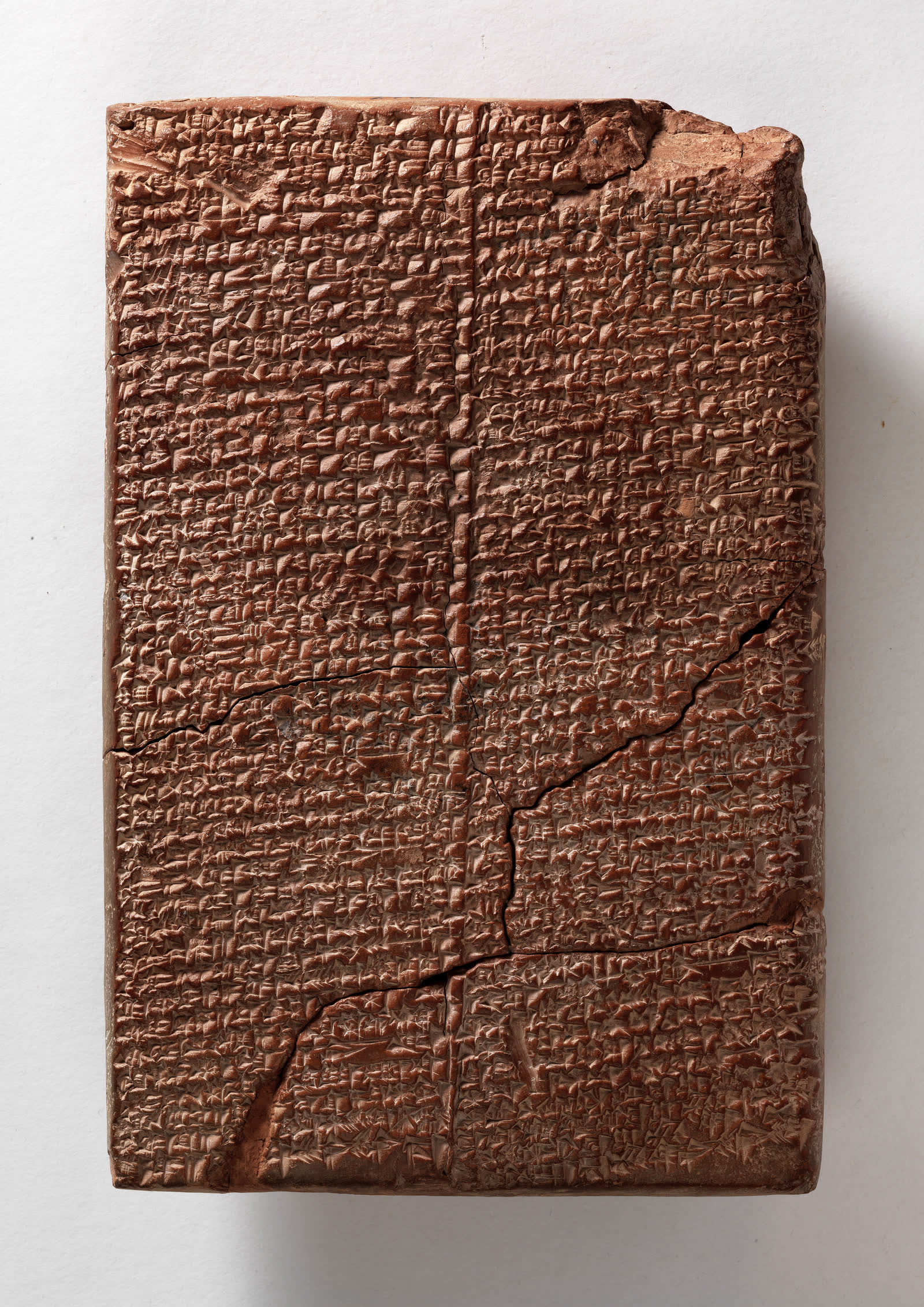
The photograph above shows why historical caution and literary pleasure belong together. Penn Museum tablet CBS7847 is a substantial Old Babylonian witness of Inanna B, densely written across repaired clay. It is genuinely a page of the poem, but not an autograph from Enheduana's lifetime.[7]
Around one hundred Old Babylonian tablets preserve the work, according to Zgoll's account; the archive is rich precisely because later people copied it.[4] Helle notes that when Sumerian ceased to be a native language, it continued as a language of scholarship and ritual, and Enheduana's attributed poems survived through Babylonian school curricula.[5] Transmission complicates the historical claim and makes the literary afterlife possible at the same time.
Modern reception has often led with firstness. The 2022–23 exhibition She Who Wrote centered Enheduana as the earliest named author, while Helle's complete English translation and teaching project have brought the poems to a much wider readership.[5][6] The achievement is real. The poem itself, however, offers a more useful definition of firstness than a place on a podium: a named voice becomes audible by passing through office, goddess, ritual, singer, scribe, excavator, editor, translator, and reader.
That is why the smallest translation choices matter. “Speak,” “sing,” or “recite” decides whether composition sounds oral, musical, or already textual. Apposition or doubled declaration decides whether name and office merely coexist or generate one another. “Recited” or “gave birth” decides whether the line clarifies an action or preserves a bodily metaphor. “I” becoming “her” decides whether the close looks like loss of control or the beginning of transmission.
The strongest English version would not make all those tensions disappear. It would let Enheduana arrive by degrees: first as the pressure behind “my lady,” then as a singer, then as a high priestess who speaks her name, then as the body from which the song comes, and finally as the “her” whom another voice can carry. The author is not a label placed above the poem. She is the poem's most consequential change of person.
Sources
- Sophus Helle, “The Exaltation of Inana: Annotated translation”—Sumerian transliteration, line-by-line English translation, manuscript variants, and philological commentary.
- University of Oxford, Electronic Text Corpus of Sumerian Literature, “The exaltation of Inana (Inana B)”—scholarly English translation with manuscript variants and section references.
- Sophus Helle, “The Birth of the Author: Co-creating authorship in Enheduana's Exaltation,” Orbis Litterarum 75, no. 2 (2020), pp. 55–72—Aarhus University research record and abstract.
- Annette Zgoll, “En-Ḫedu-ana: The Birth of Literature Through the Goddess,” Iraq 86 (2024), pp. 153–179—open-access textual, ritual, transmission, and authorship analysis.
- Sophus Helle, “A New Audience for the World's First Author,” Yale University Press (May 6, 2024)—the poem's performance chain, scribal-school transmission, modern translation, and teaching afterlife.
- Erhan Tamur, “Goddesses, Mothers, Rulers,” Penn Museum Expedition 64, no. 2 (2022)—Enheduanna's historical and exhibition context, later manuscript copies, creative-birth line, and material record.
- Penn Museum, collection record for tablet CBS7847 / object 29-15-422—Old Babylonian Sumerian tablet identified as Inanna B / Ninmesharra, with the archival photograph used above.