The Conjure Woman entered American literature through a door that looked reassuringly familiar. Its white Northern narrator settles on a former North Carolina plantation. An elderly Black coachman, Julius McAdoo, tells him supernatural stories in dialect. The porch, the “uncle,” the plantation past, and even the rabbits on the trade binding all pointed readers toward a popular late-nineteenth-century shelf: local color, folklore, and the sentimental plantation tale.[2]
Inside that familiar arrangement, Julius's stories kept changing decisions in the white household around him. A vineyard sale displaced his income; a haunted schoolhouse was spared and lent to his congregation; a tale about a cruel enslaver helped his grandson recover a job. The narrator called these outcomes proof that Julius had an ulterior motive. The book let motive become evidence of something larger: the supposedly quaint storyteller understood property, audience, and leverage better than the man who framed his words.
That double movement—welcome first, correction second—has also governed the book's reception. Charles W. Chesnutt reached a prestigious national magazine in 1887 by inhabiting a recognizable form. His 1899 publisher made the resemblance more visible while treating the author's racial identity as a market risk. Early critics praised invention and charm but often kept the tales inside the small box of dialect and “superstition.” Later editors and scholars reopened the box, restored the publishing negotiations around it, and taught readers to see listening itself as the drama. The afterlife of The Conjure Woman is the history of a book repeatedly admitted under one description and discovered to be doing more.
1887: A familiar voice with a different author
“The Goophered Grapevine” appeared in the Atlantic Monthly in August 1887. It made Chesnutt the first African American fiction writer to appear in the magazine, although contemporary readers were not necessarily told they were reading a Black author.[2][8] The story arrived twelve years before the collection and already contained its complete reception problem.
John, who becomes the book's frame narrator, moves south because of his wife's health and because he sees a business opening. A cousin tells him labor is cheap and land “could be bought for a mere song.” At the vineyard he hopes to purchase, Julius warns that the grapes are goophered—bewitched—and tells of an enslaved man whose body waxed and withered with the vines. The former enslaver repeatedly sold the man when he appeared young and bought him back when he appeared old. John discounts the magic and buys the land.[1]
At the close, he learns why Julius may have tried to stop him. Julius had lived in a cabin on the property and earned “a respectable revenue” from its neglected grapes. John hires him as coachman and decides the wages more than compensate for the lost income.[1] To a magazine reader expecting a comic folk narrator, the ending supplies the familiar wink: the old man had a scheme. But it also alters the meaning of neglected. The vineyard was idle capital to John and a livelihood to Julius. One deed validates the first description and erases the second.
The tale could therefore pass two editorial tests at once. It offered dialect, metamorphosis, regional scenery, and a clever final turn. It also placed a Black speaker inside an elite magazine and let him contest the economic story told by its cultivated white narrator. Heather Tirado Gilligan argues that the Uncle Julius tales belong not only to a folklore lineage but to period debates over sentimental and realist representations of race in influential magazines.[7] From the first appearance, the question was not simply whether readers believed in conjure. It was which kind of realism they recognized.
1899: The cover offers Uncle Remus
Chesnutt's route from magazine story to first book was neither automatic nor fully his to design. In his 1931 retrospective, he recalled that most of the seven tales had appeared in magazines: “The Goophered Grapevine” began in the Atlantic, “The Conjurer's Revenge” ran in the Overland Monthly, and two were new to the bound volume. Walter Hines Page, then an Atlantic editor and Houghton Mifflin adviser, suggested a collection after rejecting an early version of Chesnutt's novel The House Behind the Cedars. Chesnutt submitted the book, accepted omissions and additions on Page's advice, and saw it published in 1899.[2]
Its physical presentation tried to solve the problem of unfamiliar authorship with familiar signals. A limited edition of 150 copies used yellow buckram and handmade linen paper. The trade edition showed a white-haired Black man flanked by long-eared rabbits. Chesnutt later acknowledged that the name “Uncle” Julius, the setting, and the design all suggested Joel Chandler Harris's Uncle Remus. He immediately marked the difference: except for a folk source behind the first story, his conjure plots were his own inventions, not collected folktales.[2]
The resemblance was a passport, not a destination. Harris's famous frame reassured white readers with a Black storyteller whose remembered plantation world could be consumed as affectionate folklore. Chesnutt retained the storytelling situation and changed the pressure inside it. Richard H. Brodhead's later edition describes the conjure tales as a transformation of that tradition: the plantation setting becomes a meeting place for Northern capitalism and professionalism, Christianity, a damaged Southern economy, and Black folk power rather than a nostalgic retreat from history.[6]
Even before a reader opened the brown cover, then, The Conjure Woman staged its central tactic. The book looked classifiable. Its classification was part of the story it planned to undo.
The counteroffer inside the frame
The collection's second tale shows why “folklore” is too passive a label for what Julius does. In “Po' Sandy,” John plans to dismantle an abandoned schoolhouse and reuse its pine boards for a kitchen. Julius tells him and Annie that an enslaved man named Sandy was transformed into a tree to escape repeated separation from his partner, Tenie. While she is away, the tree is cut down. Tenie returns to find it felled and sees its timber sawn; the boards become the schoolhouse and continue to moan.[1]
Annie hears the system of slavery inside the impossible event. “What a system it was,” she says, “under which such things were possible!” John asks if she means a man becoming a tree. “Poor Tenie,” she answers.[1] She does not accept metamorphosis as fact. She recognizes it as the exact imaginative shape of a regime that converted people into movable, usable property.
The frame supplies another material result. Annie refuses the old lumber. She then allows a breakaway Black Baptist congregation, with Julius among its members, to use the schoolhouse for the present. John interprets the outcome as a trick that has cost him new boards and a donation. He is not entirely wrong; Julius wanted access to the building. His mistake is assuming that interest empties testimony of truth.
That tension is the book's great defense against both condescension and piety. Julius is not a transparent vessel of communal memory. He chooses stories for audiences, pursues benefits, assists relatives, and sometimes appears to take advantage. Chesnutt later wrote with comic bluntness that Julius had “an axe to grind” every time and generally accomplished his ulterior purpose.[2] Agency includes strategy. The collection makes the supposedly simple folk figure the room's best reader.
John detects incentives but treats them as a solvent: if Julius wants something, the story need not change what John knows. Annie detects suffering but can turn politics into private feeling. The reader is placed between them and asked to become a third listener—alert to purpose, open to witness, unwilling to confuse disbelief in magic with mastery of history.
Praise inside a smaller box
The first wave of reception proves how hard that listening position was to hold. An 1899 profile in The Critic reported favorable notices “from Maine to California” and repeated comparisons that made Julius a cousin or “own brother” of Uncle Remus.[3] A Commercial Advertiser reviewer made the containment startlingly explicit: readers should “put aside all questions regarding slavery” and receive the seven stories as American folklore. The review then sorted their imagination and artistry through an openly racist taxonomy.[4] The historical pressure that Annie heard in “Po' Sandy” was precisely what this reading instructed the public to ignore.
Early reception was not monolithic. The Morning Times described “Po' Sandy” as both genuine pathos and a cunning application that secured Julius's church a meetinghouse. It even counted five of seven tales in which Julius obtained what he wanted, usually through Annie.[5] That is a sharp reading of the double frame. Yet the same review repeatedly returned Julius to the era's repertoire of the quaint, simple, “primitive,” and superstitious plantation figure. The limitation was not blindness to craft so much as the size of the category around it. Julius could be shrewd as a comic trait without his shrewdness becoming an analysis of who owned the vineyard, whose church needed a room, or why former slaveholders' property claims seemed natural while former slaves' claims appeared merely cunning.
William Dean Howells offered the most consequential praise. In a May 1900 Atlantic essay, quoted by Chesnutt three decades later, he admired the stories' “wild, indigenous poetry,” imagination, humor, restraint, and characterization.[2] The endorsement mattered enormously to a new author. Its language also shows the era's critical bargain. Artistic and primitive, disciplined authorship and seemingly native spell, could sit in the same compliment. Chesnutt was welcomed as an original while the tales were kept close to a racialized idea of instinctive folk beauty.
The handling of his identity made that bargain literal. Chesnutt recalled that Houghton Mifflin did not mention his race in announcing or advertising the book. When James MacArthur of The Critic learned it while The Conjure Woman was in press and asked to disclose it, Page initially worried the information might hurt sales before consenting.[2] The caution exposed what the frame had made commercially useful: a white-mediated voice could enter rooms from which a named Black critique might be excluded.
This does not reduce the book to camouflage. It clarifies the audacity of its form. The protective frame is also the object of satire. John delivers Julius to the reader and never notices how often Julius has redirected the delivery.
1929–1993: Survival becomes recovery
The Conjure Woman did not vanish immediately after its debut. Chesnutt wrote that Houghton Mifflin issued a new edition in 1929, thirty years after first publication, using the original plates, a black-and-red cover, and a foreword by civil-rights leader Joel Spingarn. The royalties had never made him rich, but he was justly proud that a short-story volume not then treated as a modern classic had remained available so long.[2]
Continuity is not the same as secure canonization. Chesnutt's broader work receded after his death and began a substantial scholarly recovery in the mid-1970s.[8] By then, the terms of interest had changed. Readers increasingly placed him within African American literary history, post-Reconstruction politics, realism, publishing institutions, and the formal problem of double audiences—not merely beside Harris on a folklore shelf.
Brodhead's 1993 The Conjure Woman and Other Conjure Tales made that change visible at the level of the object. It gathered the seven tales from the 1899 book with Chesnutt's additional work in the genre, added a chronology of composition, and reconstructed how the original collection emerged through negotiation with a dominant white literary culture.[6] The editorial question was no longer only “What charming stories did Julius tell?” It was also “Which conjure stories became a book, which did not, and what did publishers and readers make possible or difficult?”
That larger corpus weakens the old illusion that Uncle Julius sprang fully formed from a stable folk type. He becomes part of an extended experiment in voice, genre, market access, and historical memory. The 1899 volume remains an achieved work, but no longer looks inevitable.
2002 and after: A different shelf, a better listener
The Library of America's 2002 Stories, Novels, and Essays placed The Conjure Woman beside The Wife of His Youth, the novels, uncollected fiction, and selected political essays in a 939-page career volume.[9] The change of shelf matters. Read beside Chesnutt's writing on disfranchisement, courts, racial definition, and the postbellum literary world, the conjure tales cannot be isolated as an early holiday in folklore before the author became serious.
Modern reception has not replaced one final label with another. Brodhead stresses negotiation with literary culture; Gilligan stresses magazine reading and the contest between sentimental and realist racial representation.[6][7] Historians of the book can study covers, advertising, correspondence, exclusions, reviews, and editions. Each approach hears a different register in Julius's performance.
The most durable correction is simpler: material interest and historical witness are not opposites. Julius may want the vineyard, access to the schoolhouse, or a job for his grandson. Those wants reveal the post-emancipation present that a quaint “slave-time” tale might otherwise conceal. The story reaches backward because someone is trying to decide something now.
That is why the collection has survived every frame placed around it. Local color made the first invitation. Dialect and conjure supplied pleasure. The publisher managed racial disclosure; reviewers supplied comparisons; later editors supplied a larger archive and a different canon. Through all of those rooms, Julius keeps doing what he did on John's porch: accepting the terms of the hearing just long enough to make a counteroffer.
Sources
- Charles W. Chesnutt, The Conjure Woman. Houghton, Mifflin and Company, 1899—Charles W. Chesnutt Archive digital edition and page-indexed primary text used for story references and short quotations.
- Charles W. Chesnutt, “Post-Bellum—Pre-Harlem.” The Colophon, February 1931—Chesnutt's retrospective account of the tales, book design, editorial path, racial disclosure, early reception, and 1929 edition.
- Carolyn Shipman, “The Author of ‘The Conjure Woman,’ Charles W. Chesnutt.” The Critic 35 (July 1899), pp. 632–634—contemporary profile documenting the book's early national reception and Uncle Remus comparisons.
- Anonymous, “The Conjure Woman.” The Commercial Advertiser, June 20, 1899—contemporary review that explicitly asks readers to set slavery aside and treats the book through a reductive folklore and racial framework.
- Anonymous, “Plantation Tales.” The Morning Times, April 9, 1899—contemporary review that perceives Julius's practical successes and the pathos of “Po' Sandy” while retaining the period's plantation-story categories.
- Richard H. Brodhead, ed., The Conjure Woman and Other Conjure Tales. Duke University Press, 1993—expanded edition and introduction reconstructing the genre, composition history, and institutional negotiation around the 1899 collection.
- Heather Tirado Gilligan, “Reading, Race, and Charles Chesnutt's ‘Uncle Julius’ Tales.” ELH 74, no. 1 (2007), pp. 195–215—analysis of the tales' intervention in magazine reading, racial representation, sentimentalism, and realism.
- Library of America, “Charles W. Chesnutt, ‘The Bouquet’” (2019)—career and recovery timeline, including the 1887 Atlantic milestone, mid-1970s revival, and 2002 Library of America edition.
- Library of America, Charles W. Chesnutt: Stories, Novels, and Essays—official contents and publication record for the 2002 career volume edited by Werner Sollors.
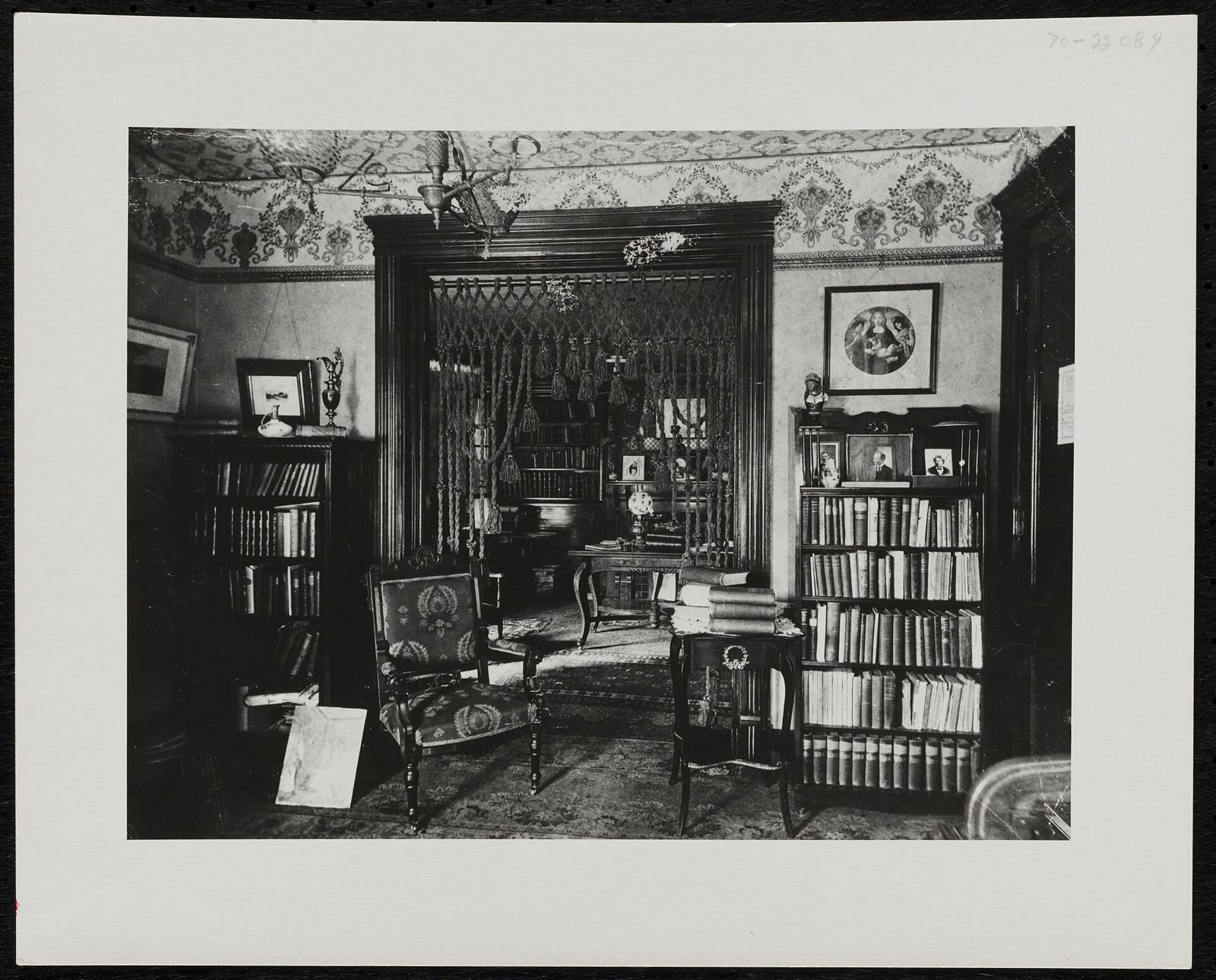
- Wikimedia Commons, “Chesnutt's Library at 64 Brenton Street Cleveland”—Cleveland Public Library archival photograph and catalog metadata for the room in the Chesnutt family home, 1888–1904.