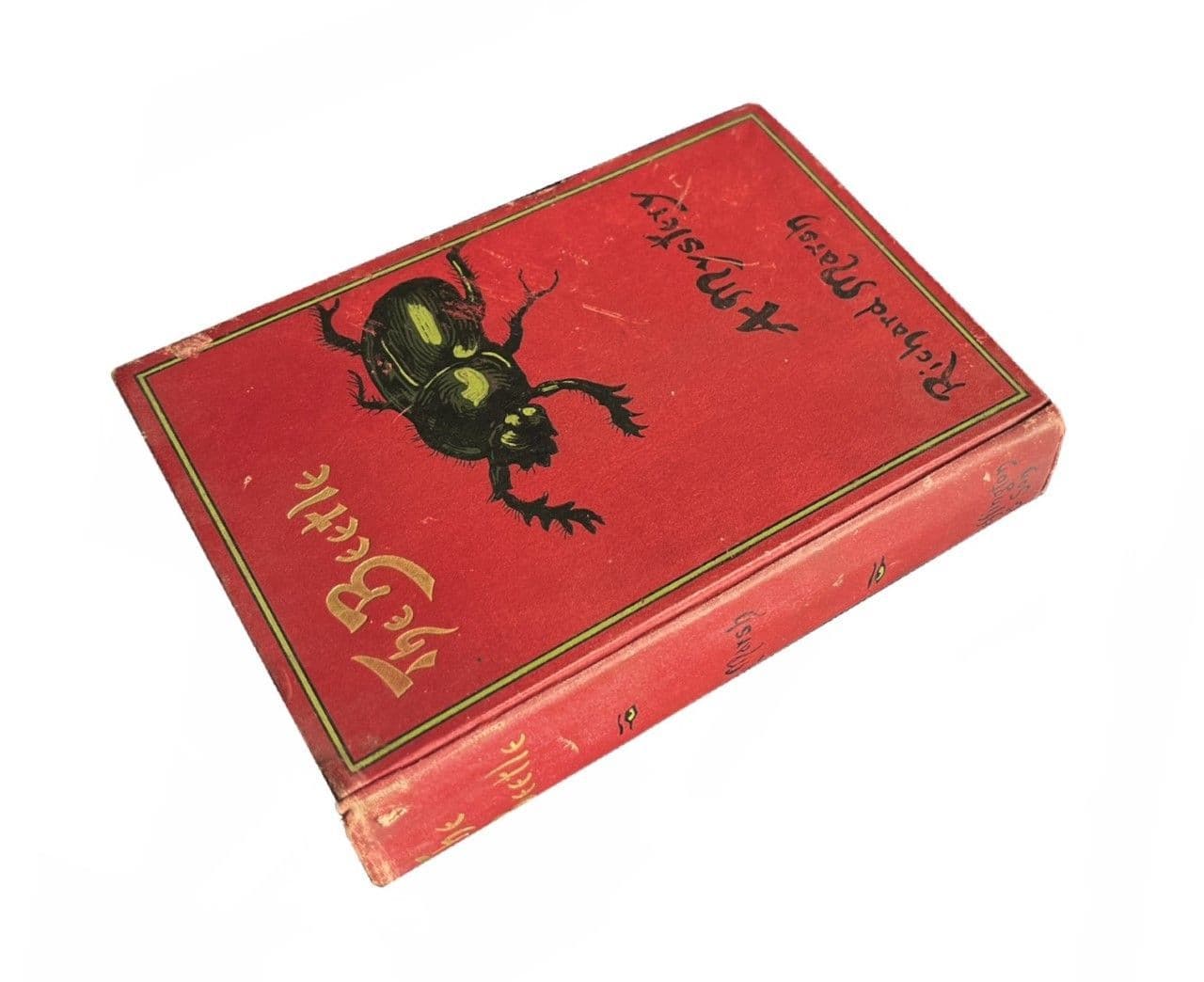
In September 1897, Richard Marsh's The Beetle did something more decisive than introduce a monster: it promoted one. The story had spent the spring in a penny weekly under the lumbering title The Peril of Paul Lessingham: The Story of a Haunted Man. For the six-shilling volume, the haunted politician surrendered the marquee to the thing haunting him. A black insect crawled across red cloth. Four internal illustrations promised occult horror, crime, society, and romance. The book itself became an advertisement for a creature its pages could never keep in one body.[2]
The advertisement worked. The first volume printing sold out; three more impressions followed before the end of 1897. The Beetle remained commercially stronger than its now-inevitable comparison, Bram Stoker's Dracula, well into the next century. Yet the vampire became a modern icon while Marsh's shape-changing creature slipped toward cult status and the rare-book shelf.[2]
That reversal is usually told as a race with one winner. It is more revealing as a story about literary packaging. The Beetle was built to move between readers, prices, genres, and narrators. Those same crossings make it exhilarating, compromised, and difficult to reduce to a reusable silhouette. Its return through scholarly editions has not restored the uncomplicated sensation of 1897. It has changed what readers think the sensation contains.
The title moved the monster to the front
Marsh's novel reached readers before it reached bookshops. Answers, Alfred Harmsworth's penny miscellany, ran it in fifteen installments from March 13 to June 19, 1897. The paper mixed serial fiction with jokes, competitions, household facts, and short features for an audience Vuohelainen estimates at half a million. Plot summaries helped newcomers board a story already in motion. The complete serial cost 1s.3d.; the September book cost 6s., almost five times as much.[2]
The change of title negotiated that move. The Peril of Paul Lessingham names a respectable man's private crisis. The Beetle: A Mystery names a commodity, a genre, and a question. It also resists the durable myth that Marsh simply copied Dracula. Marsh's serial was already running when Stoker's novel reached readers, even if the two volume editions invited reviewers to treat them as rivals later that year.[2]
The red binding completed the revision. Its insect is not a neutral likeness of anything in the plot. It is a clean emblem for an unclean, unstable presence—exactly the simplification a person scanning a crowded display could grasp. The surviving photographed copy used here still makes that logic visible: large gilt title, centered insect, and the subtitle placed below it.[6] The physical book tells us what the prose refuses to guarantee. There will be a beetle. It can be seen. It can be named.
Four witnesses keep undoing that promise
Inside, certainty immediately fractures. Book I, “The House with the Open Window,” belongs to Robert Holt, an unemployed clerk turned away from the workhouse on a wet night. Hunger and rain push him through an open window before mesmerism strips him of bodily command. Book II passes to Sydney Atherton, an affluent inventor whose comic vanity, experimental violence, and frustrated love import romance and scientific adventure. Marjorie Lindon claims Book III but loses control inside the very testimony carrying her name. Book IV converts the ending into extracts from the casebook of confidential agent Augustus Champnell.[1]
These are not four camera angles on a stable object. Each narrator supplies a different genre and a different kind of credibility. Holt's exhausted fear is easy for the gentlemen to dismiss. Atherton describes the human figure changing into a “truly astonishing example of the coleoptera,” then repeatedly qualifies what he thinks he saw. Marjorie's account brings the creature's coercion into the bedchamber. Champnell promises the evidentiary order of detection, only to finish with rags, disputed stains, a railway wreck, and no identifiable body of the creature.[1]
The title says The Beetle; the narrators cannot agree that “beetle” is an adequate noun. The creature appears human and insect, masculine and feminine, ancient and horribly modern. In Chapter XLVIII, Champnell still asks “who he was—if it was a ‘he,’” and ends prepared to believe in something “born neither of God nor man.”[1] A detective's conclusion thus preserves the mystery instead of solving it.
That formal instability helped Marsh sell several pleasures at once. The first-person blocks can behave like a slum nightmare, a drawing-room comedy, a story of sexual terror, and a pursuit thriller without requiring smooth transitions. Victoria Margree's later criticism treats the unusual narrative structure as central to the novel's entanglement of gender, unemployment, urban decline, and threatened masculinity.[3] The form is not merely a baggy container for topical fears. It is how authority keeps changing hands—and how no hand closes around the creature.
Bad taste became part of the publicity
The first reviewers recognized the machine even when they disliked what it produced. The Daily Mail granted Marsh skill in plot and mystery while calling the novel “sordid” and “vulgar.” The Saturday Review thought its terrors implausible, then conceded that it was “good reading.” The Daily Graphic supplied the most useful sales copy of all: this was the kind of book that made a reader turn up the gas and check behind the chair.[2]
Those judgments are less contradictory than they look. Reviewers could police the border between literature and sensational merchandise while admitting that Marsh knew how to cross it. Disgust named the content; compulsion named the craft. Even the objections repeated the book's promise that something bodily would happen to its audience—the flesh would creep, the hand would keep turning pages.
Sales give that mixed reception its proper scale. The novel appeared on The Bookman's bestseller lists from December 1897 through May 1898, peaked at number six, and continued at the relatively expensive six-shilling price through its ninth edition. A cheaper reprint produced another surge in 1907–08. By 1913 The Beetle had reached a fifteenth impression while Dracula was in its tenth; a twenty-fourth impression followed in 1927.[2] “Forgotten bestseller” is therefore too abrupt a label. Marsh's monster did not vanish after one season. It held readers for three decades before the terms of popular horror changed around it.
The comparison with Dracula explains less than it seems
Putting the two 1897 novels together clarifies their shared moment: foreign return, invasion anxiety, hypnosis, modern London, unstable evidence, endangered women, and men whose professional competence repeatedly fails. It does not prove that the better novel won the future. Nor does the early impression count measure private reading, cultural prestige, or every edition on equal terms. What it securely overturns is the idea that The Beetle began as a minor imitation waiting for Stoker's natural superiority to assert itself.[2]
By the end of the 1920s, Marsh's novel had been translated, staged, and adapted as a 1919 silent film. The film is now lost. By the 1960s, Vuohelainen observes, Hammer's screen vampires were giving Dracula a newly attractive body while the beetle-creature looked increasingly like an anachronism. She suggests that Marsh's ugly monster was less adaptable than the count.[2]
There is a further possibility, and it should remain an inference rather than a sales law. Dracula offers adapters a portable kit: count, castle, cape, bite, blood, invitation. Marsh's creature is most disturbing where the kit breaks down. Is it an insect, a person, a priest of Isis, a projection of its witnesses, or some combination the narrative cannot certify? Its shifting sex and form can power a novel organized around unstable testimony, but they resist the quick recognition on which serial screen afterlives thrive. The cover gave the market one beetle; the text kept taking that beetle away.
Recovery changed the question
The book's modern return did not depend on rebuilding its old brand. Broadview's 2004 scholarly edition surrounded the novel with material on fin-de-siècle London, the New Woman, British involvement in Egypt, mesmerism, and animal magnetism.[4] Later criticism pushed beyond the familiar label “reverse colonization” to examine the unemployed male body, cross-dressing, unstable narration, urban space, sexual coercion, and the book's imperial imagination.[2][3][5] A 2018 Manchester University Press collection described Marsh as a popular writer neglected by twentieth-century critics and placed The Beetle within a larger body of work about crime, gender, money, objects, and empire.[5]
That recovery makes the novel more interesting and less innocent. Marsh's creature does not simply liberate identity by crossing sex and species. The descriptions used to make it alien draw on racist physiognomy, Orientalist fantasy, and period theories that translated bodily difference into signs of degeneration or criminality; they also belong to a British culture eager to relocate its own violence into an Egyptian “other.”[2][3][5] The creature destabilizes the English characters' categories, but the novel also manufactures horror from those categories. Both facts belong in the reading.
This is why the first-edition cover matters as evidence rather than decoration. Its crisp insect solves a marketing problem by fixing one image where the narrative produces uncertainty. Modern editions and criticism perform the opposite operation: they reopen the book's materials, restore its publishing context, and ask which fears had to be compressed before that emblem could look simple.[2][4]
The Beetle did not lose the twentieth century because readers finally discovered it was bad, just as it did not outsell Dracula because the 1897 public had delivered an enduring aesthetic verdict. Its career moved through different machines of attention: the penny weekly, the bookshop display, the review page, cheap reprints, stage and silent film, the horror cinema it largely missed, and the classroom edition that returned its disturbing contexts.
The most satisfying way to read it now is to keep those machines audible. Feel the speed. Notice the handoff between voices. Enjoy the outrageous turns without mistaking outrage for neutrality. Then look back at the beetle stamped on the red cloth: one lucid, saleable creature covering a novel that knows clarity is the first fiction its monster will destroy.
Sources
- Richard Marsh, The Beetle: A Mystery (1897), Project Gutenberg illustrated HTML edition—primary text for the four books, chapter references, and short quotations.
- Minna Vuohelainen, introduction to The Beetle (Valancourt Books, 2008)—serial and volume publication, design, contemporary reviews, edition history, decline, and critical context.
- Victoria Margree, “Both in Men's Clothing: Gender, Sovereignty and Insecurity in Richard Marsh's The Beetle,” Critical Survey 19, no. 2 (2007), pp. 63–81—research record and abstract on narrative structure, gender, unemployment, and urban decline.
- Google Books record for Broadview Press's The Beetle, edited by Julian Wolfreys (2004)—edition history and contextual appendices on London, the New Woman, Egypt, and mesmerism.
- University of Brighton research record for Victoria Margree, Daniel Orrells, and Minna Vuohelainen, eds., Richard Marsh, Popular Fiction and Literary Culture, 1890–1915 (Manchester University Press, 2018)—the modern recovery of Marsh and its critical fields.
- Brought to Book Ltd., “The Beetle by Richard Marsh First Edition Skeffington & Son 1897”—source page and physical description for the photographed first-edition cover used as the lead image.