In William Wells Brown's Clotel, an enslaved woman's already-cropped hair helps her put on a gentleman's clothes and board a steamboat as “Mr. Johnson.” A Black man named William travels beside her as her servant. In Running a Thousand Miles for Freedom, William Craft's book-length 1860 account of the couple's escape, Ellen has William cut her hair, puts on a gentleman's clothes, and travels as “Mr. Johnson” while he plays the enslaved attendant. The resemblance is not a literary coincidence. Brown had helped introduce the Crafts and their extraordinary 1848 escape to abolitionist audiences before he adapted its central performance for his 1853 novel.[1][2][3]
Read side by side, however, the two books do not tell the same story twice. Brown makes the disguise arrive at speed, then subjects its finished figure to an outsider's suspicious gaze. The Crafts slow its construction until every bandage, ticket, pronoun, and polite exchange can be felt as a possible break. In Clotel, passing is both a narrative hinge and a public spectacle. In Running, it is a live collaboration that strangers keep trying to rewrite.
The difference is not fiction versus fact in any simple sense. Both books arrange evidence for an audience, borrow recognizable genres, and turn a journey into an argument against slavery. Their sharper contrast is formal. Brown asks what public observers make of a completed reversal of master and enslaved person. The Crafts ask how two people design, repair, and sustain that reversal while the world inspects it.
The public story behind Brown's private cabin
The Crafts escaped from Macon, Georgia, in December 1848. By January 1849, Brown had met them, written an early newspaper account, and read another account of their journey at the Massachusetts Anti-Slavery Society's annual meeting before the couple appeared onstage. Rosa Martinez traces that rapid circulation from Brown's letter to The Liberator, the New York Herald, a striking anonymous newspaper report, abolitionist lectures, portraits, fiction, and finally the Crafts' own volume.[3]
Clotel entered that chain in London in 1853. Often identified as the first novel published by an African American, it was never a sealed, singular object: Brown later produced three substantially different versions, and the University of Virginia Press's scholarly edition presents all four as a history of continuing revision.[4] The first Clotel is already composite. It draws reported incidents, abolitionist argument, sentimental fiction, songs, speeches, and Brown's experience into a deliberately crowded form.
The escape chapter advertises that method. Before Clotel reappears, the narrator offers several compact stories of fugitives who turn the signs of slavery against surveillance: one drives a pig as if sent on an errand; two alternate playing captive and captor; another steals a slave-catcher's clothes. These are not ornamental digressions. They teach the reader to see flight as improvisation before Clotel improvises her own social identity.[1]
Her plan then arrives with astonishing efficiency. William remarks that her cropped hair makes her look like a man. Clotel answers, “I will assume the disguise of a gentleman,” assigns him the role of servant, and uses his savings to fund both escapes. Clothes are procured, a boat appears, and the pair are aboard “in less than an hour.” Clotel buys the fares and a private stateroom. A handkerchief covers her chin, green glasses cover her eyes, and supposed illness discourages conversation.[1]
Brown compresses the preparation into velocity, but not the whole ordeal. William scouts a northbound steamer, boasts in a servants' hall of his supposed master's wealth, and answers an officer's questions; Clotel adds illness and the proprietary claim that the pair belong together. Then a purported newspaper account by a fellow passenger takes over. Its observer inventories bandages, hears a “womanly voice,” reads Mr. Johnson's complexion as Spanish, and questions William. The legal order built on appearances becomes briefly helpless before a better performance, but it never stops looking.[1]
Joint manufacture occupies a few swift sentences; the public act of reading grows long. Brown makes this an escape story about spectatorship as well as flight. Once Mr. Johnson has been assembled, the narrative's attention migrates to the people trying to classify him.
The memoir moves detail into the workshop
Running a Thousand Miles for Freedom begins from a different contract with its reader. Its preface says the volume is not a full life but an account of one escape, and the narrative repeatedly interrupts forward motion to explain the laws, customs, and routine humiliations that made each ordinary transaction dangerous.[2] A ticket is never only a ticket when a Black traveler needs written permission. A hotel register is never only a guest book when the person playing a white gentleman has been forbidden to learn to write.
William's retrospective voice gives the initial inversion to himself: it “occurred to me” that Ellen might travel as an invalid white gentleman, an idea from which she first shrinks. But a notion is not yet a viable route. William purchases the disguise piece by piece except for the trousers, which Ellen sews; then the expected writing requirements expose the plan's first potentially fatal gap.[2]
That register problem produces Ellen's breakthrough. Despairing over the signatures that hotels and the Charleston customhouse might demand, she raises her head and says, “I think I have it!” Her right hand will be wrapped and placed in a sling, allowing an official to write for her. A second poultice will hide her chin and cheeks; green spectacles will shield her eyes; illness will limit conversation. William cuts her hair. Only after the couple have sat up all night testing the design does the disguised Ellen stand before him as a “most respectable looking gentleman.”[2]
The order matters. Brown turns hair cropped as punishment into an immediate visual opportunity and moves outward into action. Running records a general scheme, then subjects it to failure analysis: gendered travel customs, passes, hotel registers, handwriting, beard, voice. The costume is not a revelation of some naturally masculine appearance. It is an answer assembled against anticipated questions.
Nor does the plan become safe once it looks convincing. At the Macon station, the cabinetmaker with whom William has worked searches the departing train. Inside Ellen's carriage sits a man who has known her since childhood; she feigns deafness to keep him from recognizing her voice. Elsewhere, a traveler offers to buy William, and a stranger supplies the “invalid” with a medical prescription Ellen cannot risk pretending to read. Hotel staff help the supposed gentleman upstairs and unwittingly supply the hot, fresh poultices William carries with him. Each encounter adds another person to the performance, often without that person's knowledge.[2]
This episodic pressure changes suspense into a form of interpretation. The question is not merely whether the disguise looks good. It is what every observer believes a white male enslaver, an ailing traveler, and an enslaved attendant should do next. Survival depends on predicting those expectations before they become demands.
A master manufactured by two people
The disguise is usually described as Ellen's, and rightly so: her body bears its most dangerous signs, and her refinements make the scheme viable. But Running does not give us a lone inventor. William proposes the initial reversal; Ellen sews the trousers and solves its signature, beard, and conversational problems. “Mr. Johnson” emerges through revision between them.
William buys the remaining garments, cuts Ellen's hair, carries luggage, tends the poultices, answers servants, and supplies the visible attentiveness expected of an enslaved man. Ellen buys tickets, accepts deference, protects William from would-be purchasers, and controls how much the supposed master speaks. Their actual marriage must disappear into an invented hierarchy so that both can leave the real hierarchy behind.[2]
The narration makes that strain audible. William begins calling his wife “my MASTER” and shifts to masculine pronouns for her while the disguise is active.[2] The grammar does more than preserve suspense. It registers the violence of the available script: the couple can travel together only if public language turns one spouse into the other's property. At the same time, the private knowledge shared by writer and reader makes every “master” double. The word names the role and exposes it as a role.
Brown uses the same tableau but distributes its emphasis differently. His William does more than fund the flight: he scouts the steamer, announces his supposed master's wealth, answers an officer, and helps sustain the pair's property-law bluff. Yet Brown renders these joint operations compactly and shifts sustained scrutiny to strangers' reading of Clotel. The Crafts' narrower account can keep asking what the tableau demands of both participants from one station to the next.[1][2]
This is why William's performance cannot be reduced to camouflage. When strangers praise Ellen's gentility, offer to purchase him, or advise the supposed owner to treat him more brutally, the masquerade makes slavery speak its assumptions aloud. The pair escape partly because white observers find the image of domination so ordinary that they help maintain it.[2]
What the sling knows
The most revealing difference lies in the role assigned to illness. Clotel retains several of the historical disguise's visual signs: covered chin, dark glasses, an assertion that Mr. Johnson is “very ill.” But it detaches those signs from the problem of literacy. Brown first moves rapidly into the private cabin, then re-expands risk through the passenger's report, where voice, complexion, and bandages become evidence to inspect.[1] In the Crafts' telling, the sling is a piece of reasoning. It explains why the hand cannot sign. The facial poultice conceals the absence of a beard. The glasses reduce eye contact. Feigned deafness protects the voice. Apparent weakness gives William a reason to support Ellen physically.[2]
Martinez places this performance inside a larger history of racial misreading, gender, disability, and the period's unstable ideas about Spanish identity. Her account shows how early observers and later writers turned the Crafts' journey into competing versions, often simplifying precisely the layers that made the disguise work.[3] The comparison here suggests a further literary distinction: Brown preserves the silhouette of invalidity, while the Crafts unfold its syntax—if an official asks this, the sling answers; if a gentleman speaks, deafness closes the exchange; if an invalid needs help, the “servant” may remain close.
The strategy exploits a brutal asymmetry. A Black traveler who cannot produce papers or answer a white question is exposed to detention and violence. A person read as a wealthy white man can present the same limits as private affliction and receive assistance. The costume does not make incapacity powerful by itself. It reveals whose vulnerability society treats with deference and whose it treats as evidence of guilt.[2][3]
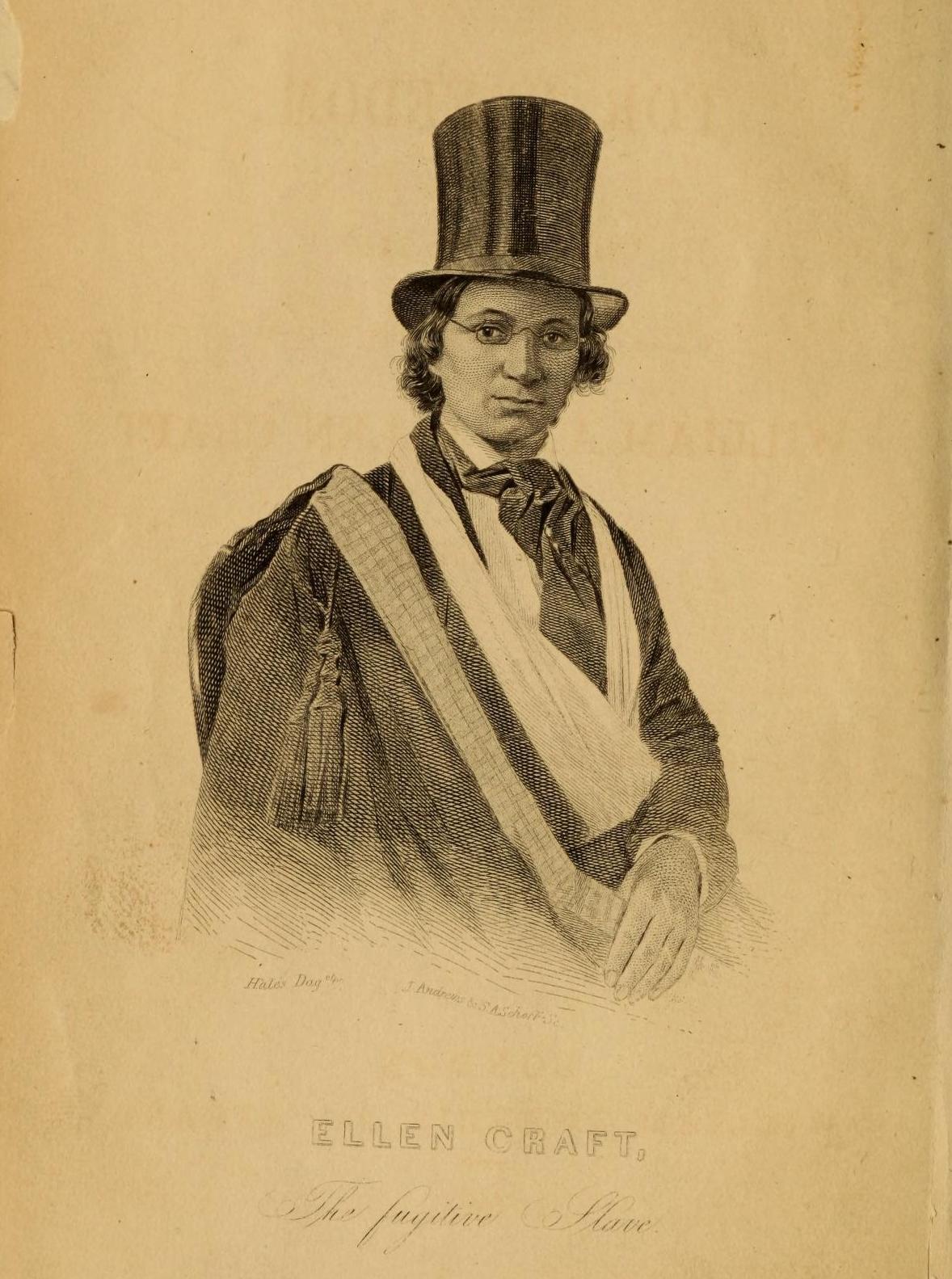
Even the famous portrait carries that argument. The Library Company of Philadelphia identifies its source as a daguerreotype made around 1849–50 and the surviving object as an engraving by J. Andrews and S. A. Schoff. Ellen poses in the top hat, spectacles, jacket, cravat, and sling of Mr. Johnson. Yet the image omits the chin poultice because, as Running explains, it would have prevented a clear likeness.[2][5][6] The portrait is archival evidence, but not an untouched snapshot of the escape. Like the two books, it selects which seams to show.
Two truths in motion
It would be easy to praise the memoir's detail by treating Brown's compression as a defect. That would miss what Clotel achieves. Brown takes a story already moving through newspapers and abolitionist halls and gives its preparations the contagious speed of fiction, then holds the completed figure under a passenger's gaze. The disguise first exposes social roles as reproducible performance and then racial and gender classification as active, fallible reading. Clotel's escape joins a repertoire of Black ingenuity; one improvised reversal seems to generate another.[1][4]
The Crafts need a different pace. Their book reclaims an escape that other people had reported, exhibited, celebrated, and adapted. It shows preparation where public legend sees inspiration, joint labor where a portrait shows one sitter, and repeated exposure where a plot summary sees one disguise. Its suspense comes from refusing to let the finished image replace the work that sustained it.[2][3]
Together, the books make “Mr. Johnson” less a character than a test of reading. Brown foregrounds the finished disguise moving through public interpretations. Running foregrounds the couple anticipating, revising, and surviving those interpretations. Both books show observers testing the same signs and, in doing so, reveal the prejudices that make them persuasive. The disguise succeeds not because appearance is shallow, but because the slave system has trained everyone to read race, gender, health, class, and authority as if they naturally belonged together.
Clotel shows the costume becoming a public story. Running a Thousand Miles for Freedom makes us feel two people holding that story together through every conversation, signature, stare, and mile.
Sources
- William Wells Brown, Clotel; or, The President's Daughter (London, 1853), Project Gutenberg HTML edition — primary text for the escape chapter, its fugitive anecdotes, and Clotel's Mr. Johnson disguise.
- William Craft, Running a Thousand Miles for Freedom (London, 1860), recounting the joint escape of William and Ellen Craft; Project Gutenberg illustrated HTML edition — primary text for the planning, journey, narration, and explanation of the portrait.
- Rosa Martinez, “Ellen Craft's ‘Spanish’ Masquerade: Racially (Mis)Reading Hispanicism in Her Cross-Dressing, Feigning Disability, and Running to Sea,” Journal of American Studies 57, no. 5 (2023), pp. 637–676 — publication history and analysis of the escape's newspaper, portrait, fictional, and memoir versions.
- University of Virginia Press, Clotel by William Wells Brown: An Electronic Scholarly Edition — reception context and record of the novel's four extant versions.
- Library Company of Philadelphia, “Ellen Craft, the fugitive slave,” P.2014.61 — catalog record and downloadable archival files for the daguerreotype-derived portrait engraved by J. Andrews and S. A. Schoff.
- U.S. National Park Service, “Ellen Craft in Disguise,” Boston African American National Historic Site digital asset — source of the 1178 × 1583 public-domain archival scan used as the lead image.