By the time Draupadi speaks in the Mahabharata’s dice hall episode, the dice have stopped deciding anything. Yudhishthira has lost his wealth, his kingdom, his brothers, himself, and then Draupadi. Shakuni has announced the final win. Duryodhana has sent a messenger to move her from the women’s quarters into servitude. The result appears complete.
Draupadi does not accept its grammar. Before entering the hall, she sends back a question about whom Yudhishthira lost first—himself or her. When the messenger compresses it for Yudhishthira, it becomes: “Did you lose yourself first or me?”[1] It is only a question about order. It is also the line that prevents the wager from becoming a fact merely because a winner says so.
If Yudhishthira lost himself first, what authority remained for him to stake another person? If he staked Draupadi while still free, the sequence changes but the deeper outrage does not: a husband has treated a wife as transferable wealth. Draupadi’s question therefore works both inside and against the hall’s rules. It finds a contradiction in the wager without conceding that a cleanly ordered version would have been just.
That is why the passage, in the Sabha Parva’s Dyuta Parva, deserves to be read at the scale of its relays, pauses, and answers—not reduced to “the game that caused the war.” In Kisari Mohan Ganguli’s section numbering, the decisive movement spans sections LXIV–LXVII: wager, message, question, silence, forced appearance, debate.[1] The scene’s moral intelligence lies in that sequence.
The question enters before the woman can be displayed
Duryodhana’s messenger reaches Draupadi with a blunt claim: Yudhishthira has been overcome at dice; she has been won; she must come and take up menial work. Her first response is not submission, lament, or appeal to miracle. She asks what prince would stake his wife and whether Yudhishthira had nothing else left.[1]
The messenger answers with an inventory. Yudhishthira first staked his brothers, then himself, then her. Draupadi immediately turns that inventory into procedure. Go back, she says, and determine whom he lost first. Only after the point is ascertained should the messenger return for her.[1]
The delay matters. Duryodhana’s order treats Draupadi as an object that can be fetched after a completed transaction. Her reply makes the messenger carry speech in the opposite direction. A command leaves the hall; a question comes back. Before her body can be made evidence of the Kauravas’ victory, her words demand that the assembly say what, exactly, it believes has happened.
The messenger addresses Yudhishthira in front of the kings. Yudhishthira gives no answer. Duryodhana then twists the request for judgment into another instrument of coercion: let Draupadi come and ask in person, so everyone can hear. The invitation sounds public-minded, but its purpose is to force the questioner into the space controlled by the men who claim to own the answer.[1]
The passage thus distinguishes visibility from a hearing. Draupadi asks the court to consider her claim before summoning her. Duryodhana insists that she become a spectacle before the court will consider it. Her question exposes the wager; his response tries to make exposure itself part of the prize.
Order is a test of capacity, not a magic loophole
It is tempting to call Draupadi’s move a legal loophole: a slave cannot possess property, so Yudhishthira’s later stake must be void. Vidura makes something close to that argument even before the messenger is sent. Because Yudhishthira had already ceased to be his own master, Vidura says, enslavement cannot attach to Draupadi.[1]
But “loophole” is too small for what the question does. It can suggest that one technical defect interrupts an otherwise valid system. Draupadi puts the system itself under strain. The hall’s logic requires her to be both a person bound by relationships and an alienable possession. It requires Yudhishthira to have lost all agency while retaining enough marital authority to dispose of hers.
Her wording makes those requirements collide. She does not begin with a general declaration of rights in a modern vocabulary the epic does not use. She takes the court’s own terms—lord, loss, stake, mastery—and asks whether they can remain coherent across two consecutive throws. The narrowness is a form of control. A sweeping moral plea could be praised and ignored; a question about sequence asks for a verdict.
Translations and recensions do not make the Mahabharata a frictionless single text. J. A. B. van Buitenen’s University of Chicago volume translates the Poona Critical Edition and situates the dicing within Book 2’s larger assembly-hall design.[2] For the short quotations here, Ganguli’s older public-domain English remains useful because the whole verbal relay can be read continuously. The critical point is not that every version supplies identical English. It is that the order of self-loss and the question it produces form the scene’s hinge.
Looking down is still an action
When the messenger repeats Draupadi’s appeal, the assembly does not lack information. It has the wager sequence, the person who made the stakes, the winner who claims her, and senior figures celebrated for their knowledge of dharma. Yet the narration says they “all sat with faces downwards.”[1]
That posture is one of the passage’s sharpest images. The elders do not leave. They do not assent aloud. They remain present while withdrawing the gaze that might make presence answerable. Their silence is not an empty interval between plot events. It creates room for a series of further choices.
The first comes from Yudhishthira. Having declined to answer, he sends a trusted messenger directing Draupadi to appear before her father-in-law visibly distressed, despite her menstruation and single garment.[1] The text does not state his motive. He may hope that the sight will shame the court into intervention. Whatever the intent, his message makes Draupadi’s exposed condition carry the argument he does not voice.
The original messenger still hesitates and asks what he should tell her. Duryodhana then replaces him with Dushasana, who enters the women’s quarters, seizes Draupadi by the hair, and drags her into the hall. The transition is brutally exact: question, lowered faces, Yudhishthira’s instruction, a subordinate’s hesitation, a stronger enforcer. No one has to produce an uncontested ruling for the disputed claim to become physical force.[1]
This is also why Yudhishthira’s silence matters separately from his defeat. Draupadi’s question is addressed first to him. He could describe the order, contest Shakuni’s conduct, or deny that he possessed the authority presumed by the stake. Instead, his next contribution is an instruction about her appearance. The scene refuses to let moral character substitute for an answer, even if his unspoken strategy is to make the court see what its silence has authorized.
“Dharma is subtle” names a collision—and risks becoming an alibi
Once Draupadi is in the hall, the phrase “morality is subtle” passes through the debate.[1] It can name a real difficulty: obligations to kin, king, husband, assembly, and truth do not line up neatly. It can also become a refined way to postpone the one judgment whose absence benefits the powerful.
Bhishma states the contradiction. On one side, a person who no longer possesses wealth cannot stake what belongs to another. On the other, he invokes a wife’s subjection to her husband. He then points to Yudhishthira’s devotion to morality and his own declaration that he has been won. Because the norms conflict and Yudhishthira accepted the loss, Bhishma says he cannot decide.[1]
Draupadi answers by changing the axis from ownership to consent. Yudhishthira was summoned into a match with players more skilled and deceitful than he was, she argues; how can such a stake be called voluntary? Her reply does not solve every hierarchy in the epic. It does something more immediate: it refuses Bhishma’s move from a disputed act to the presumed virtue of the actor.
Then Vikarna, one of Duryodhana’s brothers, breaks ranks. He gives the hall several reasons to reject the claim: Yudhishthira acted under the vice of gambling; Draupadi was wife to all five brothers, not his alone to dispose of; he had already lost himself; and Shakuni prompted the stake. Vikarna concludes that she was “not won.”[1] Karna answers by treating Draupadi as included among Yudhishthira’s possessions and attacks her polyandrous marriage. The debate has now produced arguments on both sides. What it still has not produced is protection.
The scene’s problem is therefore not simply that dharma is unknowable. Vidura and Vikarna judge. Draupadi reasons. Karna supplies a vicious counterclaim. Bhishma identifies the conflict but withholds a ruling. The assembly’s ethical shape emerges through who must speak, who may remain silent, and whose interpretation is backed by force.
The critical disagreement clarifies the stakes
Emily T. Hudson reads the dice game through suffering and rupture. On her account, Draupadi’s unanswered question opens a gap in meaning: the authorities’ failure to make dharma legible enables the violation to proceed.[3] Christopher T. Fleming challenges readings that make dharma fundamentally opaque. Drawing on jurisprudential traditions and a seventeenth-century commentary, he treats the episode as juridical brinkmanship and argues that Yudhishthira can lose the formal game while securing a moral and legal victory.[4]
Those interpretations disagree about whether subtle dharma here is chiefly an experience of disorientation or a field of strategic legal reasoning. The passage can sustain the disagreement because it dramatizes both. Its speakers do not merely express feelings about the wager; they test capacity, consent, ownership, vice, marriage, and the duty of an assembly to answer. Yet the abundance of reasoning does not prevent abuse. Argument and suffering occupy the room at the same time.
A close reading need not turn that tension into a verdict from outside the epic. The formal fact is already consequential: Shakuni’s winning throw is not self-executing. It needs messengers, an interpretation of Yudhishthira’s capacity, the compliance of elders, and Dushasana’s force. Draupadi’s question reveals every one of those dependencies.
One painted page preserves the chain
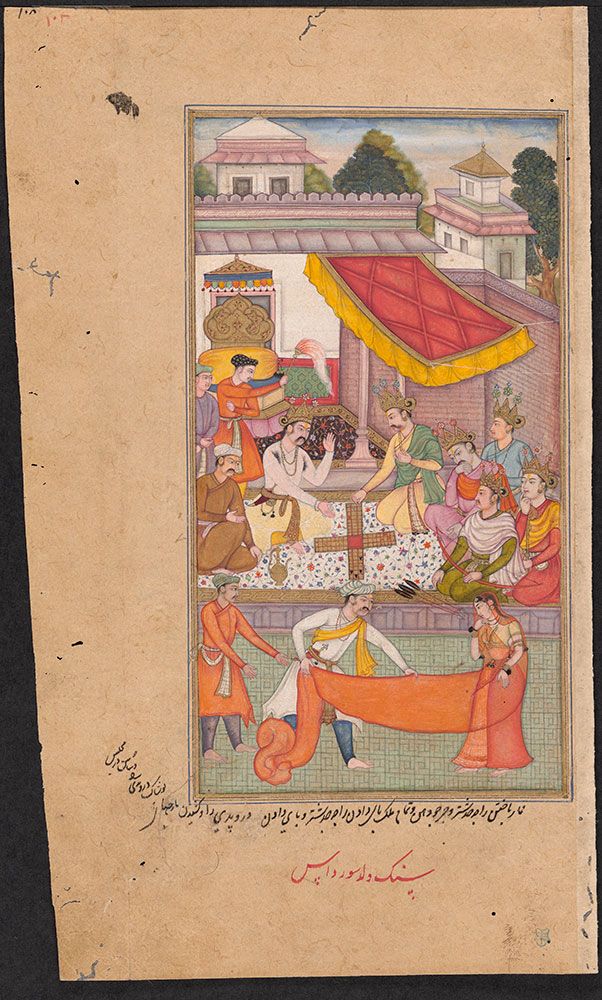
The scene’s long afterlife is visible in the article’s lead image, a 1599 Mughal-court folio from the Razmnama, or “Book of War.” The Free Library of Philadelphia catalogs it as Lewis M 28 and attributes the work tentatively to Sangha or Shankara.[5] Its digitized front is preserved through OPenn as a Persian manuscript leaf measuring 18 by 29 centimeters.[6]
The composition performs its own passage reading. The dice players and watching court occupy the upper register. Below them, the assault on Draupadi turns the game’s claim into action. Painted architecture separates the moments, but the single sheet refuses to let them become separate stories. Calculation sits above coercion.
That visual compression is not proof of how an ancient audience saw the episode; it is a Mughal-era act of transmission and interpretation. It does, however, preserve what plot summary often loses. The dice are small. The court is large. A wager becomes catastrophic because a whole arrangement of people, ranks, rooms, and silences carries it forward.
Draupadi’s question interrupts that carriage. It does not immediately free her, end the assembly, or prevent the violence that follows. Its power is less consoling: it denies the winners an uncontested account of their win.
The messenger’s either-or formulation forces the hall toward two indictments. Either Yudhishthira’s own defeat ended his capacity, or marriage is being invoked to make Draupadi permanently wagerable even after his freedom is gone. The narration ties the elders’ downcast silence to their knowledge of Duryodhana’s resolve.[1] The scene permits a further inference: any honest answer would expose something the proceedings need hidden.
Before the Mahabharata reaches its battlefield, then, it stages a quieter failure of rule. An assembly is given a precise question and cannot—or will not—make its authority answer. Draupadi does not escape the hall by finding the right words. She makes the hall reveal what its words are for.
Sources
- Kisari Mohan Ganguli, trans., The Mahabharata, Book 2, Sabha Parva—public-domain English text hosted by the University of Utah; Dyuta Parva sections LXIV–LXVII supply the wager sequence, question, silence, and debate.
- J. A. B. van Buitenen, trans. and ed., The Mahabharata, Volume 2: Book 2, The Book of the Assembly Hall; Book 3, The Book of the Forest. University of Chicago Press, 1975—Critical Edition translation and Book 2 context.
- Emily T. Hudson, “Dharma and Rupture in the Game of Dice,” in Disorienting Dharma: Ethics and the Aesthetics of Suffering in the Mahabharata. Oxford University Press, 2012—Draupadi’s question, suffering, and the assembly’s rupture.
- Christopher T. Fleming, “Gambling with Justice: A Juridical Approach to the Game of Dice in the Dyūtaparvan of the Mahābhārata,” The Journal of Hindu Studies 14, no. 3 (2021), pp. 234–258—juridical strategy and the challenge to opacity-centered readings.
- Free Library of Philadelphia, “The Fateful Game of Dice” (1599), Razmnama, Lewis M 28—catalog record, Mughal-court provenance, tentative artist attribution, and scene description for the lead image.
- OPenn, “Lewis M 28 Razmnama Leaf, The Fateful Game of Dice”—digitized manuscript front, physical dimensions, Persian-language metadata, and Free Library repository record.