People often summarize The Great Gatsby as if it were a clean thesis novel about the American Dream.[1][2][3] That summary is not wrong, but it is thinner than Fitzgerald's actual method. The book does not persuade chiefly by abstract argument. It persuades by returning certain objects to us until they start carrying emotional voltage. A green light across water. Shirts thrown into a room. Yellow and gray cars moving between the Eggs, the city, and the ash heap. Dust, smoke, and cinders gathering where glamour needs not to look.[1] These things do not sit in the novel like detachable emblems waiting for classroom labels. They form a system. Fitzgerald keeps making desire visible, touchable, drivable, and finally disposable.
That is one reason the novel has remained so teachable and rereadable across a century.[2][3][4][5] Readers can enter it through plot, style, class analysis, romantic delusion, or historical myth, but the book's staying power lies in how stubbornly concrete it is. Gatsby does not dream in philosophical language. He dreams in purchased textures, lit distances, arranged arrivals, and repeatable scenes. The novel's symbolic life therefore never floats free of matter. It stays attached to things.
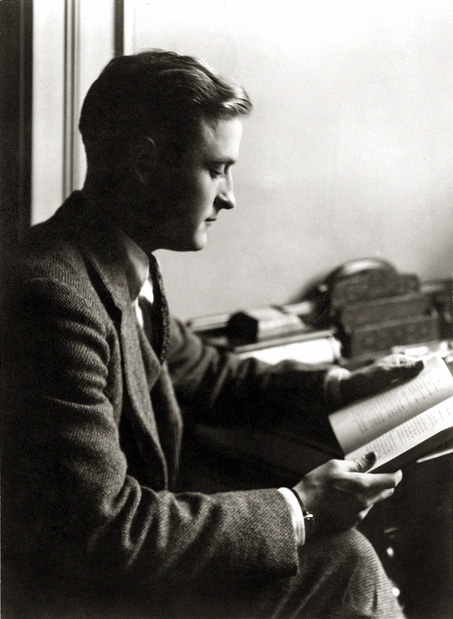
Image context: the cover uses a real photographic portrait of Fitzgerald rather than a 1925 cover reproduction or a film still.[6] That choice suits this essay because the novel's motifs are not decorative period props. They are the machinery by which Fitzgerald turns longing into surfaces that can be seen, handled, displayed, and misread.
1. The green light makes desire look close while keeping it structurally far away
The novel's first great object appears before Gatsby properly does. Nick sees him stretching his arms toward "a single green light, minute and far away, that might have been the end of a dock."[1] Fitzgerald's brilliance here is not simply that he invents a memorable symbol. It is that he gives desire a location. Gatsby's yearning is neither vague nor inward. It is fixed on something tiny, visible, and just across the water.
That distance matters more than the color alone. The light is not Daisy in any full human sense. It is Daisy reduced to a reachable point. Gatsby can orient himself toward it, imagine crossing to it, and build a future around it. But the reduction is already the tragedy. A person becomes a beacon; a history becomes a line of sight. By the time Nick returns to the image in the closing pages, saying Gatsby "came a long way to this blue lawn" and "believed in the green light," the symbol has widened into a national rhythm of postponement.[1] Yet it still keeps the old physical shape: one lit point promising arrival while preserving separation.
This is why the green light never works as pure hope.[1][2][4] It is hope translated into distance management. It teaches Gatsby how to want by keeping the wanted thing always just measurable enough to pursue and just far enough away to remain ideal. The novel's final cadence does not redeem that structure. It only makes it collective.
2. The shirts turn success into touch, and touch into embarrassment
The shirts scene is sometimes remembered as comic excess, an inventory joke about Gatsby's wardrobe.[1][2] But Fitzgerald stages it more carefully than that. Gatsby opens his cabinets to reveal shirts "piled like bricks in stacks a dozen high," then begins throwing them into the room until Daisy bends into them crying, "They're such beautiful shirts."[1] The image is absurd, luxurious, and strangely humiliating at once.
Why shirts? Because they are wealth at the point of contact. A mansion can still be scenery. A car can still be theater. A shirt belongs to the body; it carries class as texture. Fitzgerald chooses the object that turns money into fabric, color, fold, and softness. Daisy's crying is not just envy or regret over Gatsby's prosperity. It is a response to belated material proof. The years she did not live with him arrive not as argument but as linen, silk, and flannel.[1]
That is what makes the moment sad rather than merely opulent. Gatsby believes that if feeling can be made visible enough, it can also be made legible.[1][4] He fills a room with shirts as if abundance could close time. But the scene produces overflow rather than repair. The objects prove success while exposing everything success cannot undo. Fitzgerald lets commodity display become emotional evidence, then shows the evidence failing to finish the case.
3. Cars make modern freedom look theatrical until they reveal its class violence
If the green light gives desire its horizon and the shirts give it texture, cars give it motion.[1][2][3] They are everywhere in the novel: arrivals, escapes, invitations, accidents, rumors, street scenes, chauffeur labor, commuter drift between Long Island and Manhattan. Gatsby's yellow car in particular is less transportation than a moving announcement. It extends the logic of the mansion into public space.
What Fitzgerald sees early, and coldly, is that the car is also a machine for distributing consequence unevenly. The valley of ashes already contains "a line of grey cars" crawling through industrial waste.[1] Later Gatsby's yellow car becomes the instrument through which Myrtle is killed and responsibility is scrambled.[1] Jordan Baker's remark about careless drivers belongs to the same moral field.[1] In this book, mobility is never simply liberation. It is status, insulation, speed, display, and danger bundled together.
That is why the automobile matters as a recurring motif rather than as one plot device. Cars let characters behave as though movement itself were sovereignty. They slide between social worlds, carry secrets, convert privilege into velocity, and then expose how fragile that privilege is once metal meets flesh.[1][2][3] Gatsby's dream depends on repeated arrivals, but Fitzgerald makes the very technology of arrival complicit in disaster.
4. Ashes are the novel's answer to every glittering object
The green light, the shirts, and the car all tempt readers toward surfaces. Fitzgerald places the corrective almost immediately: the "valley of ashes," that "fantastic farm where ashes grow like wheat," with men already "crumbling through the powdery air."[1] This is one of the novel's most severe symbolic inventions because it is not merely a bad neighborhood or a generic industrial zone. It is wasted matter given landscape form.
Everything glamorous in The Great Gatsby seems to require that this place remain in transit, glimpsed from a road, crossed on the way elsewhere, or converted into backdrop.[1][3][4] The ash heap sits between the eggs and the city, between spectacle and its maintenance cost. Even the giant eyes of Doctor T. J. Eckleburg, half ridiculous and half apocalyptic, do not purify the zone into moral allegory.[1] They intensify the sense that modern American life is being watched through advertisement, debris, and fatigue rather than through any stable spiritual order.
Seen this way, ashes are not the opposite of Gatsby's dream. They are what the dream sheds. Fitzgerald links them quietly to the novel's other objects: gray cars move through them, labor sticks to them, and by the book's beginning Nick has already named "foul dust" as what preyed on Gatsby's dream.[1] The ash motif therefore keeps the novel from becoming a romance of disappointed idealism alone. It insists on residue. Desire burns fuel. Wealth leaves powder. Style throws off waste.
5. Why these objects still hold the book together
Read through its motif system, The Great Gatsby stops looking like a novel with one master symbol and several supporting details.[1][2] It looks more like a sequence of conversions. Want becomes a light. Success becomes shirts. Freedom becomes a car. Splendor becomes ash. Fitzgerald's control lies in how these conversions keep crossing one another without collapsing into diagram. He never lets the novel turn schematic. The objects stay alive because they remain embedded in scene, class habit, weather, bodies, and timing.
That is also why the ending still lands. When Nick returns to the green light and the boats against the current, the passage does not float above the novel's material world.[1] It carries all the objects that came before it. The light is still on a dock. The dream is still attached to lawns, roads, closets, engines, and dust. Gatsby's mistake was not that he wanted too much in the abstract. It was that he believed time, class, and human history could be persuaded by the right arrangement of things.
Fitzgerald knew better, and that is the novel's enduring sharpness.[2][3][4][5] He lets objects glitter long enough to show why people fall for them, then keeps them in the frame until their cost appears. The result is a book whose symbols never leave the ground. They continue to shine because they are made of matter first.
Sources
- F. Scott Fitzgerald, The Great Gatsby. Project Gutenberg Australia HTML text.
- National Endowment for the Arts, "The Great Gatsby" (NEA Big Read overview, timeline, and discussion prompts).
- Library of Congress, "1900 to 1949 - America Reads" exhibition entry for The Great Gatsby.
- Library of Congress, "The Great Gatsby Turns 100!" Bookmarked blog.
- Encyclopaedia Britannica, "F. Scott Fitzgerald."
- Wikimedia Commons, "File:F Scott Fitzgerald circa 1920.jpg" (source page for the lead photograph).