Tender Buttons is easiest to misread when it is treated as a locked cabinet. The temptation is to stand in front of each little prose object, hunt for the hidden key, and declare success only when the carafe, the cushion, the roast beef, or the room has been translated back into ordinary paraphrase. Stein's stranger achievement is more active than that. She makes English description stop serving the object and start exposing the habits by which a reader expects objects to become meaningful.[1]
That is why the book still feels fresh rather than merely obscure. First published in 1914 and divided into "Objects," "Food," and "Rooms," Tender Buttons takes the most handled nouns in domestic life and loosens their grammatical fittings.[1][2] It does not remove the world. It makes the world arrive without the usual smooth delivery system. A sentence may begin as if it were going to identify a thing, then drift into sound, color, appetite, touch, or social pressure. The voice is not explaining less because it knows less. It is showing how much ordinary explanation has been doing behind the reader's back.
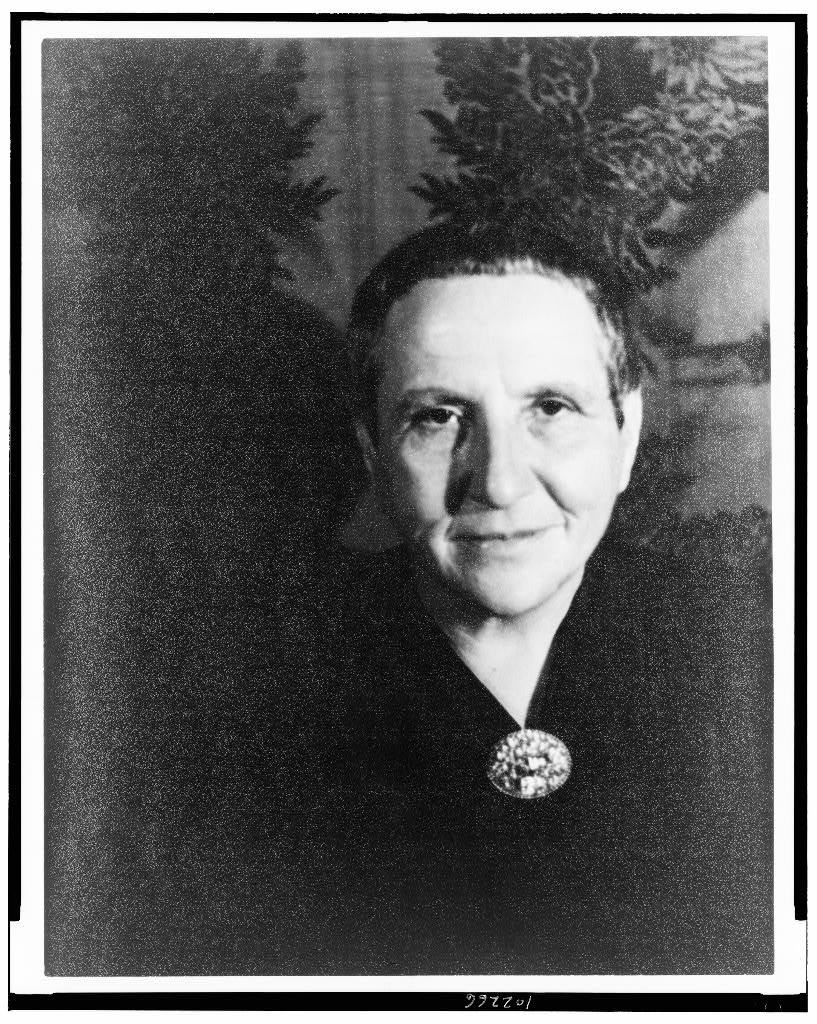
Image context: the lead image is a real archival photograph from the Library of Congress, not a generated author graphic or typographic placeholder. It fits the article because Stein's literary afterlife depends on the visible tension between a plainly documented public figure and prose that refuses plain documentary use.[4]
Description becomes an event
The famous opening, "A carafe, that is a blind glass," sounds like a definition that has immediately gone sideways.[1] A conventional description would stabilize the object: transparent vessel, table, water or wine, domestic use. Stein gives the reader a noun, a relative phrase, and then an adjective that belongs to sight but cancels it. "Blind glass" does not simply decorate the carafe. It makes the act of seeing feel unreliable.
That small shock is the book's grammar in miniature. The object remains present, but it is no longer sovereign. The sentence becomes the site where perception, metaphor, and syntax negotiate control. Academy of American Poets notes that Tender Buttons has often been linked to verbal Cubism, partly because the descriptions refuse the single stable angle expected from realist prose.[2] The comparison is useful as long as it does not flatten Stein into a painterly gimmick. Her page is not trying to imitate a canvas. It is trying to make a sentence behave as if perception were simultaneous, partial, and unstable.
The voice depends on short declarative pressure. It rarely asks permission. It states, revises, and swerves. In many passages, the prose seems to know exactly where it is going at the level of rhythm while refusing to submit at the level of paraphrase. That doubleness gives the style its odd confidence. The reader may be disoriented, but the sentence is not.
Domestic nouns lose their manners
The brilliance of Tender Buttons is that Stein chooses homely categories instead of sublime ones. "Objects," "Food," and "Rooms" are not rare subjects.[1][2] They are the stuff of cabinets, tables, menus, linen, body maintenance, household movement, and social enclosure. By choosing them, Stein refuses the idea that experiment must begin with grand matter. The ordinary house is already strange enough.
In "A box," the phrase "made sometimes" gives the object a conditional life rather than a fixed identity.[1] A box is supposed to be a container, a shape that promises edges and storage. Stein makes even that enclosure provisional. The domestic object is not an anchor; it is a grammatical occasion. A thing can be named and still not be secured.
That matters for the voice. Stein's style keeps pushing against the polite uses of household language. Descriptive prose often turns domestic life into inventory: this chair, that table, the meal, the room, the lady, the order of things. Stein breaks that inventory logic. Food becomes sound and sequence; rooms become relation and enclosure; objects become little storms of attributes. The book's pleasure comes from feeling nouns shed their assigned social work.
The Electronic Poetry Center's Stein page is useful here because it places Tender Buttons inside a broader field of Stein's writing, audio, poetics, and later experimental reception rather than treating it as a lone stunt.[3] The style is connected to Stein's larger investment in repetition, composition, grammar, and the pressure of present-tense attention. Tender Buttons is compressed, but it is not accidental.
Repetition steadies what syntax unsettles
Stein's prose is often described as difficult, but difficulty is not its only experience. The sentences can be funny, sensuous, and oddly singable. "A little piece please" works partly because it sounds like table speech, child speech, appetite, etiquette, and rhythm at once.[1] It is tiny, almost silly, and yet it lets the reader feel how request, portion, politeness, and repetition can occupy the same phrase.
That is the book's main bargain with the reader. Syntax unsettles meaning; repetition gives the ear a place to stand. A phrase may not paraphrase cleanly, but its recurrence teaches a method of listening. Stein does not ask the reader to abandon sense. She asks the reader to notice sense before it hardens into summary.
This is also why the prose should not be reduced to nonsense. Nonsense literature often builds an alternate logic through play. Stein does something more exacting. She keeps ordinary vocabulary close enough that the reader continues to expect a usable world, then disturbs the habits that would normally make that world fluent. The result is not a sealed private language. It is public English under unusual stress.
Cubism is a clue, not a solution
The Cubism tag has followed Tender Buttons for good reasons. Stein's Paris life, her collecting, and her proximity to modernist visual art make the connection historically tempting; the Academy of American Poets page also records the book's long association with "verbal Cubism."[2] But as a reading method, Cubism can become too neat. It may imply that the prose is simply breaking objects into facets the way a painting might break a guitar, a glass, or a face.
The sentences are doing something more grammatical than visual. They test articles, prepositions, pronouns, modifiers, and serial rhythm. They make little function words feel newly consequential. A reader begins to notice how much ordinary comprehension depends on the expectation that modifiers will attach correctly, that nouns will stay where they are put, and that a domestic scene will remain socially legible.
This is where Stein's voice becomes philosophical without turning abstract. She is not writing an argument about language in the usual essay form. She is making language perform the argument. The reader discovers, by friction, that description is not a window. It is a system of permissions: what can modify what, what can be counted, what can be owned, what can be eaten, what can be enclosed, what can be said to resemble something else.
The afterlife belongs to readers who keep listening
Reception has always been divided because Tender Buttons exposes a reader's tolerance for unresolved attention. Poets.org summarizes the old split cleanly: the book has been received as masterpiece, triumph, failure, gibberish, and hoax.[2] Those contradictory labels are not just review history. They describe the kind of pressure the book creates. It makes the reader decide whether difficulty is a flaw in the text, a flaw in the reader's expectation, or the point of the encounter.
The centennial afterlife suggests that the book's challenge did not expire. PennSound Daily's 2015 note on Jacket2's "Twenty-Two on Tender Buttons" describes a hundred-year conversation around the book and highlights its influence on later experimental poets.[5] That is the durable part of Stein's voice: it keeps giving later writers permission to treat words not as transparent carriers but as objects with texture, friction, echo, and social history.
The best way into Tender Buttons, then, is not to solve it once. Read it aloud. Let the headings provide just enough furniture. Notice when a noun holds and when it leaks. Notice when a phrase makes bodily sense before it makes explanatory sense. The book's style is not a refusal of pleasure; it is a refusal of automatic reading. Stein turns the domestic interior into a laboratory where the sentence stops behaving, and because it stops behaving, the reader can hear how behavior was built.
Sources
- The Online Books Page / Project Gutenberg, Tender Buttons by Gertrude Stein, Project Gutenberg Release #15396 - public-domain text used for close reading.
- Academy of American Poets, "Tender Buttons" - publication context, section structure, and reception summary.
- University of Pennsylvania Electronic Poetry Center, "Gertrude Stein" - author archive linking Stein's works, poetics, audio, and critical afterlife.
- Library of Congress Prints & Photographs Online Catalog, "Portrait of Gertrude Stein, New York" by Carl Van Vechten, 1934 - archival photograph used as the article image source.
- PennSound Daily, "Don't Miss Jacket2's 'Twenty-Two on Tender Buttons'" (March 17, 2015) - centennial reception and later experimental-poetry afterlife.