Gunnar's turn back from exile is one of those moments in medieval literature that seems almost too simple to bear interpretation. He has accepted a settlement. He is riding away from Iceland with Kolskegg. The road to survival is open. Then his horse stumbles, he looks back toward the Lithe and his homestead at Hlidarendi, and he decides not to leave.[1]
The scene is short enough to quote badly and long enough to misunderstand. Read as a picturesque national moment, it becomes a sentimental postcard: a hero sees his beloved land and cannot abandon it. Read as plot mechanics, it becomes a poor decision that lets the feud resume. The passage is more exact than either version. The saga makes Gunnar's attachment visible at the instant when law, landscape, reputation, kinship, and self-knowledge all press on one body. He turns back not because he forgets danger, but because the hillside gives danger a form he can recognize.
That is why the episode has such force inside Njáls saga, a work Britannica describes as one of the longest and finest Icelanders' sagas, built around Gunnar and Njáll as two different figures of peace trapped inside a feud culture that can keep old injuries alive.[2] The turn-back scene does not interrupt that tragic design. It condenses it. A legal settlement has produced a clean practical answer: go abroad. The eye produces another answer: stay where life has become meaningful enough to die for.
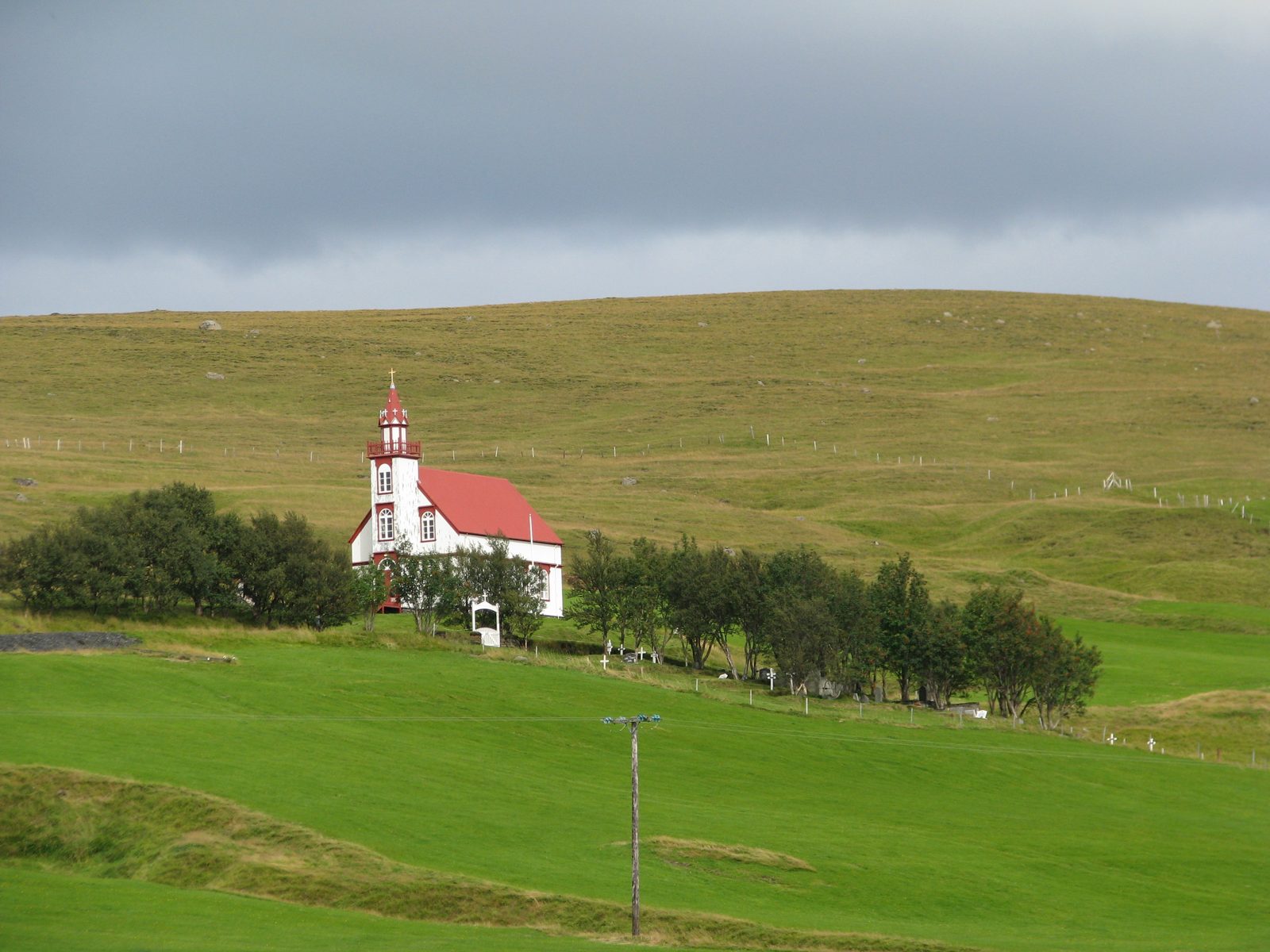
Image context: the lead image is not an illustration of Gunnar on horseback but a real photograph of Hlíðarendi in South Iceland, the farm landscape associated with Gunnar inside the saga geography.[4] For a passage essay, that matters. The scene works because a legal decision suddenly becomes spatial: slope, field, homestead, and departure path all enter the same glance.
The Fall Before The Look
The scene begins with a stumble, not a speech. Gunnar has made the emotional farewells at home, embraced the household, and ridden out with Kolskegg. Then the horse trips and throws him. The accident matters because it breaks the momentum of compliance.[1] Until that instant, the sequence is socially legible: leave, honor the atonement, preserve life, prevent further escalation. The body falling from the saddle creates a pause in which another kind of knowledge can arrive.
Medieval narrative often lets a small interruption expose a deeper order. Here the stumble is not treated as magic in any crude sense. It is enough that Gunnar is stopped, turned, and made to look. The saga's usual compression gives the moment its charge. It does not overexplain his psychology. It arranges an action: fall, turn, see, speak, return. The reader supplies the pressure because the scene has been prepared by everything before it: lawsuits, killings, settlements, prophecies, domestic tensions, and the narrowing sense that Gunnar's excellence cannot save him indefinitely.
The first important fact is therefore formal. Gunnar's decision is not born in abstract debate. It comes through orientation. He is no longer facing outward toward exile. He has his face toward the Lithe and Hlidarendi.[1] The landscape does not merely remind him of home. It reorganizes the direction of the story.
Beauty As Legal Defiance
Gunnar's famous phrase begins with beauty: "Fair is the Lithe."[1] The danger is to hear that beauty as soft. In the scene, beauty is hard. It creates an obligation stronger than prudence.
The legal situation is plain enough. Gunnar has broken the peace before; Njáll has warned him; the settlement depends on going abroad.[1][2] Kolskegg understands this immediately. His reply is not aesthetic. It is juridical and reputational: do not give your enemies this joy by breaking the atonement.[1] He hears in Gunnar's line the collapse of a public arrangement. If Gunnar stays, he does not merely choose a view. He hands his opponents a lawful opportunity.
That friction gives the passage its strange intelligence. The hillside is beautiful precisely because it is not innocent. The white fields and mown home meadow are signs of order, labor, ripeness, and belonging. They also sharpen the cost of legal exile. To preserve his life, Gunnar must leave the very world in which his life has coherence. The saga does not ask us to approve the choice. It asks us to feel why the lawful answer may be emotionally impossible.
Britannica's broader account of Icelandic literature notes that the Icelanders' sagas take shape within a thirteenth-century prose tradition deeply concerned with local conflicts, heroic memory, and social consequence.[3] This scene shows that tradition at its most economical. Landscape is not background description. It is social fact made visible.
Kolskegg Reads Correctly And Still Loses
Kolskegg is easy to underread because Gunnar's turn is so radiant. Yet Kolskegg is the scene's clear-eyed reader. He knows what Gunnar's speech means before Gunnar fully restates it. He warns him that all will happen as Njáll predicted.[1] In other words, Kolskegg does not miss the beauty. He simply refuses to let beauty cancel obligation.
That refusal gives the scene its moral balance. If everyone were swept up in Gunnar's feeling, the passage would become romance. If everyone condemned Gunnar flatly, the passage would become lesson. Instead, Kolskegg stands beside him as the counterweight: loyal enough to warn, honorable enough to keep going, intimate enough to be torn away by the one act he cannot share.
Their separation is therefore not a side effect. It is the emotional price of the choice. Gunnar asks Kolskegg to stay too, but Kolskegg says this is the one thing that can divide them.[1] The line is devastating because it makes honor plural. Gunnar's honor binds him to place. Kolskegg's honor binds him to the terms accepted and to the path already chosen. They are brothers, but the same code now sends them in opposite directions.
This is one reason the passage avoids simple fatalism. Gunnar's death is not caused by destiny alone. It is caused by a decision that others can understand, resist, and refuse to imitate. The saga's tragic force lies in that mixture. People are not puppets of fate. They are skilled readers of consequence who still sometimes choose the consequence they can live with.
One View Contains The Whole Saga
The mown meadow and harvest-ready fields compress the world Gunnar cannot abandon. They carry household, labor, season, reputation, and memory in a few visual strokes. They also look forward to absence. The scene's beauty is autumnal even if the wording does not stop to make that symbolic claim. Grain ready for harvest is grain at a threshold. A home meadow already mown is usefulness completed. Everything looks most fully itself because Gunnar is supposed to be leaving it.
That threshold quality is the passage's secret. Gunnar sees the Lithe at the moment when it becomes unavailable by law. The land's beauty has probably been there all along, but exile makes it newly legible. His own words say that it has never seemed so fair.[1] The comparative matters. The scene is not saying the hillside objectively changes. It is saying perception changes under departure.
The University of Michigan repository page for William I. Miller's work on the central feud describes Njáls saga as above all a complicated story of feud, one where wrongs become debts that demand repayment.[5] Gunnar's turn belongs to that economy, but it also reveals what the balance-sheet model cannot fully measure. A feud can count killings, compensation, insults, and retaliations. It cannot easily price the moment when a man looks back at a hill and discovers that survival abroad would make his own life feel false.
That discovery does not make Gunnar wise. It makes him complete in a tragic sense. His greatest qualities have always included courage, generosity, and an almost luminous social attractiveness.[2] In this scene those qualities harden into immobility. He can face danger, but he cannot endure the self-alienation required by exile.
Why The Scene Still Works
The passage lasts because it refuses to turn attachment into a clean virtue. Gunnar's love of place is beautiful; it is also disastrous. Kolskegg's obedience to the settlement is prudent; it is also a sundering. Njáll's foresight is right; it cannot save the friend he loves. Law exists; enforcement depends on people whose memories and desires do not become legal just because a settlement is made.
That is the greatness of the scene micro-structure. A horse stumbles. A man looks back. A brother warns him. A path divides. Nothing more is needed. The saga has already built a world in which peace can be negotiated but not always inhabited. Gunnar's return to Hlidarendi is therefore neither mere nationalism nor mere stupidity. It is the moment when the hero chooses the place that makes him himself, while the narrative calmly lets us see that this choice will destroy him.
For modern readers, that calm is the lesson. Njáls saga does not need to announce the psychology of belonging. It lets belonging become visible through posture, direction, field, meadow, speech, and refusal. Gunnar's last free decision is to stop being saved by distance. The hillside is too beautiful because it gathers the whole life he is being asked to outlive.
Sources
- Icelandic Saga Database, The Story of Burnt Njal, George W. Dasent translation (full text; Gunnar's turn-back scene in Chapter 75).
- Encyclopaedia Britannica, "Njáls saga" (work overview, major characters, feud context, and tragic structure).
- Encyclopaedia Britannica, "Icelandic literature: The Icelanders' sagas" (genre context and placement of Njáls saga among the sagas).
- Wikimedia Commons, "Hlíðarendi.JPG" (source page for the real Hlíðarendi lead photograph in South Iceland).
- William I. Miller, "Central Feud in Njáls Saga," University of Michigan Law School Scholarship Repository (feud-analysis source page and abstract).
Editor’s Pick Review
Selected as an editor’s pick because it turns a small literary instant into a complete reading experience without overburdening the scene. The essay’s strongest move is its discipline: it keeps returning to a horse stumble, a glance, a brother’s warning, and a divided road, then lets law, landscape, kinship, reputation, and self-knowledge accumulate around those few gestures.
It also clears the stricter 24-hour visual bar. The lead image is immersive rather than analytical: a real photograph of Hlíðarendi, tied directly to the passage’s place logic and explained in the caption without turning the article into a diagram. The Chinese version carries the same argument with natural flow, stable terminology, and enough rhythmic control to preserve the original’s calm tragic pressure.