Joseph Conrad is still easy to misfile. The public version of him is the sea novelist, the imperial darkness novelist, the writer of storms, harbors, river stations, and men tested far from home.[4] Those elements are real, and they matter. But the deepest continuity in the work lies somewhere harder and stranger. Conrad keeps making the act of telling feel morally belated. Again and again, the event reaches us only after it has passed through a witness, a rumor chain, an inquiry, a self-justifying anecdote, or a narrator who half knows that the sentence he is offering is already compromised.[1][2][3][4]
That is why a work-centered route into Conrad is so much better than a merely biographical one. Britannica is right to stress the force of his sea life and the fact that he turned a late-acquired English into one of the great prose instruments in the language.[4] But those facts become fully legible only once one notices what the novels do with distance. In Conrad, moral knowledge rarely arrives on time. It comes wrapped in atmosphere, memory, gossip, fascination, and defense. By the time clarity appears, it has already become part of the damage.[1][2][3]
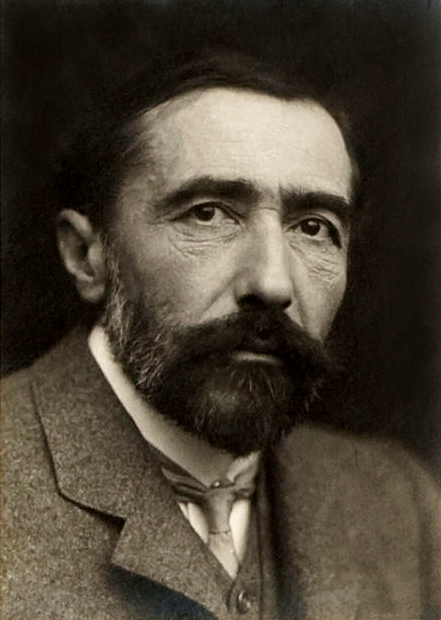
Image context: the cover uses a real archival photograph rather than a decorative ship engraving or a colonial map. That choice keeps the emphasis on the human face behind Conrad's most durable formal habit. He does not simply narrate peril. He asks what kind of person is speaking after peril, and how much blindness still clings to the report.[5]
1) In Heart of Darkness, witness becomes part of the darkness
The cleanest first proof lies in Marlow. Conrad does not give Heart of Darkness to us as a transparent adventure report. He embeds it in a frame and then lets Marlow define his own storytelling method against the ordinary sailor's yarn. For most seamen, he says, meaning lies inside the tale; for him, "the meaning of an episode was not inside like a kernel but outside, enveloping the tale."[1] That sentence is not a decorative flourish. It is the whole method in miniature.
Once the novella is read that way, imperial "darkness" stops being only a matter of geography or Congo imagery.[1] It becomes a problem of witness. Marlow sees enough to distrust the Company, enough to sense that Kurtz is both monstrous and charismatic, and enough to know that he himself is not standing outside the scene in innocence.[1] Kurtz is powerful partly because he reaches us through layers of anticipation, commentary, rumor, and final testimony. Conrad makes the reader feel that the account is contaminated by awe before the facts have even settled.[1]
This is a major reason the book has survived both admiration and attack. Its moral pressure does not come from one stable thesis finally stated at the end. It comes from how hard Conrad makes it to narrate corruption without breathing some of its air. Marlow is not a clean judge. He is a witness who keeps discovering that witness itself has become implicated.[1]
2) Lord Jim turns one failure into a whole afterlife of retelling
If Heart of Darkness shows Conrad making atmosphere answer to witness, Lord Jim shows him making a single act answer to endless narration. The physical event is brutally simple: the Patna crisis and Jim's jump.[2] But the novel does not leave the act where it happened. It pushes it into hearings, recollections, letters, conversations, secondhand reconstructions, and Marlow's own stubborn attempt to understand why Jim matters to him at all.[2]
That is why Marlow's early phrase about Jim, "one of us," carries such force.[2] It sounds affiliative, almost protective, yet it also deepens the wound. Jim is not an exotic exception; he belongs to the same professional and moral world as the men trying to interpret him. Conrad's question therefore becomes harder than simple condemnation. What sort of life is built once a person must live not only with a bad act, but with the public story attaching itself to that act?
This is where Conrad's authorial continuity becomes unmistakable. Jim's crisis is not over when the jump is over. It has hardly begun. The rest of the novel lives in delay: delay between deed and judgment, between shame and self-knowledge, between one man's legend and the fractured reports surrounding it.[2] Even Patusan does not function as a simple redemption arc. It is Conrad's experiment in whether a narrated self can ever outdistance the earlier account that has already named it.[2]
3) The Secret Agent proves that Conrad's real subject was never only the sea
Readers who think Conrad belongs chiefly to ships and colonial stations need only move to The Secret Agent. The setting is London, the texture is urban, and the machinery is political, domestic, and bureaucratic rather than nautical.[3][4] Yet the deeper method barely changes. The novel is still full of obscured responsibility, delayed understanding, and a world in which public explanation arrives after ordinary moral feeling has already been crushed.
Conrad's great cold innovation here is tonal. The prose is flatter, more acidic, more administrative than the haunted eloquence of Marlow.[3] Mr. Verloc drifts through his routines with a deadening ordinariness; officials, informers, radicals, and family members all live inside systems that translate human consequence into reports, theories, or police interest.[3] Stevie's destruction becomes legible through fragments and aftermath. Winnie's recognition arrives late and with catastrophic clarity. Conrad is still writing moral fog, but here the fog is urban and institutional rather than tropical.[3]
That shift matters because it clarifies the size of Conrad's project. He was never merely a novelist of remote extremity. He was a novelist of compromised explanation. The Secret Agent keeps asking what happens when modern life becomes narratable chiefly through agencies, files, handlers, slogans, and stunned domestic hindsight.[3] Its darkness is not far away. It is ordinary life made unreadable by the very systems claiming to explain it.
4) Why Conrad still feels close
Conrad remains close because he writes the interval between event and account as a moral zone of its own.[1][2][3] The ships, colonies, bomb plots, and foreign harbors matter, but they are not the final subject. The final subject is what happens to judgment when knowledge comes late, through pressure, and from speakers who cannot quite separate witness from self-excuse. That is as modern as anything in the twentieth century.
Britannica's broad description of Conrad as a Polish-born British novelist who mined dangerous life at sea remains useful.[4] But the more exact literary description is this: he made narration answer for its own blindness. Marlow cannot simply tell; he must circle. Jim cannot simply fail; he must go on being interpreted. Verloc's world cannot simply explain itself; it has to reveal how explanation itself has gone numb.[1][2][3]
That is why Conrad's prose still exerts so much pressure. He does not let a story arrive as finished evidence. He makes the reader inhabit the lag, the haze, and the self-implication through which evidence becomes speakable at all. Sea adventure is only the visible shell. Inside, and often outside it too, lies a writer obsessed with what a human account owes once the worst thing has already happened.
Sources
- Joseph Conrad, Heart of Darkness (Project Gutenberg HTML text).
- Joseph Conrad, Lord Jim (Project Gutenberg HTML text).
- Joseph Conrad, The Secret Agent (Project Gutenberg HTML text).
- Encyclopaedia Britannica, "Joseph Conrad" (biographical overview and major-work context).
- Wikimedia Commons, "File:Joseph Conrad 1904.png" (source page for the archival portrait used as the lead image).