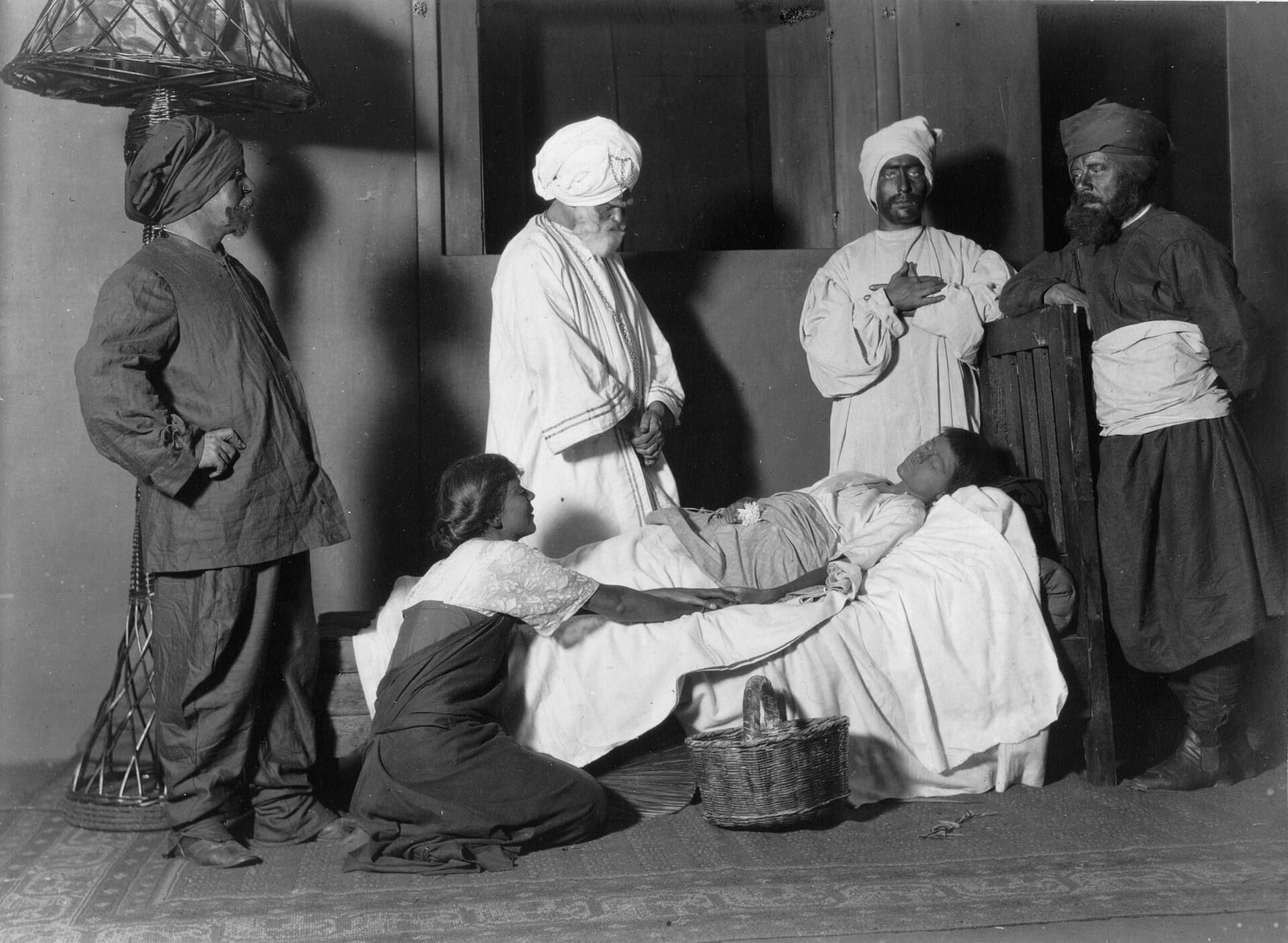
Content note: This essay discusses the Warsaw ghetto, the deportation and murder of children, and an archival stage photograph depicting brownface.
Rabindranath Tagore's The Post Office begins with one doctor ordering a sick child to stay inside and ends with another doctor throwing the room open to the night. Between those commands, very little happens in the usual dramatic sense. Amal sits at a window. People pass. A new post office stands across the road. A letter is promised, mocked, and never actually read.
That small design has made the play extraordinarily portable. The window can look like a border between illness and health, house and world, colony and empire, life and death. Yet it never settles into just one of those meanings. Every production must create some version of a room, place a child within its confinement, and decide what kind of freedom the final opening can honestly hold.
The play's afterlife tests that honesty. Its 1913 English-language premiere in Dublin put a Bengali play into an Irish theater.[2][3] A 1915 Toronto production made its own imagined “India” visible through orientalist costume and brownface.[8] In July 1942, children in Janusz Korczak's orphanage performed the play inside the Warsaw ghetto.[4][5] These stagings do not reveal a timeless allegory waiting unchanged inside Tagore's text. They show how a spare theatrical form receives history—and how necessary it is to keep metaphor from swallowing the people who performed it.
One open window does the work of a road
The first act takes place at Madhav's house, where a physician has forbidden Amal to go outdoors. Tagore gives that authority a comic edge: the physician shelters behind portentous medical scriptures while Madhav keeps asking what he should actually do. The order is nevertheless real. Amal cannot climb toward the squirrel he sees, follow a workman over the distant hill, or walk the red road taken by the dairyman.[1]
The window prevents the set from becoming inert. It lets the world pass close enough to be questioned. Amal talks with the dairyman, watchman, village headman, flower seller Sudha, and a group of boys. Each encounter briefly supplies him with a possible future. He could sell curds, gather flowers, seek work beyond the hills, or deliver letters. Plot is replaced by rehearsal: the child tries out forms of motion in speech because his body cannot try them on the road.
When Sudha offers to close the window because watching may tire him, Amal refuses: “Only this one's open! All the others are shut.”[1] The line describes the house, but it also states the play's method. One aperture is enough to admit labor, gossip, cruelty, friendship, time, and fantasy. The audience keeps looking at a child who keeps looking elsewhere.
The new post office enlarges that aperture without changing the scenery. The watchman says it belongs to the King and suggests that a letter may arrive for Amal. What delights the boy is not a secret message from power. It is the idea that a distant sender could know his name, that postmen might find his house, and that he could one day join their movement. His chosen request is modest and immense: “make me your postman.”[1]
Tagore then lets the village headman turn that hope into a joke. He presents a blank slip as the King's letter and invents a message about puffed rice. Because the paper contains nothing, the scene separates official-looking objects from genuine recognition. A letter can be held and still fail to address anyone; a child without a letter can nevertheless imagine an entire route linking mountain, stream, field, and door.
The ending opens the room, not the argument
Act II moves Amal away from the window and into bed. His body occupies less space while his imagined routes grow more exact. He can picture the King's postman descending a hillside with a lantern, following water into fields, and coming nearer through the night. The description reverses the audience's ordinary perspective: instead of watching Amal escape, we watch a world travel toward him.[1]
The first physician responds to the boy's decline by tightening the enclosure. He orders the front door locked and the window shut against the sunset. Then a knock comes from outside, the door is broken, and the King's herald and state physician enter. The second physician's first instruction—“Open wide all the doors and windows”—answers the whole physical logic of the play.[1]
This reversal is not medical realism, and it does not prove that death is secretly painless. It is stagecraft. Air and starlight alter the room in front of an audience; the shut house becomes a place capable of receiving visitors. The King remains offstage. The promised letter remains blank. What arrives instead is a sequence of actions: a barrier gives way, the dark is made visible, and Amal is treated as someone whom power must visit rather than someone local authority may ridicule.
Tagore also refuses to let the King's promise own the final note. Sudha arrives with flowers after Amal has fallen asleep. Her last request is human-sized: “Sudha has not forgotten him.”[1] The play can support a spiritual reading of Amal's sleep, but its last act of communication is remembrance between two children. The ending opens a ritual space around death without closing down what death means.
That incompleteness is central to the work's adaptability. A production can make the royal arrival solemn, skeptical, devotional, or political. It cannot avoid choosing a tone. The play supplies doors, windows, a blank page, voices outside, and a sleeping child; performance decides how much consolation those things should bear.
Dublin made the room a translation chamber
The Post Office reached the Abbey Theatre in Dublin on 17 May 1913 in an English translation by Devabrata Mukerjea, whose surname Project Gutenberg catalogs as Mukherjee.[1] The Irish Playography record lists Lennox Robinson as producer, Edward Gordon Craig's screens as the scenic design, and Lillian Jago as Amal.[2]
That production gave the window new surroundings. Carl S. O'Brien places Yeats's promotion of Tagore within two related but unequal projects of literary nation-building. He also shows how Yeats often recognized India through a romanticized image of ancient Ireland—an affinity that could welcome Tagore and still press his work into a European dream.[3] The Abbey staging therefore created a conversation among Bengali writing, Irish theater, English translation, and experimental stage design without turning Ireland and India into interchangeable colonial stories.
That cultural labor matters because “universality” can make mediation disappear. Dak Ghar did not float intact from Bengal to Dublin. A translator chose English words; Yeats advocated for the play; Robinson produced the staging; Craig's screens framed a room; and a theater supplied the institution. The work traveled because people and institutions moved it.[2][3]
The January 1915 photograph from the Toronto Arts and Letters Club records another stage in that movement.[8] It shows the final bedside grouping in crisp physical detail, but its turbans and darkened faces also expose the receiving company's racial fantasy. The image should not be treated as an illustration of Tagore's Bengal. It is evidence of how an early Canadian production packaged difference for itself. Adaptation carried the play outward while also laying new distortions over it.
Warsaw made the walls historical
The surviving invitation to the Warsaw performance is a slight, typed object. Dated 15 July 1942 and preserved in the collection of the Jewish Historical Institute, it names Tagore's Poczta, the Polish title of The Post Office, and documents a performance directed by Ester Winogron at the orphanage's temporary premises at 16 Sienna Street, with another entrance at 9 Śliska Street.[4] The performance took place on 18 July.[4][5]
The setting cannot be reduced to theatrical atmosphere. German occupation authorities had confined Warsaw's Jewish population in the ghetto, where starvation and disease were pervasive. Korczak, Stefania Wilczyńska, and the orphanage staff tried to preserve education, concerts, lectures, theater, and daily responsibilities amid those conditions.[6] According to the Jewish Historical Institute's reconstruction, the orphanage had likely staged the play once during Passover and performed it again on 18 July; the mass deportation known as the Great Action began four days later.[5]
It is tempting to say that Korczak chose the play simply to prepare the children for death. That statement is too certain. The Jewish Historical Institute explicitly says the reason for the choice, and how much Korczak understood about the immediately approaching destruction, cannot be known completely; later witness accounts support the interpretation but do not give access to every child performer's experience.[5] Historical care begins by preserving that uncertainty.
The analogy also has a hard boundary. Amal is confined by illness and adult fear inside a loving household. The Warsaw children were imprisoned by a genocidal regime. Treating those circumstances as equivalent would turn persecution into a literary symbol and make the children supporting actors in Amal's story. The performance's force lies elsewhere: the play gave them roles, lines, rehearsal, an audience, and a shared interval of attention. Jyotsna Kapur reads that communal making in relation to Korczak's commitment to children's rights and to theater's capacity to affirm existence across imposed boundaries.[7]
That affirmation did not rescue the performers. In early August, German authorities deported the orphanage's nearly two hundred children, Korczak, Wilczyńska, and other staff to Treblinka, where they were murdered.[6] No account of art's transcendence should soften that fact. The production mattered without becoming a miracle.
What changed in Warsaw, then, was not the plot but the cost of its gestures. A child speaking from behind a window, a visitor entering a closed room, a flower delivered, and a name remembered acquired unbearable proximity to life in the ghetto. Yet theater also changed the direction of attention. For the length of the performance, the children were not merely the objects of confinement or future victims in someone else's retrospective. They were actors making a world before witnesses.
An afterlife without an escape hatch
The endurance of The Post Office does not come from a message simple enough to survive translation. It comes from a form open enough to disclose the conditions of each staging. Dublin reveals the labor and politics of cultural transmission. Toronto reveals the distortions that transmission can carry. Warsaw reveals both the need for metaphor and the danger of letting metaphor erase historical difference.
The final window therefore offers no guaranteed exit. It changes who may enter, what can be seen, and whether the confined child is addressed with dignity. That is a theatrical freedom, not a claim that suffering has been redeemed. Tagore leaves the King unseen and gives the last message to Sudha. The grand promise stays offstage; the smaller obligation remains with us: do not forget the person in the room.
Sources
- Rabindranath Tagore, The Post Office, translated by Devabrata Mukherjee. Project Gutenberg edition of the 1914 English text — Acts I and II used for the close reading.
- Irish Playography, “The Post Office” — production record for the Abbey Theatre premiere on 17 May 1913, including cast and production credits.
- Carl S. O'Brien, “Rabindranath Tagore's India and William Butler Yeats's Ireland: The Intersection of Classical Languages, Literature, and Nation-Building in Postcolonial East and West,” Canadian Review of Comparative Literature 46.1 (2019) — Yeats's promotion of Tagore, the first Abbey staging, and romanticized cross-colonial identification.
- Korczak Digital Repository, “The invitation to a performance at Janusz Korczak's Orphanage on July 18, 1942” — catalog record and scan provenance for the surviving invitation, identifier ARG I 352.
- Emanuel Ringelblum Jewish Historical Institute, “18 lipca 1942. Ostatnie przedstawienie w Domu Sierot Janusza Korczaka” — reconstruction of the performances, venue, witnesses, chronology, and limits of certainty (in Polish).
- United States Holocaust Memorial Museum, “Janusz Korczak” — institutional history of the orphanage in the Warsaw ghetto and the deportation of the children and staff to Treblinka.
- Jyotsna Kapur, “When Children Die, What Can Theater Do? Tagore's Dak Ghar in the Warsaw Ghetto,” The Acorn 22.2 — analysis of collective performance, child rights, and remembrance.
- Wikimedia Commons, “Scene from The Post Office by Tagore at the Toronto Arts and Letters Club (I0014574)” — file page for the January 1915 archival photograph from the Archives of Ontario used as the article image.