Late in Gustave Flaubert's A Simple Heart, the servant Félicité's bedroom has become almost impossible to enter. A wardrobe obstructs the door. Rosaries and medals cover the walls. On a bureau stand a box of shells, a watering can, a toy balloon, schoolbooks, an illustrated geography, and a pair of shoes. Virginie's moth-eaten hat hangs by the mirror; her father's old coat survives because nobody else wanted it. Above them all perches Loulou, the stuffed parrot.[1][2]
The narrator calls this room both “a chapel and a second-hand shop.”[2] The phrase can sound like a joke at Félicité's expense: sacred things and junk, reverence and bad taste, indiscriminately crowded together. But Flaubert warned one early reader that the tale was “nullement ironique” (“not at all ironic”) and “très sérieux & très triste” (“very serious and very sad”).[3] The room asks to be read with that seriousness. It is the story's alternative archive, preserving bonds that the respectable household, the market, and even ordinary memory are prepared to discard.
Its objects follow a recurring sequence:
use → gift → keepsake → relic → sacred display
The sequence is not a ladder by which common matter becomes purely spiritual. Each stage remains inside the next. Bread is still bread when it expresses care; a hat stays moth-eaten when it equalizes two grieving women; Loulou is still a damaged taxidermied specimen when his blue head shines among altar roses. In A Simple Heart, Félicité's supposed simplicity is not an inability to distinguish people from things. It is a material way of knowing: love means making room, and making room means refusing to let one attachment erase another.
Use: the servant is priced before she is seen
Félicité enters Madame Aubain's house through a wage calculation: one hundred francs a year for cooking, cleaning, sewing, washing, harnessing the horse, fattening poultry, churning butter, and remaining faithful to a mistress who is “not an agreeable person.”[1][2] Her labor converts continuously into household order, yet the opening pages describe her own body as if it were another implement. After years of work, “she resembled a wooden figure working automatically.”[2]
That mechanical image is not the last word on her. Flaubert places beside it a tiny counter-image: after eating, she gathers crumbs from the table with her fingertip so that no bread is wasted.[2] Her economy is partly imposed by scarcity, but the same gesture expands into care. When her nephew Victor visits, she eats as little as possible to contain the expense while pressing food on him until he sleeps. Service has trained her to count every morsel; affection changes the direction of the count. She saves by diminishing herself and gives by feeding another.
Bread therefore begins the motif chain at the point where use and love are hardest to separate. Nothing announces itself as a symbol. There is only a loaf, a budget, a working hand, and an appetite Félicité treats as more important than her own. Her inward life appears not in explanation but in the management of matter.
Gift: shells cross a distance the map cannot
Victor's voyages return to Félicité first as small presents: a box of shells, a coffee cup, a gingerbread doll.[2] The objects are modest, but they have made the trip his body has made. They arrive from the routes he describes in sailor's language and give distance a surface she can touch.
When he sails toward Havana, official geography fails her. Monsieur Bourais opens a map, lectures about longitude, and points to a speck. The “maze of coloured lines” hurts Félicité's eyes without enlightening her. She asks him to show her the house where Victor lives, and he laughs.[2] His map answers the approved question—where is Havana?—while missing hers: where, exactly, is the person I love?
The scene does expose an educational inequality. Félicité cannot read the abstraction Bourais controls, and his pleasure in that control makes the atlas an instrument of rank. Yet her request is not simply foolish. A coordinate can locate a port while withholding the inhabited place she needs to imagine: a door, a room, a body safe inside it. The atlas belongs to Bourais and is never said to enter her collection. What later stands near Victor's shells is the children's earlier illustrated geography, a reminder that geographic images formed almost the whole of Félicité's literary education.[1][2]
The distinction is characteristic of the tale's object world. Neither atlas nor illustrated geography can correct Félicité's ignorance, and the shells do not reveal Havana. Instead the objects register two kinds of distance at once: the world as impersonal lines and images, and the world as something carried home by a particular hand. The box of shells matters because it has crossed the gap that the atlas can only measure.
Keepsake: the room refuses succession
The hat enters the room through another act of handling. After Virginie dies, Madame Aubain and Félicité unfold the girl's dresses and underclothes. Sunlight exposes stains and creases left by the body's movement. Then they find the small plush hat, already moth-eaten. Their eyes fill; the mistress opens her arms; the servant falls against her. In the narrator's exact formulation, the kiss “equalised them for a moment.”[2]
Class does not disappear. The moment is brief, and Félicité receives it with the gratitude of someone accustomed to treating recognition as a favor. But equality becomes possible through a worn object neither woman can regard as mere property. The hat retains the absent body's scale. It lets two different griefs meet without making them identical.
Later, in Félicité's room, Virginie's hat remains beside Victor's shells, Monsieur Aubain's coat, the children's schoolbooks, and objects Madame Aubain has thrown out.[1][2] This arrangement matters because the tale's sequence of losses can tempt a crude psychological summary: abandoned by a lover, Félicité transfers love to the Aubain children; after Victor and Virginie die, she transfers it to Loulou; after Loulou dies, she transfers it to the Holy Spirit. The room tells a different story. Nothing is cleared away to prepare for the next devotion.
Félicité accumulates. Victor is present in shells; Virginie in the hat and shoes; the household's vanished routines in coat, books, watering can, and balloon; Catholic practice in medals and holy-water basin; Loulou on his mahogany base. Every morning, the sight of the parrot brings back “the smallest details of insignificant actions” without bitterness.[2] The adjective insignificant belongs to an outside scale of value. Inside the room, small actions are exactly what can be kept.
The “second-hand shop” half of Flaubert's phrase is therefore as important as the chapel. A shop assigns exchange value and expects objects to circulate. Félicité withdraws castoffs from circulation. Her collection is materially shabby but emotionally inalienable: nothing is for sale, and nobody's meaning can be priced apart from a life.
Presence: Loulou will not stay a symbol
Loulou seems built for symbolic promotion. He comes from America and recalls Victor. The living bird has a green body, a blue head, pink wing tips, and a golden breast; an Épinal print supplies a scarlet-winged, emerald Holy Spirit that Félicité recognizes as Loulou.[1][2] As she grows deaf, his voice becomes the one voice that can still penetrate her narrowing world. She and the bird repeat phrases to each other until, in an unnamed early English rendering, he becomes “almost a son, a love.”[2]
But the living Loulou is inconveniently animal. He bites his perch, pulls out his feathers, scatters bathwater, fouls the floor, and refuses the polished performances visitors expect. He disappears outdoors; Félicité searches for him in panic; he returns without converting the episode into a lesson.[1][2] Such behavior keeps the parrot from becoming a neat code in which “bird” simply means Victor, child, or Holy Spirit.
Didier Philippot argues that Flaubert's animal writing troubles the line between sign and living presence: Loulou can support allegorical readings without being exhausted by them.[5] The distinction fits the tale's method. Félicité does not love a doctrinal diagram disguised as a bird. She loves this noisy, biting, repetitive creature, and resemblance grows from sustained proximity.
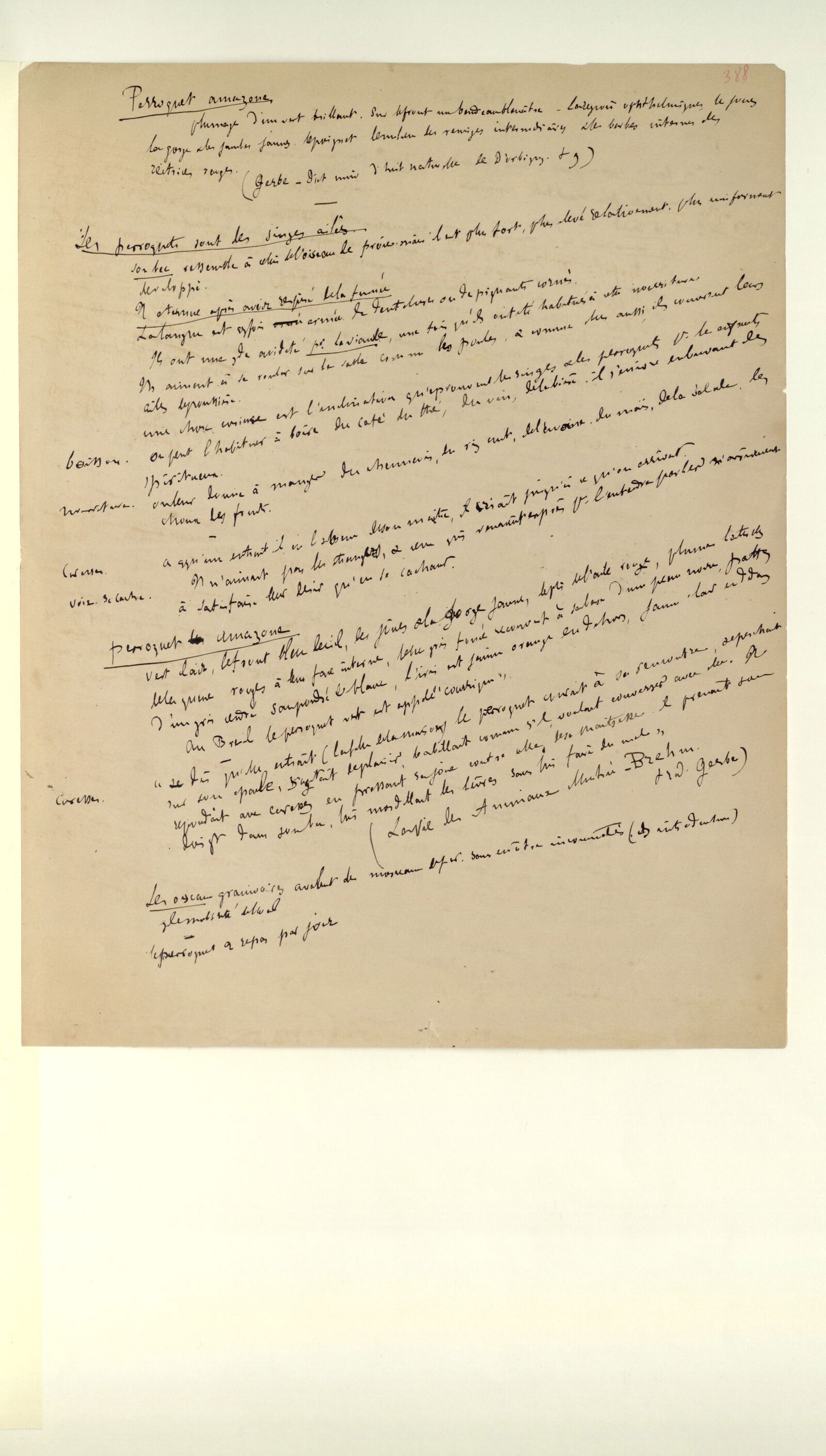
Flaubert's own preparations moved in the same direction, from emblem toward specimen. His 1876 chronology records that he borrowed an Amazon parrot from Rouen's natural-history museum while finishing the tale; his surviving manuscript page headed Perroquet amazone itemizes colors, feathers, beak, tongue, claws, habits, and habitat.[4][6] Exact observation does not cancel symbolism. It supplies the resistant body that symbolism must continue to carry.
Relic: the altar does not repair the object
Death changes Loulou from creature into problem. Félicité sends him to a taxidermist, who returns him after a long delay on a branch fixed to a mahogany base, one foot raised, a gilded nut in his beak.[2] The transformation is faintly absurd. A natural body has been arranged as decorative permanence, and a tradesman's taste has supplied the gold.
Yet taxidermy also lets Félicité keep practicing proximity. She installs Loulou above the crowded room, sees him at waking, and eventually wants him placed on the Corpus Christi altar in the courtyard. The household display and the religious display merge. Roses hide almost the entire bird; only his blue head remains visible, “like a piece of lapis-lazuli.”[2] A creature once associated with colonial distance and domestic mess now appears like a jewel in a public ritual.
Flaubert refuses to make the metamorphosis clean. By the day of the procession, the specimen is worm-eaten, one wing is broken, and its stuffing is coming out. Blind Félicité presses it to her cheek before it is carried downstairs.[1][2] The gesture collapses the whole motif chain into one contact. Loulou is an object made for display, a keepsake of companionship, a decaying animal remnant, and something treated as a relic. None of those identities abolishes the others.
That persistence protects the scene from two easy verdicts. If the parrot were only sacred, its broken construction would be irrelevant. If it were only ridiculous, Félicité's touch and the decades of attachment gathered around it would be irrelevant. The altar neither repairs the bird nor proves her belief. It gives damaged matter a place where private memory and communal form briefly coincide.
What the objects finally know
As incense rises and Félicité dies, she “thought she saw” the half-open heavens and a gigantic parrot hovering above her.[2] The phrasing keeps the vision inside her perception. The tale does not certify a miracle, diagnose a hallucination, or step outside the scene to mock it. What appears is the form her lifetime of associations has made available: color, voice, distance, child, animal, and Holy Spirit held in one immense image.
The ending can seem to replace Christianity with Loulou, or Loulou with Christianity. The room has already shown why replacement is the wrong operation. Félicité's imagination works by adjacency. Shells stay beside an illustrated geography; a hat beside an old coat; devotional medals beside toys; the stuffed bird beside the bureau made altar-like long before the procession. Meaning gathers without purifying its materials.
This is the strength hidden inside the tale's contested adjective simple. Félicité lacks education, money, and social authority; other people repeatedly use those absences to misunderstand her. But her room gives physical form to a knowledge the more sophisticated characters do not possess. It knows that love is made of recurring tasks. It knows that grief may need the pressure of cloth or shell against a hand. It knows that objects do not restore the dead, yet can prevent one life from being tidily superseded by the next.
The room keeps what the plot takes away. Not intact, not elegantly, and not forever. It keeps attachments together long enough for a second-hand shop to become a chapel without ceasing to be crowded with junk—and for a worm-eaten parrot, still visibly itself, to open onto heaven.
Sources
- Centre Flaubert, Université de Rouen Normandie, Gustave Flaubert's Un cœur simple — authoritative French text and publication record for the tale, serialized and then published in book form in Trois contes in 1877.
- Gustave Flaubert, A Simple Soul, Project Gutenberg ebook 1253 — unnamed public-domain English rendering used for the quoted English wording and checked against the French text.
- Gustave Flaubert to Edma Roger des Genettes, 19 June 1876, Centre Flaubert — the author's description of the tale as serious, sad, and not ironic.
- Centre Flaubert, “L'année 1876” — composition chronology, including Flaubert's field research and his July loan of an Amazon parrot from Rouen's natural-history museum.
- Didier Philippot, “Le rêve des bêtes : Flaubert et l'animalité,” Revue Flaubert 10 (2010), Centre Flaubert — scholarly discussion of Loulou as both sign and animal presence.
- Bibliothèque nationale de France, Gustave Flaubert, autograph notes headed “Perroquet amazone,” NAF 23663 (1), fol. 388r — Gallica digitization and source of the article image. Source: gallica.bnf.fr / BnF.