Samuel Beckett keeps getting flattened into the wrong legend. He is often treated as the patron saint of emptiness, the great modern poet of nothing happening, a writer whose world has already been stripped of event, hope, and ordinary human warmth.[1][2][4] That summary catches the surface of some famous scenes and misses the achievement. Beckett's real force lies in reduction with pressure still inside it. He keeps removing scenery, explanation, psychology, and even narrative confidence until what remains has to prove that it can still live on the page or stage. In his best work, diminished means do not produce deadness. They produce concentration.[1][2][4]
That is why his career reads more clearly as method than as myth. Britannica's capsule biography gives the essential facts: an Irish writer who moved through Dublin and Paris, wrote in both French and English, and became globally central through drama and prose, especially Waiting for Godot.[1] Nobel's 1969 citation names the deeper formal point, honoring writing that, "in new forms for the novel and drama," gave the destitution of modern man a strange elevation.[2] Grove's author page adds the technical frame that matters for reading him now: Beckett wrote across genres, shifted languages, and kept paring theater to its barest elements while never abandoning the need to express.[4]
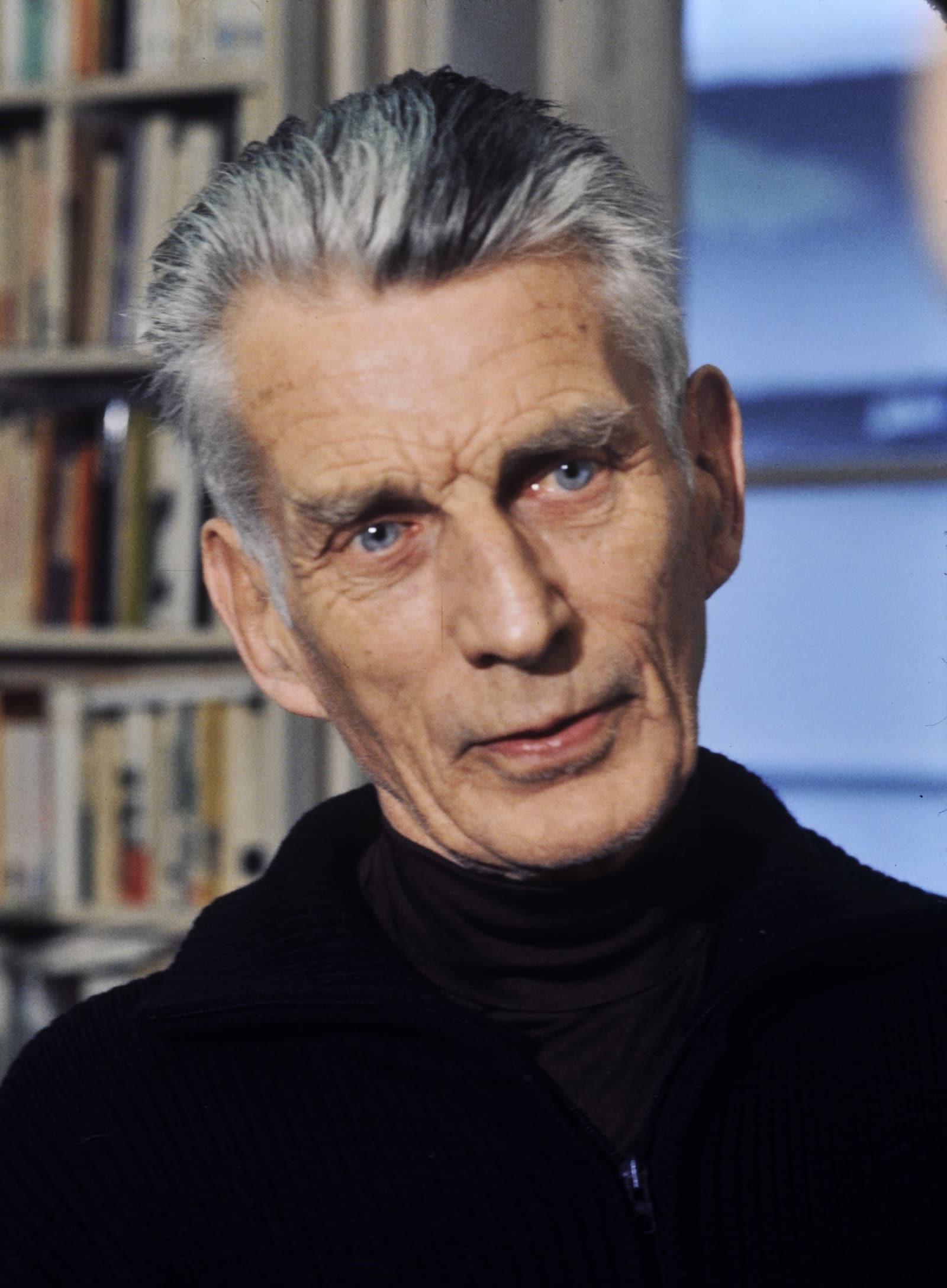
Image context: the cover uses Roger Pic's 1977 photograph of Beckett rather than a production still or a generic lonely tree.[8] That choice suits an author profile because Beckett's work is less about abstract despair than about a highly specific artistic discipline. The face in the photograph looks reduced and weathered, but not emptied out. That is Beckett's art in miniature: less furniture, more pressure.
1. The bilingual turn made reduction into method
One of the cleanest ways to enter Beckett is to stop treating biography as background color and start treating it as a change in artistic procedure. Grove's author page notes that Beckett wrote in both English and French and that his best-known works are mostly in the latter language.[4] Nobel's biographical sketch fixes the timing that matters: after moving permanently to France, he began writing in French after the Second World War.[3] That shift was not a decorative cosmopolitan flourish. It helped turn limitation into method.
Writing in a language that was his but not his first seems to have encouraged a harsher economy, a prose and dramatic line less tempted by inherited ornament.[1][3][4] Beckett's later self-description on Grove's author page is revealing here: "there remains the need to express."[4] That sentence matters because it refuses the lazy assumption that Beckett's work is organized by pure negation. Even when everything seems reduced, exhausted, or damaged, expression remains an obligation. The art keeps going because the need keeps going.
This helps explain why Beckett never feels merely inert. He is not the writer of vacancy as such. He is the writer of what remains after many familiar consolations have been removed. Language, habit, clowning, memory, complaint, breath, and relation all survive the cuts. The question is what shape they can still hold.
2. Waiting for Godot makes waiting itself into action
The most famous example is still the best one. Grove's Waiting for Godot page preserves the opening stage direction in its stark sequence: "A country road. A tree. Evening."[5] Then comes Estragon's exhausted verdict: "Nothing to be done."[5] Few twentieth-century openings do more with less. The scene looks stripped down to almost nothing, yet the play is immediately full of effort: boot-pulling, remembering, bickering, embracing, mishearing, postponing, joking, and trying once more to understand what exactly is being waited for.[5]
This is Beckett's signature move. The apparent absence of plot is really a transfer of attention. Instead of forwarding a conventional story, he intensifies recurrence, gesture, phrasing, and relation. Grove's summary of the play gets at its historical effect by calling Godot a cornerstone of twentieth-century drama after its bewildering early reception.[5] That happened because Beckett discovered that delay could itself become theatrical machinery. Waiting is not empty time here. It is the force that bends every exchange.
The play's loneliness matters, but so does its comedy. Vladimir and Estragon are not symbols pinned to a thesis. They are a pair with timing, grievance, dependence, rhythm, and physical irritation. Beckett gives modern desolation vaudeville bones. That is one reason the play survives interpretation so well: the thought is severe, but the life inside the thought keeps flickering, complaining, and refusing to disappear.
3. The trilogy turns narration into a damaged moving body
If Godot shows Beckett discovering how little theater needs, the midcentury trilogy collected as Three Novels shows him performing a similar operation on prose.[6] Grove's description of Molloy, Malone Dies, and The Unnamable is useful because it emphasizes broken continuities rather than stable plots: stories are "taken up, broken off, and taken up again," while voices rise, crumble, and return.[6] That is almost a miniature poetics of Beckett.
These books matter because they make narration itself feel bodily. Movement is difficult, orientation unstable, authority uncertain, and identity never fully secured.[6] A narrator advances by detour, self-correction, repetition, and collapse. Yet the prose keeps generating shape through cadence and insistence. Beckett does not strip away the novel because he despises form. He strips it until form has to reappear as voice under duress.
That is why the trilogy still feels so modern. It does not simply tell us that the self is fractured. It makes fracture audible in the act of telling. Beckett lets consciousness continue after many of the old guarantees of coherence have failed. The result is miserable, funny, and oddly triumphant at once. Expression becomes less a confident statement than a stubborn remainder.
4. Endgame and the late work prove that bareness is not blankness
Beckett's late severity is easiest to caricature and hardest to imitate. Grove's Endgame & Act Without Words page calls Endgame a pinnacle of his "raw minimalism" and a devastating distillation of human life in the face of approaching death.[7] The play's excerpt shows how much relation survives inside that severity. Hamm calls for Clov; Clov answers; Hamm declares, "Nature has forgotten us."[7] Even apocalypse arrives as dialogue, dependence, and timing.
That is the key to Beckett's late bareness. The stripped room, the dustbins, the near-dead world outside, the crippled and half-trapped figures: all of it looks like terminal reduction.[7] But the art is not blank. It is dense with residual forms of attachment and contest. People still need one another for witness, service, irritation, memory, and speech. Beckett reduces the stage so that those remnants become glaring.
The same logic runs through the late prose and miniatures. Reduction in Beckett is almost never pure disappearance. It is a testing chamber. What happens to sentence, image, or relation when nearly everything expendable has been removed? How much comedy can remain inside exhaustion? How much rhythm can remain inside damage? Beckett's answer is severe, but never merely null.
5. Why Beckett still matters
Beckett lasts because he found a form for persistence after prestige language had begun to fail.[1][2][4] He could be philosophical without turning into abstract system, comic without turning evasive, and minimal without turning decorative. The Nobel framing still holds because it names the central paradox exactly: destitution in his work does acquire elevation, though not by becoming noble in any easy sense.[2] It becomes exact.
That exactness is what keeps him contemporary. Readers and theatergoers still recognize the worlds he built: overtalking as survival, routine as shelter, delay as structure, relation as burden and rescue at once, and the strange fact that once language has become unreliable it still cannot be discarded.[4][5][6][7] Beckett never promises repair. He keeps asking what remains speakable after repair has stopped being believable.
An author profile should therefore end with method, not aura. Beckett mattered because he kept cutting until the work reached a state of late bareness where almost nothing was left except voice, timing, and the need to go on. The miracle is that this nearly-emptied art still feels crowded with life.
Sources
- Encyclopaedia Britannica, "Samuel Beckett" (biographical overview of Beckett's bilingual career and major works).
- Nobel Prize, "The Nobel Prize in Literature 1969" (award citation for Beckett's new forms in novel and drama).
- Nobel Prize, "Samuel Beckett - Biographical" (career chronology including the postwar turn to writing in French).
- Grove Atlantic, "Samuel Beckett" (publisher author page with career summary and Beckett's late statement on expression).
- Grove Atlantic, Waiting for Godot: A Tragicomedy in Two Acts (publisher page with production context and opening excerpt).
- Grove Atlantic, Three Novels: Molloy, Malone Dies, The Unnamable (publisher page describing the trilogy's broken narrative movement and voices).
- Grove Atlantic, Endgame & Act Without Words (publisher page describing Beckett's raw minimalism and including excerpt material).
- Wikimedia Commons, "File:Samuel Beckett, Pic, 1 (cropped).jpg" (source page for the lead photograph by Roger Pic, 1977).