Some novels keep traveling because they are syllabus staples. Some survive because their plots can be refitted to any decade. A Room with a View has a stranger kind of durability. It became easier to remember once cinema gave it a weather system.[1][4][5] Forster's 1908 novel was already full of rooms, crossings, air, music, and the pressure of choosing between borrowed manners and felt truth.[1][2] But for many later readers, the 1985 Merchant Ivory adaptation fixed those abstractions into a shared public memory: Florence in open light, Surrey in upholstered shade, and Lucy Honeychurch caught between them.[4][5]
That does not mean the film replaced the book. It means the film discovered what sort of memory the book wanted. The novel is often misfiled as literary tourism or Edwardian romance, as though Italy were there mainly to provide violets and pensione comedy.[1][2] In fact Forster built a sharp anti-pretence machine. The opening begins with a failed promise of a room and a failed promise of perspective: the wrong rooms, the wrong view, the wrong codes of behavior, all before Lucy has even begun to know what kind of life she wants.[1] The book keeps asking whether she can distinguish inherited decorum from genuine perception.
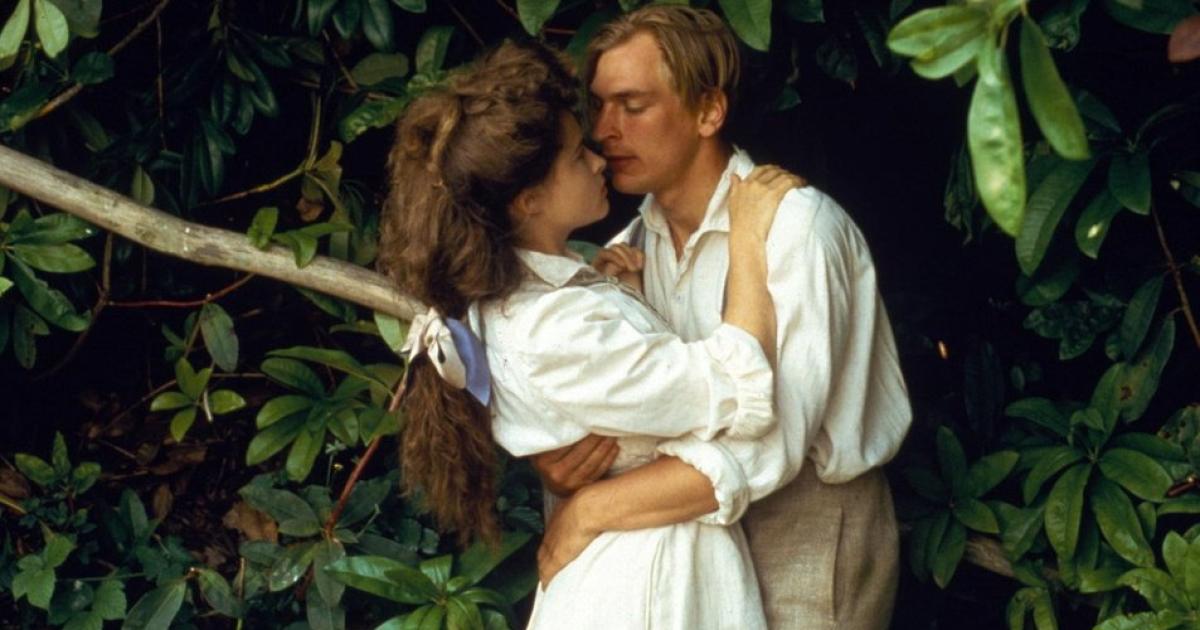
The cover image matters in that context. Using a real photographic still from the 1985 adaptation is useful because the article is about afterlife, not first publication alone.[5] The still shows exactly what the film made durable in collective memory: not simply costume detail, but the sensation that air itself has become a moral argument.
The novel is not really about travel; it is about cleared perception
Forster started planning the book after an extended stay in Italy in 1901-02, then reworked it through multiple abandoned versions before publishing it in 1908.[2][4] That long compositional history matters because the finished novel does not read like a travel notebook preserved in amber. It reads like a machine for separating scenery from seeing. Italy does not improve Lucy by magic. Italy unsettles the social script that England has made easy for her to repeat.[1][2]
The opening "view" is already doing more than one thing at once.[1] It is a literal room assignment, a class expectation, and a promise that life might yet become more direct than the cramped codes carried by Charlotte Bartlett and Cecil Vyse. The British Library essay is helpful here because it frames the novel as a struggle with convention in pursuit of authentic connection.[2] That phrase gets to the center quickly. Forster is not merely pitting free love against repression. He is asking what clarity feels like when a person has been trained to perform tact before she has learned to trust perception.
That is why Lucy's strongest inner register is musical rather than argumentative. At the piano, Forster says, "the kingdom of music is not the kingdom of this world."[1] It is one of the book's clearest signals that Lucy possesses an interior life larger than the social language available to her. She cannot yet formulate her freedom as doctrine. She can hear it before she can explain it. The novel's drama depends on that delay.
Merchant Ivory understood that the book needed climate, not just fidelity
The Merchant Ivory film lasts in memory because it does not treat Forster as heritage upholstery.[4][5] It certainly gives viewers the pleasures that heritage cinema can offer: Florence, church interiors, terraces, lawns, linen, Puccini, and a cast whose faces now function almost like shorthand for literary adaptation itself.[4] But the film's deeper success lies elsewhere. It finds a visual equivalent for Forster's moral meteorology.
The contrast between Italy and England becomes atmospheric without becoming simplistic.[1][4][5] Florence is not merely freedom, and Surrey is not merely imprisonment. What the adaptation does is make legible the difference between exposure and arrangement. In Italy, Lucy is repeatedly put where she can be surprised: in streets, piazzas, carriage routes, sudden encounters, open views.[1][4] Back in England, experience is reorganized into rooms, visits, engagements, and correct phrasing. The film turns that structural contrast into color and air. It teaches viewers to feel what the novel is already doing syntactically.
That is why the adaptation became the book's dominant public memory rather than just one respectable version among others.[4][5] BFI's capsule description of the film as a handsomely mounted dissection of polite Edwardian society is accurate, but what keeps it alive is the pressure under the manners.[5] Merchant Ivory's own production notes emphasize the Florentine locations, the English lawns, and Ruth Prawer Jhabvala's screenplay as one of the great literary adaptations.[4] The key point is that the screenplay knows where to stay light. It does not over-explain the novel's argument. It allows weather, glance, and pacing to carry a large part of the burden.
Lucy survives adaptation because she is a listener before she is a rebel
The book's most important line of emotional instruction comes late, when George says that he wants Lucy to have "your own thoughts" even in intimacy.[1] That phrase is small, but it is decisive. Lucy's problem is not simply that she must choose between two men. She must choose between two ways of inhabiting consciousness. Cecil offers an edited self, one that is legible, stylish, and socially approved. George offers something riskier: the possibility that feeling might arrive before etiquette has prepared its explanation.[1]
The film preserves that distinction better than many literary adaptations preserve their central argument.[1][4][5] Helena Bonham Carter's Lucy is not played as a modern heroine accidentally stranded in Edwardian clothes. She is played as someone whose perceptions run ahead of her available language. That keeps the novel's intelligence intact. Forster did not write a manifesto disguised as a courtship plot. He wrote a novel about the embarrassment of becoming audible to oneself.
This is also where the adaptation's afterlife becomes clearer. Later audiences often remember A Room with a View through posture, light, and movement before they remember its sentences.[4][5] That might sound like a diminution, but it is actually a translation of medium. The novel already works through bodily hesitation: pauses, missed timings, social recoil, sudden openness, and the ongoing effort to stop muddling truth into acceptable form.[1] Cinema simply gave those hesitations a widely shared set of faces and skies.
Why the book still returns
Forster's reputation rests more heavily on Howards End and A Passage to India, yet Britannica is right to describe his fiction more generally as modern in tone and unusually colloquial against Victorian inheritance.[3] A Room with a View remains one of the cleanest places to see that shift happening. It wants social comedy, but it also wants inward weather. It wants talk, but it keeps asking what speech is hiding.[1][3]
The reason its afterlife has been so stable is that the 1985 film did not flatten those tensions into postcard nostalgia.[4][5] It made the novel memorable by finding the right public image for its private argument. Readers and viewers return not because Lucy and George form an eternally charming couple, though charm helps. They return because Forster found a pattern that does not age: a person raised inside polished scripts, a sudden encounter with less arranged air, and the difficult work of recognizing one's own life before agreeing to live it.[1][2][4][5]
Sources
- E. M. Forster, A Room with a View. Project Gutenberg text of the 1908 novel.
- Stephanie Forward, "A Room with a View: class, conventions and the quest for clarity." The British Library.
- Encyclopaedia Britannica, "E.M. Forster" - biography and overview of his fiction and critical reputation.
- Merchant Ivory Productions, "A Room with a View" - production page with synopsis, director's comments, and awards context for the 1985 film.
- BFI, "A Room with a View (1985)" - film page and still source for the lead image used in this article.