Official Nobel interviews can make novelists sound tidier than their books. The setting is formal, the questions are concise, and the laureate is invited to summarize a lifetime's work in the language of influence, vocation, and advice. Olga Tokarczuk's official Nobel interview, published on March 27, 2020, begins inside exactly that ceremonial frame.[1][2] What makes it worth revisiting is that she keeps loosening the frame from within. Instead of treating authorship as a sovereign intelligence arranging plots from above, she describes fiction as a practice of receptivity: early reading shaped by physical access, psychology as disciplined listening, characters arriving before they are fully knowable, and borders experienced both as historical force and as a pleasure in crossing.[1][2]
That combination matters because Tokarczuk's reputation can easily harden into a slogan about scale. Britannica's compact description is accurate as far as it goes: she writes complex novels that move across centuries, places, perspectives, and mythologies.[4] The Nobel citation is equally grand, praising a "narrative imagination" that represents the crossing of boundaries as a form of life.[5] Yet those summary lines can make her fiction sound encyclopedic in a cold, top-down way, as if her books were planned from an aerial map. The interview offers a better entry. Tokarczuk makes large form sound bodily and local. Her imagination begins with shelves near the floor, with fairy tales, with the habits of attention learned from psychology, and with the feeling of a border in the forest that exists politically and dissolves existentially.[1][2]
Her Nobel lecture, The Tender Narrator, gives that workshop language a larger philosophical frame.[3] There she argues for a mode of narration capacious enough to hold relation, vulnerability, and the hidden interdependence of beings.[3] The interview is shorter and plainer, but it reaches toward the same idea from another side. You hear a writer explaining how tenderness begins operationally. First one notices where books sit in a house. Then one learns to listen. Then one becomes porous enough to hear characters speaking before they have solidified into case studies or symbols. Only after that does the work acquire the shape readers later call a novel.[1][2][3]
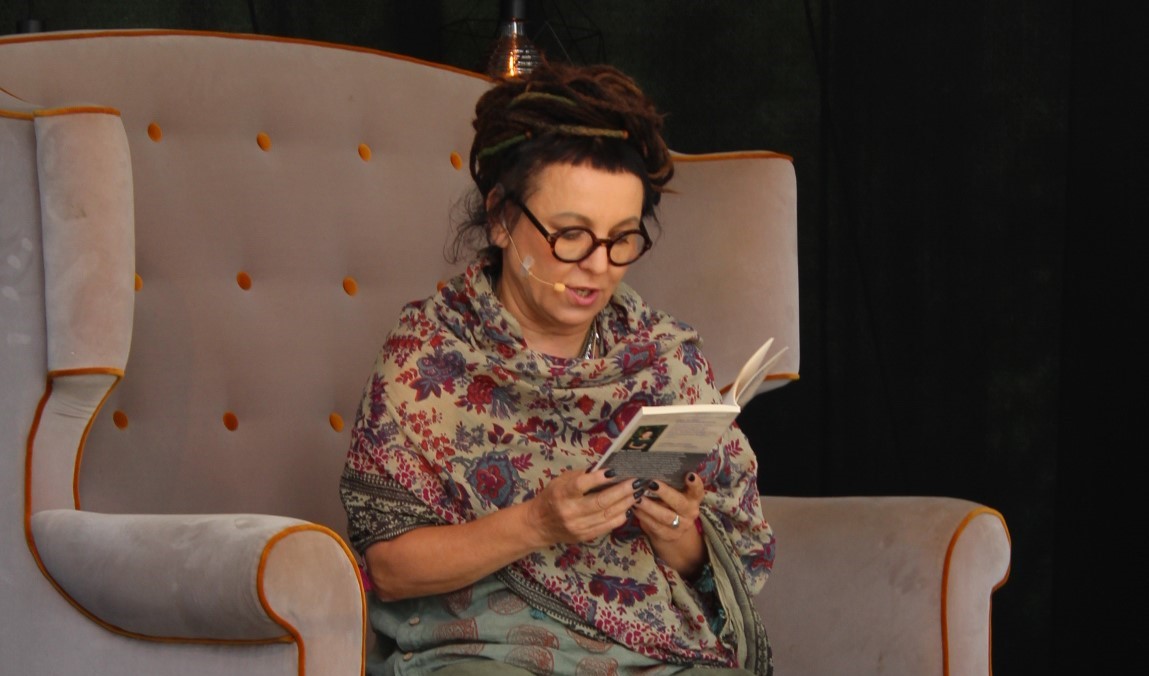
Image context: the cover uses a real 2024 Wikimedia Commons festival photograph of Tokarczuk rather than a jacket cover or a symbolic landscape. That choice fits this article because the clip is about literary presence in public speech. The face and posture matter here: they hold together curiosity, calm, and the slightly amused seriousness with which Tokarczuk describes the making of narrative.[6]
The official Nobel Prize video below is brief enough to watch in one sitting. The richest passages come in the opening answer about childhood reading, the middle section on psychology and character formation, and the later exchange where Tokarczuk links her life to the experience of borders.[1][2]
Around the opening minute, reading begins as bodily access rather than literary prestige
Tokarczuk's first answer is easy to underestimate because it sounds almost domestic.[1][2] She recalls a house where books were constantly present, where her parents discussed them, bought them, and kept them within everyday reach. The detail that stays with her is physical: the most interesting books were close to the ground, so as a child she explored those shelves intensely.[1] That memory matters because it shrinks literature back down to scale. Books do not begin here as monuments of culture. They begin as reachable objects in a room.
The next turn sharpens the point. Tokarczuk says fairy tales were the first decisive form, and that she still reads the Brothers Grimm almost as poetry.[1][2] Then she moves outward, describing how later reading taught her to think across countries and cultures. The sequence is revealing. She does not oppose the local shelf to boundary-crossing ambition. The shelf is the training ground for it. Physical nearness to books creates the imaginative habit that later becomes transnational movement. In literary terms, this is a useful correction to the way Tokarczuk is sometimes introduced only through abstraction, montage, or intellectual range.[4][5] Her expansiveness grows from touch, placement, and recurrent return.
That is why the interview's opening works so well as an annotated viewing moment. It shows that Tokarczuk's scale is not imperial. She does not sound like a writer claiming authority over continents. She sounds like someone who learned that books offer alternate coordinates, and that once those coordinates are available, crossing becomes a way of thinking before it becomes a theme.[1][2]
Around 4:03, psychology becomes the craft lesson that keeps fiction from turning schematic
The interview becomes much more precise when Tokarczuk explains why studying psychology was "a good choice."[1] Her answer is richer than a standard remark about character motivation. She says psychology taught her two foundational things: first, that every human being is the source of a novel; second, that listening is an ability one can actually train.[1][2] Those claims help explain why her books so often feel populous without becoming sociological diagrams. The human subject is inexhaustible, but access to that subject depends on attention rather than on theory alone.
This is also where the interview locks neatly into The Tender Narrator.[3] In the lecture, Tokarczuk argues against the hardening effects of distance and simplification, pushing instead toward a narrative stance that can register connection without flattening difference.[3] The interview supplies the practical underside of that position. A writer trained to listen will be slower to reduce people into functions. Listening creates delay, and that delay protects fiction from turning purely exemplary.
The importance of psychology here is therefore literary, not merely biographical.[1][4] Tokarczuk is not saying that the novelist becomes a therapist. She is saying that the novelist becomes less arrogant. The job is not to classify human beings from above. The job is to stay open long enough to notice how much unrealized narrative surrounds any person. That is one reason her fiction so often feels full of latent roads not taken. The listening comes first; the architecture follows.
Around 6:40, characters arrive cloud-like before they begin to speak
The interview's best craft passage comes a little later, when Tokarczuk explains how characters appear to her.[1][2] She says they seem to come from outside the story and initially remain only half-formed, "cloudy," not yet fully physical.[1] Then another stage begins: she can hear them talking to one another, or talking to her. This is the moment she calls the best one in writing.[1]
That description matters because it changes the usual picture of authorial control. Tokarczuk does not present herself as inventing characters the way an engineer drafts components. She presents herself as entering into relation with presences that only slowly become legible. There is still craft here, of course. She immediately adds that writing also demands research, note-taking, conversation, and the sculpting of the whole story.[1] But the order is crucial. Reception comes before sculpture.
Seen beside her published work, the interview clarifies why Tokarczuk's narratives can feel both designed and oddly alive.[3][4][5] They are shaped, but they preserve the sensation that the world exceeds the frame. Characters do not merely serve a thesis. They retain some of the surprise they had when they first began speaking. That is a difficult balance, and the interview makes it audible in unusually plain terms.
Around 13:14, borders stop being a metaphor and return to history, family, and physical joy
The later exchange about borders gathers the whole interview into one field.[1][2] Tokarczuk traces the subject back to her own life: she was born near the German border, later lived near the Czech border, and grew up inside a family history altered by the postwar redrawing of Polish territory.[1] Borders were therefore not abstract lines in a political essay. They were part of childhood atmosphere.
Then comes the small memory that makes the answer memorable. Tokarczuk recalls an old border in the forest and says she used to walk there with her dogs partly for the simple pleasure of crossing it, for the joy of feeling like a free person and discovering that the border did not exist in any ultimate sense.[1] This is the exact kind of detail that saves the concept from pomposity. "Crossing boundaries" can sound like institutional branding around a Nobel citation.[5] In her own telling, it is first a bodily experiment in freedom, undertaken by someone who knew perfectly well that borders could also wound families and rearrange histories.
That doubleness is essential to reading Tokarczuk well.[1][3][4][5] Borders are coercive facts, imaginative provocations, and occasions for narrative motion all at once. The interview condenses that complexity into a single lived image: a line in a forest that is politically consequential and existentially unstable. No wonder her fiction so often moves through travelers, refugees, pilgrims, eccentrics, and displaced archives. The border is never just a map mark. It is a narrative engine because it exposes the mismatch between what states draw and what persons feel.
Why this interview keeps paying literary attention back
The most useful thing about Tokarczuk's Nobel interview is that it makes a major writer sound methodologically humble without making her small.[1][2] Books begin low to the ground. Psychology teaches listening. Characters arrive before they are fully visible. Borders are both inherited injury and illicit delight. Each answer trims away the fantasy that the novelist's power lies in total command. What remains is a more exact, and more generous, picture of literary intelligence: disciplined receptivity that later becomes form.
That is why the clip belongs in a literature feed rather than a general culture roundup.[1][2][3][4][5] Its value is not laureate color or career recap. It gives a compressed account of how fiction stays open without becoming shapeless. Tokarczuk's novels may cross centuries and systems, but the interview makes clear that their expansiveness depends on smaller acts of faith: reach for the low shelf, listen harder than you classify, wait for the characters to speak, then cross the border and see whether it still holds.
Sources
- Nobel Prize, "Olga Tokarczuk, Nobel Prize in Literature 2018: Official interview," YouTube video, published March 27, 2020.
- Nobel Prize, "Olga Tokarczuk - Interview" - official interview page for the 2018 literature laureate.
- Nobel Prize, "Olga Tokarczuk - Nobel Lecture: The Tender Narrator."
- Encyclopaedia Britannica, "Olga Tokarczuk" - biography and overview of her major novels.
- Nobel Prize, "Olga Tokarczuk - Facts" - prize motivation and laureate context.
- Wikimedia Commons, "File:Olga Tokarczuk 22.jpg" - source page for the lead photograph used in this article.