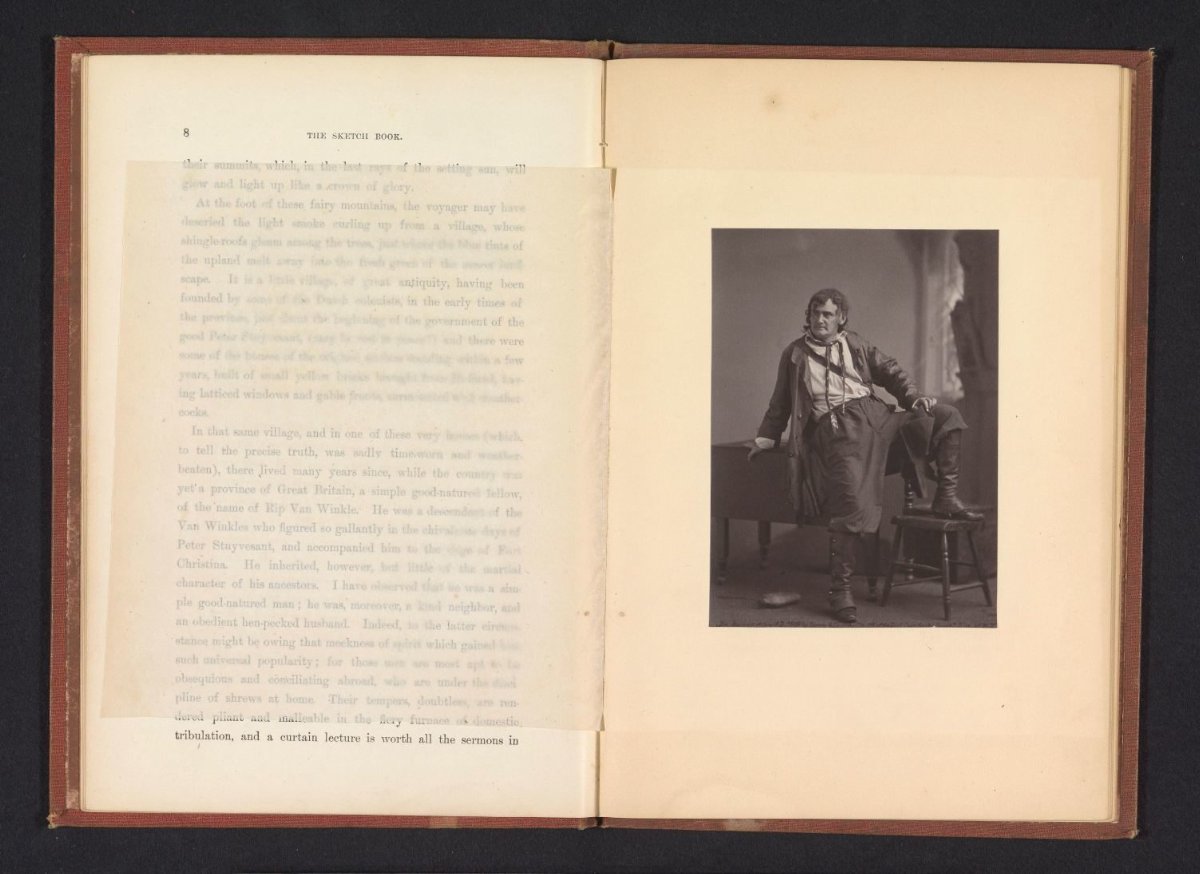
The twenty-year sleep survived the journey from Washington Irving's story to Joseph Jefferson's stage. Rip's wife survived it, too. In Irving, she is dead when her husband comes down from the mountains. In the published play Jefferson made famous, she is still there, in a village that has aged without him. Keeping her alive creates the possibility of a reunion. It also gives the adaptation someone to kneel beside Rip and ask him never to leave again.[1][2]
That changed ending is a useful place to begin reading backward. The familiar beard and rusty gun preserve the outline of Rip Van Winkle. Underneath, the theatre has rearranged who receives pity, who must apologize, and whose suffering can bring down a curtain.
Irving's tale, first published in 1819, is already an accomplished exercise in taking Rip's side while leaving evidence against him. Early on, the narrator diagnoses an “insuperable aversion to all kinds of profitable labour.” Yet Rip willingly helps neighbors with strenuous jobs. His energy fails when his own household needs it. The distinction matters: the village enjoys the generosity for which his family pays.[1][3]
The narrator makes Dame Van Winkle's anger oppressive and comic, but supplies its grounds in neglected land and ragged children. When Rip returns after his enchanted absence, the American Revolution has happened without him. He is less concerned with the new political order than with release from “petticoat government.” His daughter takes him in; age now excuses the idleness that used to require defense. His account of the mountains varies before settling into its familiar form. We can enjoy the marvelous escape while noticing how conveniently it serves the person telling it.[1]
Jefferson inherited a theatrical tradition rather than an untouched story. Earlier dramatizations preceded his own experiments; Dion Boucicault revised his version for the London production that opened at the Adelphi in September 1865. Jefferson continued altering it. The four-act text published in 1895 is therefore a record of an accumulated performance, not an exact transcript of opening night. Its publisher also credits Cora Hamilton Bell with expanding the stage directions, with Jefferson's approval. Those directions are especially revealing: they preserve instructions for where the audience's attention should go.[2][3]
The play initially gives Gretchen a strong case. Act I opens with her washing clothes while laughter comes from the inn. She explains how Rip's property has passed into the hands of Derrick, who supplies the money for his drinking. Her work is visible before her husband's charm arrives. The stage puts the household economy in a tub and washboard, within sight of the drinking companions.[2]
Act II brings that conflict indoors. A storm rages outside the kitchen; the furniture is sparse, the crockery meager. Rip spins out a hunting story while Gretchen waits to discover whether he has brought anything home. His digressions offer an actor delicious opportunities: a rabbit's tail, its ears, a shot, a disappointing result. Her interruptions keep recalling the practical question. What will they eat? The audience can laugh at the time he takes because she is the one who needs an answer.[2]
The comedy becomes uglier when Rip comforts her while stealing back a bottle from her pocket. Affection provides cover for the hand movement. He promises reform, then reaches for another drink. The script gives us ample reason to understand her fury. Nevertheless, when she expels him, the emotional balance shifts. The children plead; Rip blesses his daughter; Gretchen relents too late. He staggers into the weather, and she calls him back before fainting at the curtain.[2]
The scene's power comes from its timing. Years of exhausting behavior have produced one spectacular instant of rejection. An audience watches the instant happen to Rip. The household's longer history remains available to judgment, but the immediate spectacle favors the man at the door. This is my reading of the sequence, rather than a claim that every spectator surrendered to it.
One contemporary essay makes precisely that disagreement audible. In “Rip Van Winkle,” collected in From the Easy Chair, George William Curtis stages a debate with a companion called Portia. She objects that Jefferson's skill makes the irresponsible husband seem the victim of the home he has damaged. The narrator counters that Rip's lost years and ruined old age expose the cost of his conduct. Yet he also describes the actor's commanding effect in a wonderfully candid sentence: “This figure excludes all the rest.”[5]
Curtis's essay supplies both the defense and its difficulty. The performance can make wasted life painfully visible. It can also concentrate feeling so thoroughly on the person who wasted it that everyone who lived through the consequences slips toward the edge of the picture. Compassion and exoneration are distinguishable ideas; in a theatre, they may arrive with the same tears.
Jefferson had his own defense of the play's changing register. In his introduction, the meeting with the mountain spirits marks a passage from ordinary domestic life into fairy tale. He describes removing the spirits' speech so that Rip's voice sounds alone against their silence. He also explains his resistance to an ending in which Rip refuses a drink: that would turn the work into a “temperance play.” The final cup was a considered artistic choice.[2]
By Act IV, Gretchen has married Derrick, believing Rip lost, and the household is subject to the villain's power. The ending defeats Derrick and restores Rip. Then Gretchen kneels, promises never to speak unkindly, and offers him extraordinary latitude, including permission to get drunk. Meenie helps persuade him to accept a welcoming drink. Rip briefly refuses before reviving his old exemption: “I won't count this one.”[2]
The return of that excuse makes the reunion more troubling than a simple happy ending. A habit that helped break the household becomes part of the ceremony that restores it. Rip receives recognition and affection; Gretchen undertakes the explicit change in behavior. The adaptation has kept her alive, given her labor a visible place, and allowed her grief to be heard. Its final arrangement nevertheless makes her welcome certify his homecoming.
Reading the story beside the play lets us hold two pleasures together: Irving's slippery account of a man who becomes his own legend, and the actor's ability to make age and bewilderment demand care. The question the adaptation leaves behind is who gets to remain in view once that demand is met. Watch the final cup move from Gretchen's hand to Rip's. Their home has been restored, and the old argument has found a new way to end.
Sources
- Washington Irving, Rip Van Winkle (1819), Project Gutenberg text of the illustrated Heinemann edition — opening characterization, return to the village, and concluding account of Rip's retirement.
- Joseph Jefferson and Dion Boucicault, Rip Van Winkle, as played by Joseph Jefferson. Dodd, Mead, 1895; Internet Archive scan — publisher's note; introduction, pp. 9–19; Acts I–IV, especially pp. 27–34, 100–115, and 197–199.
- Arthur Hobson Quinn, introduction to Rip Van Winkle in Representative American Plays (1922 edition; collection first published in 1917), Wikisource — earlier adaptations, the 1865 Adelphi production, and the development of Jefferson's published version.
- Rijksmuseum, Portrait of Joseph Jefferson as Rip Van Winkle, Napoleon Sarony, 1869, RP-F-2001-7-1005-2 — photograph, date, medium, and collection record.
- George William Curtis, “Rip Van Winkle,” in From the Easy Chair (1891), Project Gutenberg — contemporary debate about Jefferson's performance, audience sympathy, and the play's moral effect.