This essay reveals the story’s ending.
The first thing Furnivall Manor confesses is not a fact but a sound. Late in the day, after the child in her care has gone to bed, Hester hears an organ “booming and swelling.” The other servants will not explain it. When she opens the instrument in daylight, she finds its mechanism “all broken and destroyed inside.” No living player could be making this music.[1]
That is the ghost story’s beautiful impossibility. It is also its method. In Elizabeth Gaskell’s “The Old Nurse’s Story,” a family history refuses to stay quiet, but it does not return as plain speech. The dead patriarch comes back as music without a visible body. The child he helped kill appears at a window as a visible body without audible cries. One haunting possesses the great hall; the other remains outside asking to enter. Long before Hester learns what happened, sound and silence have already arranged the crime.
The organ therefore does more than announce a ghost. It preserves the Furnivalls’ habit of converting violence into atmosphere. Its music rolls through the house, frightening everyone and accusing no one in words. Only Hester’s act of telling can do what the instrument cannot: connect effect to cause, name who was left in the snow, and carry that knowledge to children who were not there.
Before the ghost, Hester insists on a beginning
Gaskell opens with an interruption. The elderly Hester is telling Rosamond’s children about their mother’s childhood, and she notices that they are impatient with the family preliminaries. She agrees to move faster, but she does not actually discard them. Before the organ sounds, her listeners must hear how she entered service, how Rosamond was orphaned, and why a teenage nursemaid promised never to leave her.[1]
That delay establishes the moral scale of the tale. Furnivall Manor measures people by title, ancestry, and the rooms they may enter. Hester measures obligation by care. Rosamond’s mother asks for her protection on a deathbed, but Hester says she would have followed the child to the end of the world even without the request. The sentence makes service exceed contract. She is employed by the family, yet her loyalty is to a person rather than to the family’s prestige.[1]
This is why the title matters. Gaskell does not call the piece “Furnivall Manor” or “The Spectre Child.” She gives narrative possession to an old nurse. Jean Fernandez places the story in a study of Victorian servant literacy, class, orality, and narrative power; the relevant chapter pairs repression with the pleasures of a servant’s spoken account.[5] Hester’s grammar may identify her social position, but the structure belongs to her. She chooses what the next generation must know.
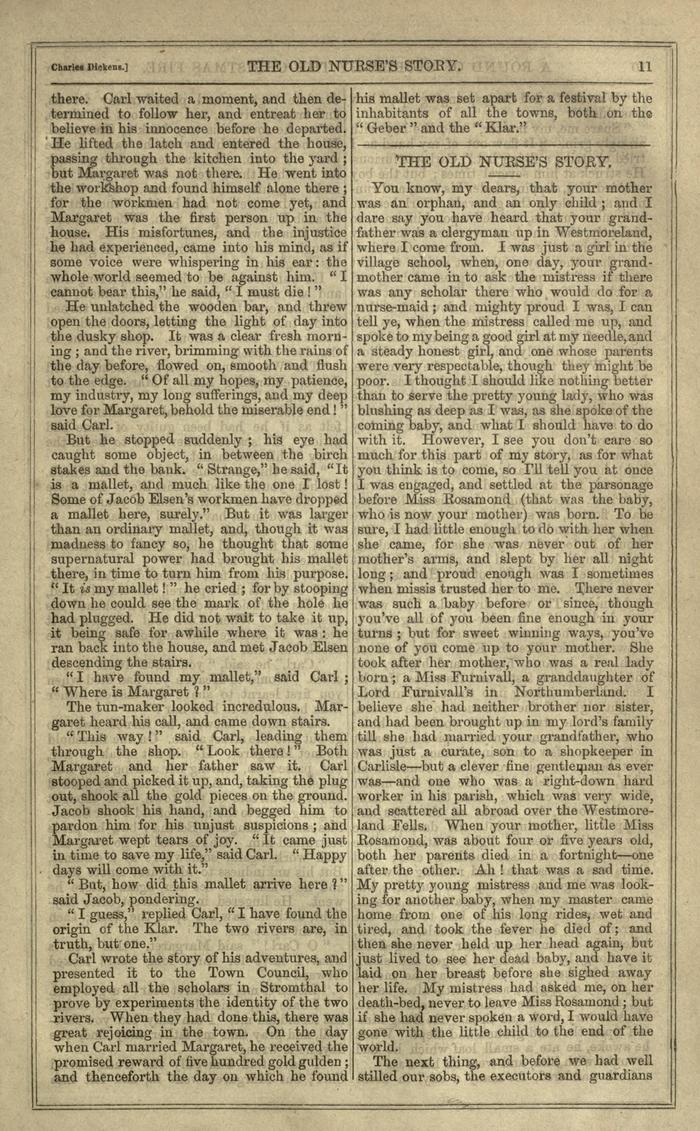
The story first appeared on December 25, 1852, in the Christmas number of Charles Dickens’s Household Words.[2][4] Its original page makes its voice look communal before a reader reaches the plot: another tale fills the left column and ends at the top of the right, before Hester begins below it. Caley Ehnes argues that this publishing frame turned the Christmas ghost story into a social form, translating an older scene of oral storytelling into a modern periodical sold for the season.[6] Hester’s affectionate address to the children survives that translation. Print lets us overhear a voice still shaped by an audience in the room.
A fine exterior with a ruined instrument inside
The organ stands in the hall Hester and Rosamond cross on arrival. From there, the house divides knowledge into zones. The east wing is locked. Maude’s portrait has been turned to the wall. Miss Grace Furnivall sits in the west drawing room, nearly deaf but intensely watchful. Warmth and talk collect in the kitchen and nursery; rank, tapestry, and evasion occupy the formal rooms.[1]
The instrument condenses that arrangement. It looks “brave and fine,” but its working parts are wrecked. The resemblance to the manor is tempting because it is exact: an imposing shell encloses a damaged system. Yet Gaskell makes the organ more active than a Gothic emblem of decay. It produces the very thing the household is organized to prevent—a sign that travels through walls.[1]
Hester first hears it when she is keeping still beside the sleeping Rosamond. Silence makes reception possible. At supper she asks who played, and the household immediately demonstrates several ways of not knowing. James calls the sound wind. Dorothy looks afraid. Bessy mutters under her breath and turns white. The next day Hester questions Dorothy alone, but the older woman has been given her lesson and will say nothing; only afterward does Bessy offer a partial explanation under a promise of secrecy.[1]
The servants’ silence is not empty ignorance. It is managed knowledge. Each person knows a different amount; each also knows what the hierarchy permits them to repeat. The official explanation reduces music to weather, even though Hester can distinguish gusts from tunes. Her ear becomes a small act of independence: she trusts the shaped sound more than the master’s household account of it.
At first, this seems almost pleasurable. Hester says the music “wailed and triumphed” like something alive, then grows used to it because it apparently harms no one.[1] That accommodation is one of Gaskell’s shrewdest touches. A haunting can become house noise if it does not yet demand action. The organ keeps the past perceptible while also making it possible to live beside the past without understanding it.
The old lord used beauty as insulation
Dorothy’s eventual account changes the music retrospectively. The former Lord Furnivall loved instruments and paid lavishly for performance, but aesthetic sensitivity did not soften his cruelty. A visiting musician arranged for the great organ to be brought from Holland, taught the lord to play, and courted both of his daughters while their father was absorbed in music. Maude secretly married the visitor and had his child. Grace, jealous of her sister, stood by when their father’s rage turned fatal. On a freezing night, the lord drove Maude and the little girl from the house and forbade the servants to shelter them. The child died on the fell.[1]
The cruel irony is not simply that a music lover behaves brutally. The organ gives the lord a flattering theory of himself. Servants assume its sweetness has calmed his temper; meanwhile, his daughters’ lives develop outside his attention, under rules that make honest acknowledgment dangerous. Art becomes insulation from relationship. He hears refinement where everyone else needs him to hear fear, rivalry, and dependence.
Gaskell is precise about when his playing stops. After the expulsion, the old lord never touches the organ again. The living performance ends at the moment its moral fraud becomes undeniable; the ghostly performance begins later, when the ruined instrument renews his claim on the hall.[1] Haunting does not give him a repentant message. It gives his power duration.
The Gaskell Society traces a suggestive source behind this choice: in a local legend Gaskell recorded, an aristocratic ghost searches through rooms for disputed legal papers. The Society asks what changes when documents become organ music.[7] One answer—necessarily an interpretation—is that papers would make the haunting about title and inheritance, whereas music makes it about cultivated feeling detached from care. The Furnivalls do not lack records alone. They lack a language in which beauty creates responsibility.
The father is heard; the child is seen
The story’s most disturbing scene occurs before Hester knows Dorothy’s history. Rosamond sees the ghost child outside a window, crying and beating to be admitted. Hester sees her too. Yet even while the small hands appear to strike the glass, there is “no faintest touch of sound.” At that instant, the organ erupts loudly enough to stun Hester.[1]
The contrast is almost architectural. The dead lord commands the interior through volume. The dead child, expelled from that interior, can make herself visible only at its boundary. His violence has resonance; her suffering has gesture. A window allows sight while refusing touch, shelter, and audible exchange.
Rosamond responds before she understands. She wants to open the door because a child may freeze. Her sympathy is morally right and physically dangerous: the phantom has already lured her onto the fell once and continues trying to draw her into the old death. Hester must therefore refuse the ghost child in order not to repeat the family’s abandonment of a child. The paradox is brutal. She saves Rosamond by keeping the door shut, but she does so while holding the victim’s claim fully in view.[1]
That complication keeps the haunting from becoming a simple demand for restitution. Neither ghost offers a usable remedy. The organ repeats force; the little girl repeats exposure and recruits another child into it. Memory without interpretation is compulsive. It can reveal the wound and still reopen it.
The story’s visual and acoustic split also prevents a comforting hierarchy of evidence. Seeing does not solve what hearing obscures. Rosamond’s first journey leaves only one set of footprints, her own. Hester sees the child’s wounded shoulder but cannot hear her. Music fills the manor yet comes from a mechanism that cannot work. Every sense supplies evidence and a reason to doubt the terms on which that evidence arrives.[1]
Deafness hears what denial has stored
Miss Grace’s deafness initially seems like one more piece of Gothic portraiture. She uses an ear trumpet, watches faces closely, and depends on Mrs. Stark to manage conversation. But at the climax Gaskell turns deafness into a measure of guilt. Grace is the first living adult to hear the old scene returning. She rises, commands the room to listen, and identifies her father’s voice before Hester and Mrs. Stark can hear anything.[1]
Soon the whole house of sensation changes. Ordinary wind disappears beneath voices and screams. A cold fire burns. The locked east door crashes open. The old lord drives Maude and her child toward the outer door, then raises his crutch. Only now does another figure form beside him: Grace as a young woman, watching with the same stony triumph Hester had earlier seen in her portrait. The old Grace begs her father to spare the child, but the scene continues. She must watch her earlier self refuse the plea she makes too late.[1]
The published ending makes at least its final revelation collective. Just as the phantom of the younger Grace forms beside the old lord, Hester’s compact phrase is “we all saw.”[1] That plural had an editorial history. Dickens sent Gaskell proofs with a proposed alteration and later conceded that he could not claim his ending would have improved the story; he praised it as it stood.[3] The modern critical edition summarizes the disagreement as Dickens arguing that only Rosamond should see the ghosts and Gaskell resisting, while cautioning that the precise sequence of revisions cannot now be recovered.[4]
Whatever changed in proof, the surviving plural is decisive. It does not make every supernatural perception collective: Rosamond retains a special vulnerability to the ghost child. But it prevents the climax’s final image of complicity from being dismissed as hers alone. The younger Grace, who once watched her sister’s child struck without intervening, becomes visible to the assembled household. The family’s hidden witness is now herself witnessed.
Recognition, however, is not repair. The blow falls again. Grace collapses, faces the wall, and repeats that the past can “never be undone.”[1] Her final speech resembles the organ more than Hester’s narrative: low, circular, unable to reach an answer. Remorse has become another refrain inside the house.
Hester turns recurrence into testimony
The organ remembers, but it remembers badly. It preserves weather, dread, grandeur, and the old lord’s domination without distinguishing warning from renewed assault. Grace remembers, but she has built her adult life around silence until memory can only stage a trial whose verdict changes nothing. Hester is the one person who converts recurrence into a sequence another generation can understand.
Her method is notably careful. She reports when she saw something herself, when Rosamond told her something, and when Dorothy passed on what older neighbors had said. She admits uncertainty about the family tale rather than turning hearsay into omniscience. Then she places those layers beside material facts: a locked wing, a reversed portrait, a broken organ, a child found nearly frozen, a wound in the same place where the spectral crutch lands.[1]
This attention is the opposite of Furnivall pride. The old lord mistakes taste for goodness. Grace mistakes silence for escape from consequence. Hester does not need perfect certainty before acting; when Rosamond is pulled toward the phantoms, she holds the living child with both arms. Her story gives that bodily care an intellectual form. It teaches listeners how to keep hold of someone while looking directly at what a family would rather turn to the wall.
The story’s critical afterlife has often connected its supernatural machinery to social criticism and to damaged bonds among women. The Gaskell Society places it beside Cranford as a dark reversal of sustaining female community, while Fernandez’s focus on servant narration clarifies why the history becomes speakable from below rather than through the aristocratic family.[5][7] Ehnes’s periodical reading adds a final turn: a story about a household unable to transmit truth entered Victorian homes in a format designed for shared seasonal reading.[6]
That is the deeper reason the organ must be broken. A working instrument would need a player, and a player could stop. This one makes suppression audible as a system: impressive on the outside, ruined within, and still able to fill every room. Hester cannot silence it or undo its first music. She can do something less magical and more useful. She can tell the children where the sound came from.
Sources
- Elizabeth Gaskell, “The Old Nurse’s Story,” in Curious, If True: Strange Tales, Project Gutenberg eBook 24879 — complete primary text used for the close reading.
- Dickens Journals Online, “The Old Nurse’s Story” — Household Words catalogue record, December 25, 1852 publication data, and original page facsimile used for the lead image.
- Charles Dickens, letters to Elizabeth Gaskell dated December 1 and December 17, 1852, in The Letters of Charles Dickens, Project Gutenberg — proof revision and Dickens’s assessment of the ending.
- Charlotte Mitchell, ed., The Works of Elizabeth Gaskell, Volume 3: Novellas and Shorter Fiction II (Pickering & Chatto, 2005; Routledge, 2016) — critical-edition introduction, first-publication history, reprint history, and note on the uncertain revisions to the ending.
- Jean Fernandez, Victorian Servants, Class, and the Politics of Literacy (Routledge, 2010) — publisher record and contents for the chapter on orality, repression, and narrative power in “The Old Nurse’s Story.”
- Caley Ehnes, “Winter Stories—Ghost Stories… Round the Christmas Fire: Victorian Ghost Stories and the Christmas Market,” Illumine 11, no. 1 (2012), 6–25 — original periodical frame and the ghost story as a social Christmas form.
- Diane Duffy, “The Old Nurse’s Story,” The Gaskell Society — Gaskell’s local ghost legend, women’s bonds, social criticism, and questions about the organ’s role.