A hen pheasant appears almost beneath the window. A nightingale sings across the road. Richard Jefferies has moved within convenient reach of London and discovered that the birds have failed to respect his idea of where the countryside ends. In the preface to Nature Near London, he admits that he expected to need much greater distance from town before finding so much life.[1]
That willingness to have an expectation overturned is a good introduction to Jefferies. His prose can give extraordinary pleasure: warm turf, small flowers, sunlight moving over water. Yet the pleasure often starts something restless. Close attention may reveal an abundance he had overlooked, intensify a desire he cannot satisfy, or make a landscape frightening. Across his essays, inward autobiography, and speculative fiction, looking becomes an adventure with uncertain consequences.
Born at Coate Farm near Swindon in 1848, Jefferies learned natural history from his father and entered local newspaper work as a teenager. He married Jessie Baden in 1874; in 1877 they moved with their young son to the Surbiton area. His rural articles found success in the Pall Mall Gazette. The writer associated with fields and hedgerows was also a working journalist, finding forms in which experience could reach readers elsewhere.[2]
A place cannot keep an appointment
Nature Near London, first published in 1883, makes that relationship with the reader unusually candid. Why, Jefferies anticipates being asked, has he not identified every attractive hedge and meadow precisely? Because even an exact address cannot deliver the experience. Frost might arrive after the leaves have fallen. The birds might have left the tree. Weather and attention will differ.[1]
The preface's questions gently undo the promise of a scenic itinerary. A writer can describe chestnut leaves reflected in a brook, but cannot book the same reflection for somebody else. Description gives access to an encounter while preserving its unrepeatability.
What he offers instead is duration: walking the paths “day by day, and week by week.” The repeated phrase makes knowledge sound like a habit of returning. A disappointing visit proves very little. His inventories of birds acquire their force through accumulated watching, including the later discovery of species he initially thought absent.[1]
The opening essay, “Woodlands,” puts that method into motion. Small strawberry flowers receive sunlight before the overhead leaves grow thick; last year's dry cow-parsnip leans against the underwood because its root has rotted. The scene holds several times at once. What is flowering, what is pushing upward, and what survives only as a dead stalk occupy the same bank. Jefferies's eye makes spring complicated enough to feel inhabited.
He also positions the observer. A pheasant notices that a gateway is occupied and crouches out of sight. Rabbits feed at a distance he measures in relation to gunshot. The countryside contains animals responding to a human presence, and a human whose vocabulary carries the habits of country sport. The writing's intimacy comes with those particulars.[1]
The body on the hill
In The Story of My Heart, also published in 1883, the observing body becomes the main subject. Chapter I begins with a mind grown cramped by familiar circumstances. A walk uphill changes its condition: effort clears away heaviness, the view opens, and the narrator reaches the emphatic repetition, “I felt myself, myself.”[3]
The doubled word matters. The self becomes more intensely present as its surroundings expand. Lying on the grass, he addresses earth, air, sea, and sun, seeking an inward equivalent of their strength and brilliance. Then the movement turns back toward things within reach: thyme, a blade of grass, chalk crumbling through his fingers.
The passage alternates immense distances with touch. He can imagine the sea while holding a little earth. Repeated clauses beginning with “By” gather these presences into a kind of litany, although he repeatedly worries that inherited words cannot contain the feeling. Even “prayer” is an inadequate name for what he is doing.[3]
This is an autobiography organized around the effort to register experience. Its opening drama happens almost invisibly. Jefferies imagines a passing shepherd assuming that the man on the turf is merely resting. The reader, admitted to the inward activity, knows how much that plausible observation would miss. He returns home exhausted.
That exhaustion complicates the easy association between nature and repose. The hill releases an appetite for fuller existence; it does not neatly satisfy it. His language strains and repeats because the desired intensity exceeds what an orderly account can hold. The same author who patiently records a bird's movements now tries to make a reader feel the pressure of something he cannot classify.
When the birds go the other way
Two years later, After London gives observation a more alarming task. Its opening announces that “It became green everywhere in the first spring, after London ended.” Read quickly, the greenness sounds restorative. Read through the following paragraphs, it becomes evidence that the labor maintaining a familiar landscape has stopped.[4]
The wheat is unreaped. Meadow grass falls and withers where it grew. Roads disappear under vegetation. Saplings survive because cattle no longer eat their first leaves; drains choke and water spreads. Jefferies builds the transformation through consequences, making a vanished social order visible in the changing growth of plants. What looked like scenery was also continuous work.
Much later, in Part II, chapter XXII, Felix travels by canoe toward the ruined city. Waterfowl pass him in the opposite direction. Smaller birds move the same way, and finally swallows and martins sweep over the water. He notices the pattern before he understands it. The nesting season makes the departure especially strange.[4]
This is the nature writer's catalogue turned into suspense. Each named species strengthens a warning that the traveler cannot yet interpret. After the abundance comes absence: empty water, empty bushes, then stunted and discolored vegetation. The reader learns to fear the missing birds.
In chapter XXIII, the observer's own reliability deteriorates. Poisonous emanations dull Felix's senses; he can register disturbing objects without feeling an appropriate alarm. Looking closely now has a bodily limit. The environment acts upon the person trying to read it, reducing his ability to recognize his danger.[4]
The Environment & Society Portal places After London among early examples of what is now called eco-apocalyptic fiction, while noting that contemporary readers understood it through romance or fantasy.[5] That distinction keeps the book in its own literary world. Its imagined future offers a powerful experiment in environmental consequence, without requiring us to treat it as a forecast of a particular modern crisis.
Jefferies died in 1887, leaving these books within a short, varied career.[2] Reading them together reveals an imagination that keeps testing the relation between perception and desire. The suburban watcher must return tomorrow; the man on the hill wants more life than his words can express; the canoeist sees the warning and still sails onward. Jefferies lets us enjoy the green world while making us work to understand what our enjoyment leaves out.
Sources
- Richard Jefferies, Nature Near London, preface and “Woodlands.” Project Gutenberg transcription of the 1905 Chatto & Windus edition; observation, suburban wildlife, and the limits of reproducing an encounter. Publication date documented by Wellcome Collection's record of the 1883 Chatto & Windus edition.
- S. Tuersley, “Richard Jefferies,” Wiltshire and Swindon History Centre. Farm upbringing, newspaper work, marriage, the move near Surbiton, literary career, and death.
- Richard Jefferies, The Story of My Heart: My Autobiography (1883), chapter I. Project Gutenberg transcription; the hilltop experience, the repeated invocations, and the imagined shepherd.
- Richard Jefferies, After London; or, Wild England (1885), Part I, chapter I, and Part II, chapters XXII–XXIII. Project Gutenberg transcription; abandoned cultivation, departing birds, and Felix's impaired perception.
- Environment & Society Portal, “After London; or, Wild England.” Publication history and the relationship between Victorian romance and the later eco-apocalyptic classification.
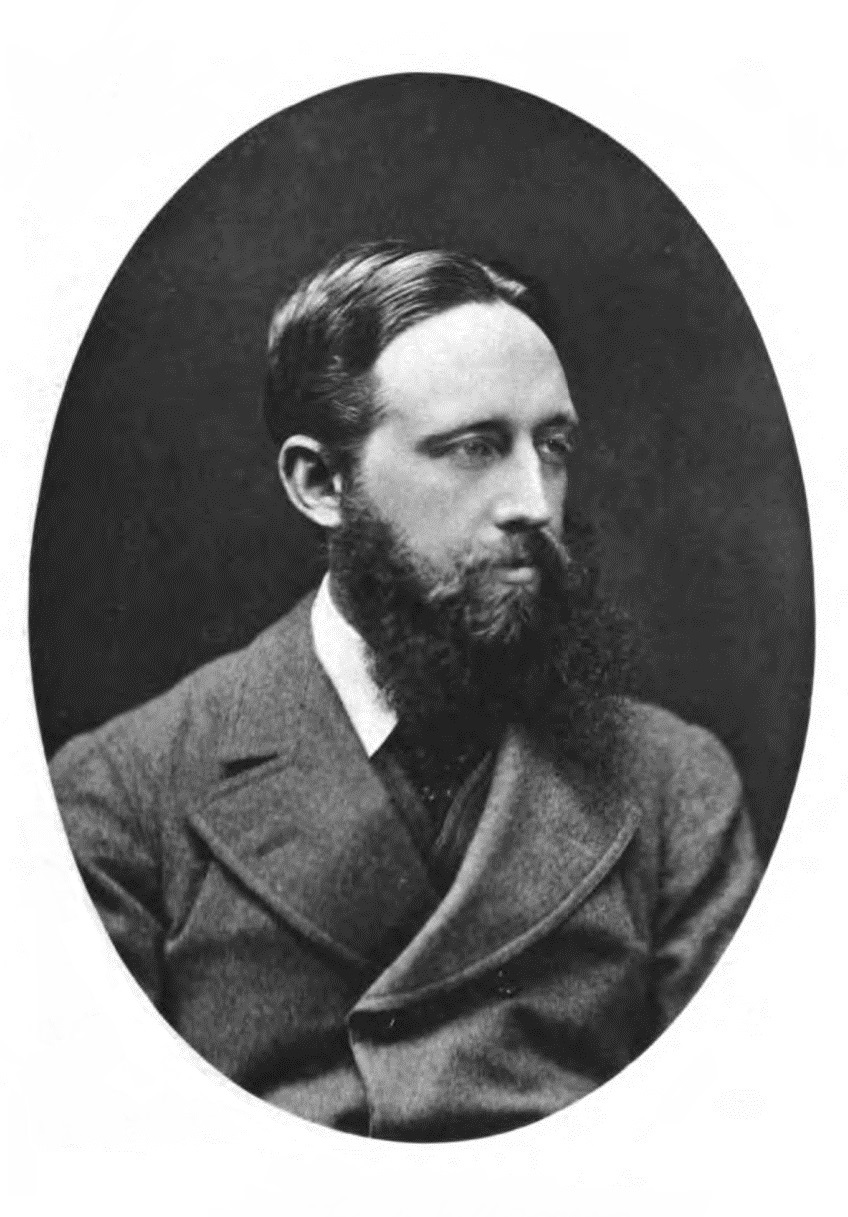
- Wikimedia Commons, “Photo of Richard Jefferies.jpg.” Archival photograph dated 1879, photographer unidentified, reproduced from Richard Jefferies, His Life and Work, with a link to the digitized source volume.