A fir tree wants to get indoors. A snowman wants to lean against a stove. The warm room promises each of them a more satisfying existence, and in each case the reader can see what the wish leaves out: the body that would have to survive it. Hans Christian Andersen gives these unlikely dreamers wonderfully specific misunderstandings. Their mistakes are funny long before their endings hurt.[1][2]
“The Fir Tree” appeared in December 1844; “The Snow Man” followed in March 1861. Reading them together brings out a difference that a shared moral about appreciating life would miss. The tree has years of experience and keeps finding reasons to discount it. The snowman begins by enjoying exactly the conditions that sustain him, then discovers a desire those conditions cannot satisfy. Each tale eventually leaves an object behind, inviting an explanation just when its protagonist can no longer answer.[1][2][3][4]
The discussion includes both endings. Quotations follow Jean Hersholt's English translations.
The tree keeps moving its happiness forward
At first, the fir tree treats size as the measure of a worthwhile life. A hare can jump over it: humiliating. Later, the hare must go around: progress. The comedy comes from giving a tree an exquisitely social embarrassment. It experiences a perfectly ordinary encounter in the woods as evidence of its inadequate standing.[1]
Its ambition changes when birds report what happens to other trees. A stork describes ships' masts; sparrows describe decorated Christmas trees. These witnesses have seen real things, but their information ends too early. The sparrows can describe the splendor inside a house. They cannot say what follows it. The fir tree fills that gap with an expectation of further promotion.[1]
“And then?” is its great question. It sounds like the question of a delighted listener asking for more story. In the tree's mouth it also prevents any scene from being sufficient. The imagined future must contain something grander because the present has been assigned the job of preparing for it.
Christmas offers a devastatingly literal fulfillment. The tree reaches the beautiful room, receives its decorations, and becomes the center of attention. Yet a candle burns one of its branches, the children strip off the presents, and its importance expires. Its triumph has a timetable nobody thought to explain.[1]
Even then, it postpones enjoyment. “Tomorrow I shall not quiver,” it decides. The sentence is touching because it promises an improved performance at an event that will not be repeated. The next day brings storage in a dark garret. Its resolution has arrived one day late.
The snowman starts by being happy
The snowman presents a sharper problem for any lesson about gratitude. He likes the cold. “The cold is lovely,” he tells the watchdog. Before he becomes infatuated with the stove, he already possesses the appreciation the fir tree lacks.[2]
The dog introduces the alternative. Once a pampered house pet, he remembers the comfort of lying beneath the housekeeper's stove. His recollection gives warmth the authority of experience. For him, the room really was a better place to live. His advice becomes dangerous only when its pleasures pass into the imagination of a creature made from snow.[2]
Andersen lets desire travel through conversation. The snowman looks through the window after hearing the dog's account; the stove becomes an object of longing within a story someone else has told. The comparison with the sparrows matters here. Neither the birds nor the dog needs to lie. An accurate account of another creature's happiness can still produce a disastrous idea of one's own.
Then the window freezes over. The cold preserves the snowman's body while blocking his view of the stove. What should be perfect weather becomes unbearable. Hersholt's “stove-sick” makes the absurdity compact and strangely recognizable: a household appliance has acquired the emotional force of an absent beloved.[2]
The dog warns him that approaching the stove would melt him. The warning supplies information without dissolving the wish. Read beside the fir tree, the snowman makes the moral difficulty harder to dismiss. Knowing what is good for one's survival does not necessarily settle what one longs for.
Stories give comfort, then set the terms
The fir tree also learns what to expect from a story. During Christmas festivities, it hears about a figure called Humpty-Dumpty in Hersholt's version, who falls downstairs and nevertheless wins a princess. The tree takes this reversal as useful knowledge about the world. A fall might precede advancement; present neglect might be the middle of a happy ending.[1]
That borrowed plot sustains it in the garret. It also makes the tree a storyteller. Mice gather to hear about its life and then about Humpty-Dumpty. Recounting its past helps it recognize pleasures it barely noticed at the time. For a while, telling a story gives it company as well as a different relation to memory.[1]
The arrangement ends when rats arrive and ask for stories about food. Their disappointment changes the mice's opinion; the audience drifts away. Andersen is very funny about literary taste here. A story's reception depends partly on what its listeners want to consume. The tree's newly discovered vocation cannot guarantee that anyone will keep listening.
John D. Niles's critical essay on “The Fir Tree,” preserved by Museum Odense, emphasizes the force of placing a feeling, reflecting tree at the center of events it cannot control. That observation helps qualify the easy accusation that the tree wastes its life through dissatisfaction. Its impatience shapes its experience, but people still decide when to cut it, display it, put it away, and burn it.[3]
Reading the two tales together extends that distinction. Both protagonists misunderstand their circumstances. Neither commands the circumstances that will end its life.
What the surviving objects can tell us
The endings leave unusually small remains. A child takes the fir tree's gold star and later wears it while the tree has been reduced to fuel. When the snowman collapses in the thaw, a stove rake remains standing where the boys built him around it.[1][2]
The star separates display from experience. It can keep sparkling after the creature that wore it has suffered and disappeared. The child's pleasure continues; the tree's account of that pleasure ends. A decoration preserves the appearance of celebration while carrying no visible record of its cost.
The rake appears to offer a more complete explanation. The dog attributes the snowman's longing to the implement inside him: part of his body already belonged with a stove. The revelation is an excellent final joke. It gives his impossible attraction a material reason.[2]
Yet an explanation of the attraction leaves much of the tale untouched. It does not describe the snowman's delight in the cold, the intensity of watching the window, or the frustration when frost obscures it. Those experiences required the story. The rake alone could never tell them.
The final movement toward spring makes that difference painful. The household welcomes the returning season, and the snowman drops out of its attention. The reader has just spent enough time with him to feel the loss. The star and the rake ask us to pause before mistaking what remains for everything there was.
Sources
- Hans Christian Andersen, “The Fir Tree,” translated by Jean Hersholt — full text at the Hans Christian Andersen Centre, University of Southern Denmark; forest, Christmas room, garret, and final courtyard scenes.
- Hans Christian Andersen, “The Snow Man,” translated by Jean Hersholt — full text at the Hans Christian Andersen Centre, University of Southern Denmark; conversations with the watchdog, the frozen window, and the thaw.
- John D. Niles, “Andersen's ‘Grantræet’ and the Old English Dream of the Rood,” Museum Odense — critical discussion of the tree's perspective, powerlessness, and December 1844 publication context.
- Hans Christian Andersen Centre, “The Snow Man,” register of works, no. 151 — first publication on 2 March 1861 and subsequent editions.
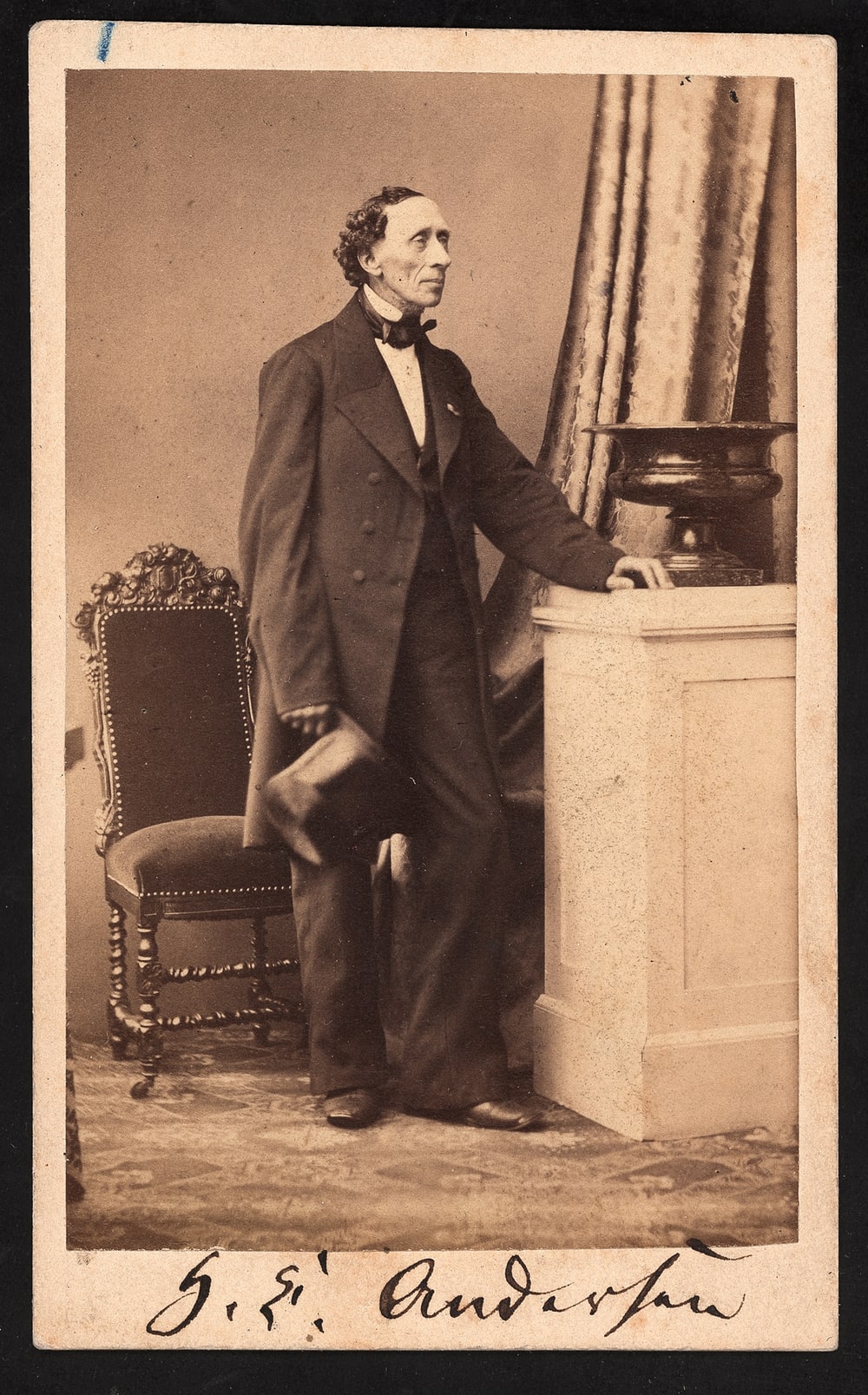
- Wikimedia Commons, “HCA 1862 by Georg E. Hansen.jpg” — archival photograph, photographer and date, with provenance attributed to Odense's Andersen museum.