Ephraim Mackellar begins with the confidence of a man who has kept the papers. He knew the Master of Ballantrae, served his brother, traveled with them, and witnessed the catastrophe. Other people have rumors; he has evidence. In the first chapter of Robert Louis Stevenson's novel, he promises to report events “like a witness in a court.”[1]
Then Stevenson gives that witness a story too large for his position in it. Mackellar must borrow another man's adventures, admit his own violence, and assemble testimony from people whose interests differ from his. The excitement comes partly from following the brothers across the world. A quieter suspense accompanies it: how much authority can a narrator keep while showing us the limits of his authority?
This essay discusses the ending.
The papers arrive with a promise
The novel appeared in book form in 1889; its serialization had begun the previous year. The familiar preface about discovering Mackellar's manuscript came later: the Stevenson bibliography dates its first publication to the Edinburgh Edition in 1898. The Project Gutenberg text used here includes it. That distinction matters because this later frame changes how we enter the account.[1][2]
In the preface, an editor visiting an Edinburgh friend encounters a sealed packet of family papers. Mackellar has stipulated that it remain unopened for a century. After reading it, the friend proposes improving its scenery, characters, and style; the editor insists on publishing it as it stands. The exchange makes apparent roughness a guarantee of authenticity. We are invited to believe that someone has preserved evidence rather than polished a performance.[1]
Yet Mackellar's first chapter immediately supplies a motive for the performance. He loved Henry Durie, the younger brother, and believes that telling the truth will repay a debt to his memory. Devotion gives his testimony warmth and urgency. It also gives it a destination before the evidence has been heard.
The crucial distinction is between knowing many facts and knowing what they mean. Mackellar's access to the family establishes the first. The arrangement of the novel keeps testing the second.
An adventure interrupts the household
The brothers' division begins in 1745. James, the elder and the Master of the title, joins the Jacobite cause; Henry stays behind. When James is reported dead, Henry's life becomes entangled with the estate and with Alison, who had been intended for James. Mackellar can describe the household's injuries. He cannot personally supply the missing brother's years abroad.[1]
For those, Chapter III hands the page to the Chevalier de Burke. The change is immediately pleasurable. A land steward's account opens into flight, piracy, and hazardous travel, told by a soldier of fortune who admires James's abilities. Readers temporarily inhabit the attraction that Mackellar spends so much effort resisting.
But the handover is qualified before it occurs. Mackellar says Burke's oral account to the family was “a very varnished version”; the extract he now supplies is meant to stand in its place. We therefore encounter several acts of selection: Burke's recollection, Burke's performance before the household, and Mackellar's decision about what to reproduce.[1]
This is more interesting than a simple contest between a truthful narrator and a liar. A person can accurately describe courage while overlooking cruelty. Another can correctly identify cruelty while resenting its owner's charm. Changing speakers changes the qualities that receive attention, even when the underlying person remains the same.
Stevenson's account of composing the novel gives the interruption a practical origin. He wanted a story spanning distant countries, but knew India largely through books. A secondary narrator offered a way to cross that territory lightly. Burke's admiring moral simplicity then became part of the design.[3] A solution to the author's problem of distance becomes the reader's problem of judgment.
The witness puts out his foot
Chapter IX makes Mackellar's position more uncomfortable. At sea with James, he listens to a story about a revenge contrived to look like an accident. The ship pitches; James balances precariously; the listener's hatred acquires an opportunity. Mackellar thrusts out his foot, trying to send him overboard. James escapes.[1]
The placement of the embedded story matters. Earlier, Burke's narrative brought James's distant conduct into the family account. Here, James's own storytelling helps precipitate an action by the man recording him. A tale inside the tale reaches out and changes its teller's listener.
Mackellar confesses the attempt. That candor deserves weight: a narrator intent only on looking innocent could have omitted it. But confession does not restore his old position. We now know that the person arranging the evidence has wanted one of its principal subjects dead.
James, meanwhile, can recognize murderous loyalty as loyalty. His response unsettles the steward's moral categories because he finds something to admire in the very act Mackellar condemns in himself. The scene gives neither man a clean victory. It makes the language of faithful service difficult to separate from the violence it may license.
Three sources cannot become one pair of eyes
By Chapter XI, Mackellar openly describes the work of compilation. His account of the expedition into the American wilderness draws on Mountain's written statement, conversations with Secundra Dass, and further conversations with Mountain. He acknowledges inconsistencies. Mountain's written version suppresses criminal responsibility; his spoken disclosures are more candid because he takes Mackellar for an accomplice.[1]
The same man can therefore become a different source when he imagines a different audience. The novel has taught us to notice this with Burke; now the distinction is essential to reconstructing the approach to the ending.
Mackellar puts the incidents in order, but order cannot erase how he obtained them. His smooth sequence is an editorial achievement. Its clarity should not be mistaken for the experience of a single observer who saw everything happen.
Then, at the grave, Stevenson makes even direct observation insufficient. As Secundra works to revive the buried James, Mackellar sees the Master's eyes open. Henry collapses. The steward turns to the brother he loves and discovers that he is dead. Other people subsequently report further movements by James, but Mackellar cannot certify them: “I know not, I was otherwise engaged.”[1]
The understatement is devastating. He was engaged in the central obligation of his life. His failure to watch everything follows from the same attachment that made him write everything down.
We need not settle the strange physiology of the apparent revival to see what the scene does formally. Two events compete for one witness's attention. The more faithfully Mackellar serves Henry, the less completely he can observe James. At the point where an authoritative account seems most necessary, the narrator has to give us a boundary.
What the sealed packet preserves
Stevenson recalled that the image of a buried man returning in the frozen wilderness helped set the whole book in motion. He imagined repeated disappearances building toward that last, grim return.[3] The ending was therefore part of the design early on, however startling it feels when reached through Mackellar's practical prose.
The manuscript frame promises that a long-kept packet will finally explain an old scandal. What it delivers is more intimate: the record of a person trying to explain events while remaining bound to the people inside them. Mackellar can preserve what he saw, identify what he borrowed, and admit where he turned away. The most trustworthy moment in his history may be the one in which he tells us what he cannot know.
Sources
- Robert Louis Stevenson, The Master of Ballantrae (1889), Project Gutenberg — primary text including the later preface; especially Chapters I–III, IX, and XI–XII.
- The Robert Louis Stevenson website, “Works Chronology” — serialization, 1889 book publication, and the preface's first publication in the 1898 Edinburgh Edition.
- Robert Louis Stevenson, “The Genesis of ‘The Master of Ballantrae,’” in Essays in the Art of Writing, Project Gutenberg transcription of the 1905 Chatto & Windus edition — the wilderness ending, geographical scope, and creation of Burke.
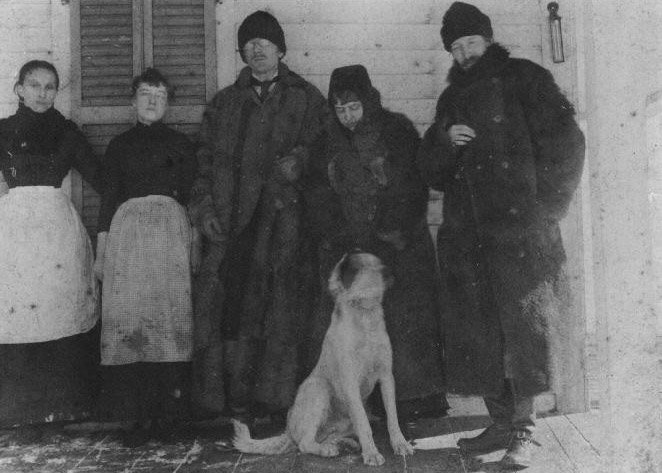
- The Robert Louis Stevenson website, “New York and Saranac” — the author's 1887–88 stay and archival photograph identified as “RLS at Saranac Lake (1887).”