The force of The Red Badge of Courage does not come from military explanation, patriotic uplift, or a trustworthy map of the battlefield. Stephen Crane gives almost none of those things. Instead he writes combat as a damaged field of perception: rumors swell before orders arrive, smoke turns whole units into guesses, color flashes where strategy ought to be, and Henry Fleming's mind keeps talking in borrowed heroic language long after his body has begun to panic.[1] That is why the novel still feels modern. Its subject is not war as an organized pageant. It is war as a crisis in what language can honestly register.
Britannica calls the book Crane's masterwork and notes that it became a landmark because it tells war through the psychological turmoil of an ordinary soldier rather than through the commanding view of generals.[2] That description gets to the center quickly. Crane was only twenty-five when the novel appeared in 1895, and Britannica's biography emphasizes the odd fact that he had not yet seen battle firsthand when he wrote it.[2][3] Yet the absence of firsthand command experience helps explain the book's style. Crane is not trying to reconstruct a campaign in staff-officer terms. He is inventing a prose method for confusion, vanity, fear, and recoil.
Britannica's broader account of American naturalism makes another useful point: Crane was an impressionist as well as a naturalist, a writer who made details and their arrangement embody a vision of human beings overwhelmed by circumstance.[4] In The Red Badge of Courage, that impressionism matters sentence by sentence. Henry does not inhabit a stable moral world that battle later disturbs. He inhabits a world of impressions so unstable that courage itself has to be redefined inside them.
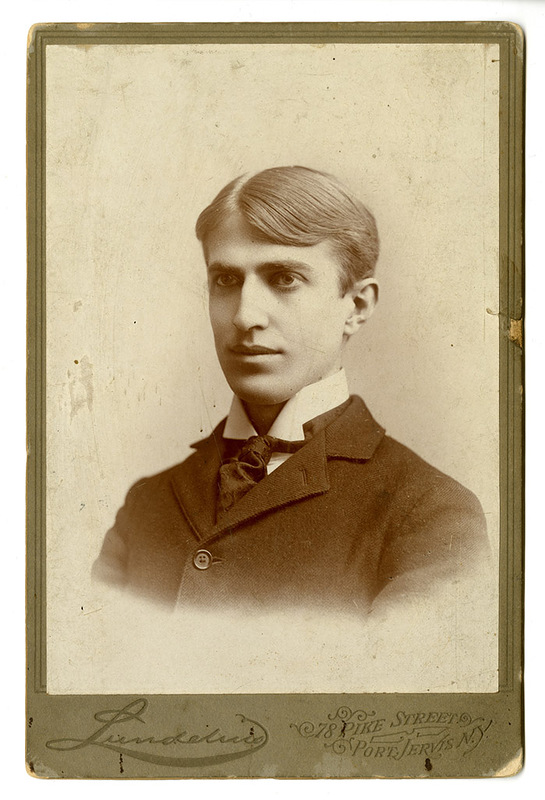
Image context: the cover uses a real 1896 cabinet photograph of Crane from Wikimedia Commons rather than a Civil War battlefield engraving or reenactment image. That choice keeps the article anchored in literary method. The novel's deepest drama happens inside a young writer's invention of battle-consciousness: a face, a nervous system, a vocabulary of panic and bravado, and the struggle to make sensation legible without restoring false nobility too soon.[5][6]
1) The novel opens in rumor, not in command
Crane's first chapter tells you immediately that battle will arrive as atmosphere before it arrives as history. The army lies waiting while camp rumor multiplies through chains of half-heard authority, one soldier citing another who cites another.[1] This matters because the novel begins by treating information as texture rather than fact. Henry does not step into a clear cause or a noble plan. He steps into mud, fog, delay, waiting, and the unstable speech of men who want movement partly because stillness is unbearable.[1]
That opening already breaks with cleaner war narrative. A conventional heroic novel might begin with mission, banner, or oath. Crane begins with collective nerves. The regiment exists as a crowd of listeners and speculators before it exists as an instrument of action. The reader therefore learns battle the same way Henry does: indirectly, nervously, and through language that advertises certainty only because certainty is absent.
2) Henry thinks in second-hand heroics until the body revolts
Henry's interior life is one of the novel's sharpest technical achievements. He does not simply feel fear. He keeps narrating himself in advance, asking whether he will run, whether he will prove equal to the image of the soldier he has already carried into camp.[1] That self-address is full of theatrical residue. He wants to become the hero of a story whose phrases have been prepared before experience begins.
Library of America describes Crane as a writer who looked steadily at the unceasing civil war inside American life.[5] The Red Badge of Courage gives that pressure an inward form. Henry is divided against himself long before he meets the enemy. One part wants spectacle, distinction, and the "red badge" that would certify masculine bravery. Another part calculates escape. Crane's style lets those parts coexist without smoothing them into one mature consciousness. Thoughts flare, reverse, justify, and accuse. The result is not a stable character sketch but a syntax of self-division.
That is why Henry's flight matters so much. It is not only a moral event. It is a linguistic collapse. The public script of glory cannot survive contact with the body's refusal. When Henry runs, the prose has already prepared the act by making perception jagged, noisy, and anti-ceremonial.[1][2] The battlefield becomes exactly the place where inherited rhetoric fails first.
3) Crane writes armies as weather, animals, and color-fields
One reason the novel still feels so unlike older battle fiction is Crane's refusal to keep the human figure sovereign. Men become lines, surges, fragments, and instinctive masses. Regiments move like animals. Smoke thickens into weather. Flags flare out of haze. The enemy appears less as a named political opponent than as pressure, noise, and sudden material force.[1]
Britannica's naturalism overview helps here because it places Crane among writers attentive to symbolic detail and impressionistic arrangement.[4] In this novel, color does moral work without becoming allegory in any simple way. Red is wound, rage, heat, face, banner, exposure. Blue is uniform, mass, belonging, a kind of temporary shelter.[1] The book's battlefield vision is therefore unstable in a productive sense. Readers do not receive a clean diagram of who stands where. They receive the sensory violence through which Henry keeps trying to discover whether he is still inside the army or outside it.
This is also why the crowd scenes are so strong. Crane does not write comradeship as a set of noble speeches. He writes it as momentum, contagion, and temporary shared direction. Henry is often brave when the group is moving and spiritually stranded when he is alone. Courage in this world is never purely private virtue. It is tied to rhythm, proximity, and the body's relation to other bodies under fire.
4) The famous wound is an irony machine, not a medal
The title's cruelest stroke is that Henry's "red badge" does not first arrive through glorious combat at all. He is struck by a fleeing soldier from his own side.[1][2] The wound gives him the look of bravery before it gives him the reality of it. Crane turns the whole culture of martial appearance inside out in one move. The sign of courage can be earned by confusion, accident, and shame.
That irony matters because the novel does not simply debunk heroism and stop there. Henry later returns to the fighting and acts with real steadiness. But the title ensures that any later courage will be contaminated by the earlier counterfeit.[1][2] Crane does not permit innocence after panic. He makes maturation pass through fraud, self-deception, resentment, and exhausted recognition.
Henry's mind keeps trying to repair the gap by telling stories about itself. That habit never fully disappears, which is part of the book's honesty. Courage is not a pure moral essence waiting to emerge. It is something Henry feels through aftershocks: after running, after shame, after a false wound, after the crowd has carried him back into action. Crane's style keeps every one of those layers alive at once.
5) The ending keeps the triumph uneasy
By the close, Henry has undeniably changed. He has returned to battle, endured fear, acted under fire, and shed some of his theatrical innocence.[1][2] Yet the ending does not read like a patriotic cleansing. Crane lets pride rise, then shadows it with memory: the flight into the woods, the fantasies, the uglier corners of self-protection.[1] Henry's growth is real, but it is not stainless.
That uneasy finish is one reason the book remains durable. Crane does not deny that courage exists. He denies that courage can remain separable from panic, vanity, accident, and the pressure of belonging. The novel's style enforces that denial. Battle becomes readable only after language breaks formation, after public words fail, after color and motion and bodily recoil have done their work on consciousness.
So the real modernity of The Red Badge of Courage lies not in antiwar opinion alone, nor in psychological depth by itself, but in prose method. Crane writes the battlefield as a place where sensation outruns ideology and where the self learns too late that the stories it had prepared for itself were thinner than smoke. What survives after that lesson is not grandeur. It is a harder, more chastened form of perception, and from that perception Crane builds one of American literature's most exact studies of courage after illusion.[1][2][3][4][5]
Sources
- Stephen Crane, The Red Badge of Courage: An Episode of the American Civil War, Project Gutenberg full text.
- Encyclopaedia Britannica, "The Red Badge of Courage" (novel overview, publication context, and psychological focus).
- Encyclopaedia Britannica, "Stephen Crane" (biography, publication context, and literary significance).
- Encyclopaedia Britannica, "American literature - The naturalists" (Crane as impressionist and naturalist).
- Library of America, "Stephen Crane" (author page and career context).
- Wikimedia Commons, "File:Stephen Crane by Lundelius studio.jpg" (source page for the lead archival photograph).