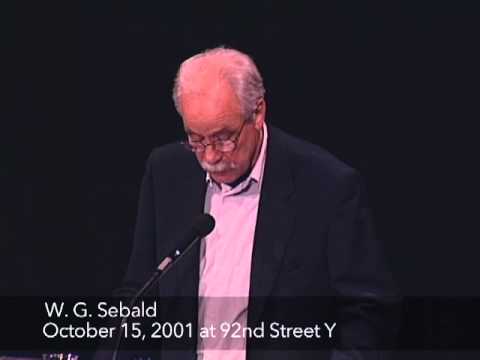
On October 15, 2001, W. G. Sebald stood at the 92nd Street Y and introduced a newly published book to an American audience. The book was Austerlitz, which had appeared in German earlier that year and had just come out in the United States.[1][2] What survives in the recording is not only a literary reading. It is a late self-explanation conducted almost accidentally. Sebald first summarizes the plot in plain terms, then reads for roughly twenty-five minutes from the Marienbad section of the novel, and finally answers a question about photographs in a way that unlocks nearly everything his prose had been doing for a decade.[1][3][4]
The archive matters because Sebald's live voice is less theatrical than his reputation. Readers often arrive with the adjective already prepared: haunted, spectral, melancholy, digressive, elegiac. All of that can be true, but the recording shows what those abstractions are made of. They are made of patient scene-setting, of withheld explanation, of public interiors where people lose and half-recover themselves, of old black-and-white pictures that interrupt the forward motion of narrative, and of a prose rhythm that makes history feel less like a lesson than like weather closing in.[1][3][5]
That is why the clip belongs inside a literature archive rather than beside generic author footage. The video lets you hear Sebald building a relation between architecture and memory before interpretation arrives. Liverpool Street Station, a state-owned spa hotel, a school-exercise register, a porter dragging suitcases up the stairs, a forgotten photograph in a box: these are not decorative details. They are the very medium through which his fiction allows catastrophe to appear without flattening it into slogan.[1][3][4][5]
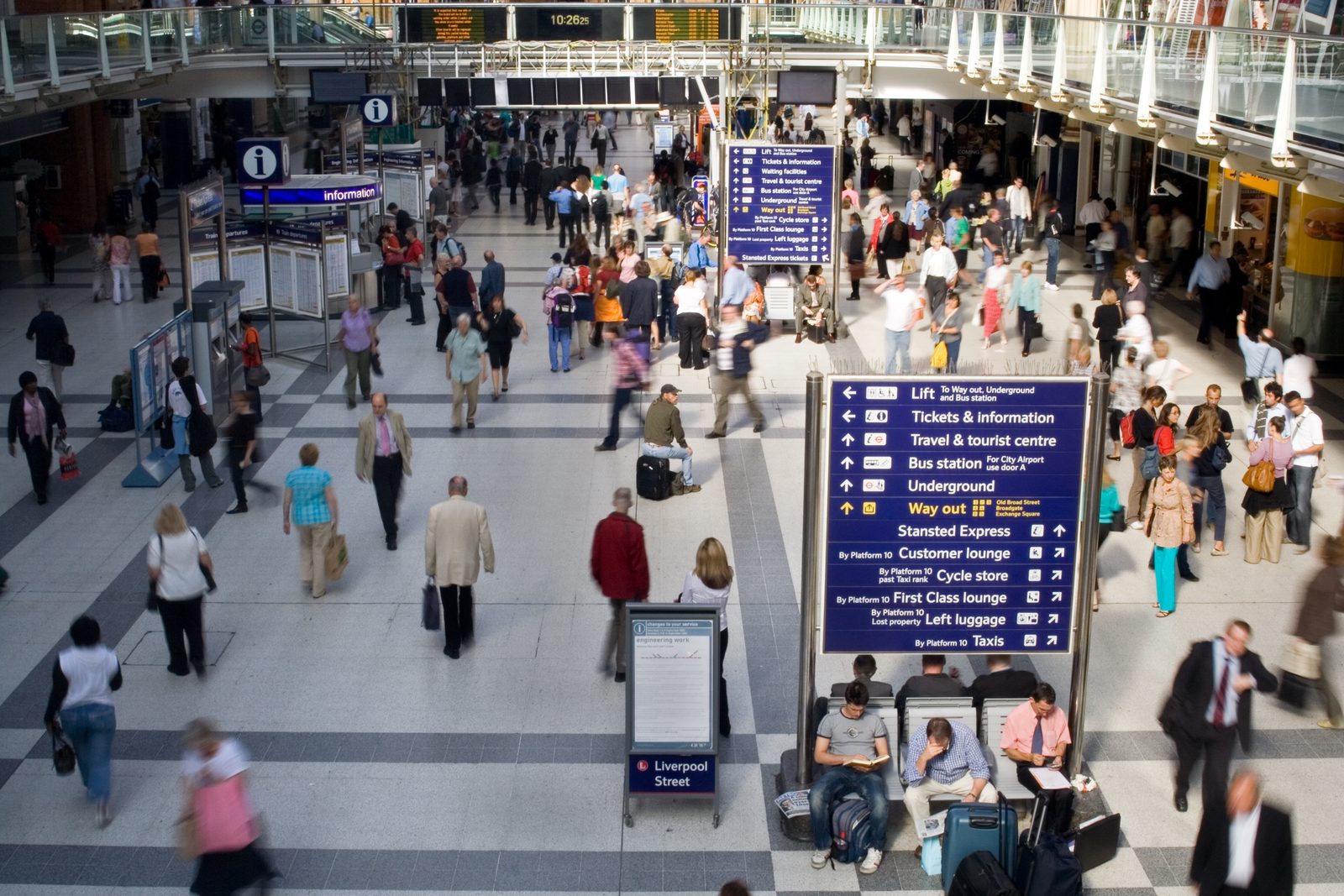
Image context: the cover uses a real documentary photograph of Liverpool Street Station from Wikimedia Commons. That choice fits this article because Sebald's opening summary of Austerlitz treats the station as more than a location. It becomes the public threshold where anonymity, rescue, erasure, and the afterlife of transit first gather around the child Austerlitz.[1][6]
Historical context: by late 2001, Sebald had already turned exile, photographs, and delayed knowledge into one form
The University of East Anglia's archive record is useful here because it states the institutional facts without mythologizing them. Sebald taught at UEA, became professor there in 1987, and in 1989 founded the British Centre for Literary Translation. The same record lists the sequence of books through which English-language readers came to know him: The Emigrants, The Rings of Saturn, Vertigo, and finally Austerlitz in 2001.[2] The UEA materials also make clear that his audiovisual archive now exists as a real collection rather than as an aura around a dead writer: eight boxes, a ring binder, and partially digitized materials spanning 1975 to 2001.[2]
That institutional history matters because Sebald's work is often described as if it had arrived fully formed from nowhere. It did not. UEA's commemorative essay on his legacy describes a writer who taught in East Anglia for three decades, worked across criticism, fiction, poetry, radio, and image practice, and left behind not a monument but an accumulation of traces, photographs, office views, boxes, and archival remains.[3] That is exactly the right frame for the 92Y reading. It catches Sebald not as a metaphysical brand but as a working writer still explaining a new book in ordinary prose before his syntax closes around it.
New Directions' description of The Emigrants remains one of the clearest short accounts of what Sebald had already achieved before Austerlitz: lives in exile reconstructed through memory, documents, diaries, routes of travel, and those "enigmatic snapshots" that keep documentary pressure and fictional drift in the same field.[5] The 92Y reading should be heard as a late extension of that method. By 2001 Sebald had found a way to make displacement legible not by declaring its themes, but by letting rooms, stations, landscapes, and paper relics hold the burden of what cannot be said all at once.[1][4][5]
Harvard Review's 1998 archive interview helps explain the ethical side of that method. There the interviewer observes that Sebald repeatedly finds objective correlatives for what cannot be said directly, and Sebald answers by speaking of crystallization, remains, and the hardening of former lives into literature.[4] The 92Y recording is valuable because it lets you hear that theory in practice. Austerlitz is introduced as plot, then transmuted into atmosphere, then clarified in the Q&A as an art of photographic interruption and partial rescue.[1][3][4]
Video provenance
The embedded video is the official upload from The 92nd Street Y, New York. Its description identifies the event as W. G. Sebald at 92nd Street Y, October 15, 2001, and places the upload inside the institution's "75 at 75" archival project, which released recordings from the Y's literary archive together with brief response essays by later writers.[1] That provenance is unusually strong for a literary video: original venue, original date, named institution, and explicit archival-restoration context. The UEA archive record and legacy essay give the broader afterlife: Sebald's audiovisual materials now sit inside a preserved university collection, and the public clip is one surviving branch of that larger record.[2][3]
Around 0:20, Sebald tells you the book as a station story before it becomes a trauma story
The first striking thing is how unceremoniously Sebald frames Austerlitz.[1] He says the title is not the famous battle but the name of the main character. He gives the child-history plainly: Prague, the Kindertransport, Liverpool Street, Welsh foster parents, the deprivation of identity, the later return to Prague in search of origins.[1] There is no attempt to inflate the moral register through performance. Instead he builds the novel out of public waypoints. The station comes first. The biography arrives through transit.
That ordering is important. Sebald does not begin by announcing trauma as private feeling. He begins by locating a person inside systems of movement, rescue, bureaucracy, and historical violence.[1][2] Liverpool Street is described as a place formerly famous for its gloom, a threshold that seemed to many travelers like an entrance to hell.[1] Whether or not a reader already knows the novel, the oral emphasis falls on architecture before confession. Sebald wants the room, the route, and the public machinery of transfer in place before he lets the inner history thicken.
This is where the station photograph matters as more than illustration. Sebald's work repeatedly treats built spaces as vessels that retain what people cannot carry clearly in consciousness.[1][3][5] A platform, a waiting room, a hotel corridor, a fortification, an archive box: these are not merely backgrounds. They are storage devices for delayed recognition. In the 92Y reading, the explanatory summary already contains the whole poetics in miniature.
Around 4:32, Marienbad arrives as atmosphere before it arrives as explanation
When Sebald turns from synopsis to the chosen passage, the prose immediately deepens into a different medium. The approach to Marienbad unfolds downhill through darkened wooded slopes; the town appears sparsely lit; the hotel staff seem to move in a denser atmosphere than everyone else; forms are filled out, registers inscribed, keys found with difficulty, and luggage hauled laboriously upstairs by a porter whose exhaustion is rendered with almost comic exactness.[1] The passage is funny in places, but it is never merely comic. What Sebald makes audible is a world lagging under its own historical sediment.
The reading matters because his voice refuses false emphasis. He does not dramatize the sentences from outside. He lets them keep gathering furniture, wallpaper, stair landings, medical schedules, water cures, and bureaucratic delay until the place itself begins to feel metabolically strange.[1] That flatness is not neutrality. It is a way of preserving pressure. The more level the delivery, the more the listener notices how the sentence keeps refusing release.
This is why the passage feels so Sebaldian without requiring the label. Marienbad is not simply remembered; it is made available as a zone where several times coexist badly: the Belle Epoque spa residue, Cold War public ownership, childhood recollection inherited through Vera, and Austerlitz's adult belatedness.[1] UEA's essay on Sebald's archive describes the photographs in his prose as clues to a mystery not yet revealed.[3] The Marienbad reading performs a similar operation in sound. Description does not solve the past. It keeps the past in suspension long enough for the listener to feel how many layers are present at once.
Around 28:06, the question about photographs unlocks the whole performance
The archive becomes most valuable in the Q&A. Asked about the relation between text and photographs, Sebald says that the pictures often precede the writing: he had collected scraps of paper and old photographs for years before he began to write, so they already possessed a kind of precedence in his imagination.[1] He then gives three reasons for including them, and together they form a compact manifesto.
First, the photographs interrupt narrative momentum. Sebald says books tend by nature toward an apocalyptic structure, a slide down the negative gradient toward the end, and the pictures help hold that flow up.[1] This is one of the most useful remarks he ever made about his own form. The photographs are not there only to corroborate content. They are brakes. They make the reader stop, look, and endure delay. In a body of work obsessed with catastrophe, delay is an ethical instrument.
Second, the older black-and-white images carry an appeal that is almost a demand. Sebald says they ask to be addressed as representations of lost lives, and he adds that writing ought to be an attempt at the saving of souls in a nonreligious sense.[1] That phrase is as close as the recording comes to open declaration, and even here he refuses theological grandeur. "Saving" means giving the dead a little more resistance against smooth disappearance. It means refusing the speed with which history summarizes them away.[1][3][4]
Third, the photographs are both truth-tokens and instruments of deceit. Sebald notes that readers believe photographs more readily than almost any other form of evidence, which lets images certify a story as truth-adjacent; then he admits that he has tampered with some of them, including visual material in The Emigrants, turning the book into a game of hide-and-seek between affirmation and forgery.[1][5] That admission is crucial. It clarifies that his ethics of memory does not depend on naive documentary faith. What matters is not purity of evidence but the form's capacity to reactivate attention toward lives otherwise headed for oblivion.
Why this archive still matters
The 92Y recording matters because it strips away the easiest way of talking about Sebald. Instead of praising the aura, it lets you hear the mechanism. Plot is introduced through stations and state systems. Memory is re-entered through atmosphere and physical detail. Photographs interrupt the rush toward conclusion, call the dead back into address, and at the same time expose how easily evidence can be staged.[1][3][4][5]
That is why this is a genuine archival spotlight rather than a prestige clip. The video gives access not to celebrity but to method. Sebald reads as if prose were a way of arranging relay points between the living and the lost: a station concourse, a spa hotel, a stray photograph, a box in an archive, a sentence that will not let history become smooth. The recording remains worth watching because it teaches, in public and without jargon, how literature can slow the catastrophe just enough for memory to become visible.[1][2][3]
Sources
- The 92nd Street Y, New York, "W. G. Sebald | 92Y Readings," YouTube video, recorded October 15, 2001 and uploaded July 18, 2013.
- University of East Anglia Archive Collections Catalogue, "WGS - W.G. Sebald Audio-Visual Collection."
- University of East Anglia Stories, "WG Sebald at the University of East Anglia: A View Between Thresholds."
- Harvard Review, "From the Archives: An Interview with W. G. Sebald."
- New Directions Publishing, "The Emigrants by W.G. Sebald."
- Wikimedia Commons, "File:Liverpool Street Station.jpg" (source page for the lead photograph used in this article).
Editor's Pick Review
This is the strongest editor-pick candidate from the last 24 hours because it combines unusually high source density with a piece of archival media that is not ornamental. The article turns a 92Y recording into a readable account of Sebald's method: stations and hotels carry memory before psychology arrives, photographs slow narrative catastrophe without becoming naïve proof, and the video annotation gives the reader a reason to watch rather than merely admire the name attached to it.
It also passes the stricter visual bar cleanly. The Liverpool Street Station photograph is immersive, topic-grounded, and historically adjacent to the argument; it gives the piece a public interior rather than an analytical diagram or decorative abstraction. The Chinese version keeps the same pressure and rhythm with strong literary control, preserving the archive logic while sounding like finished Chinese prose rather than a mapped translation.