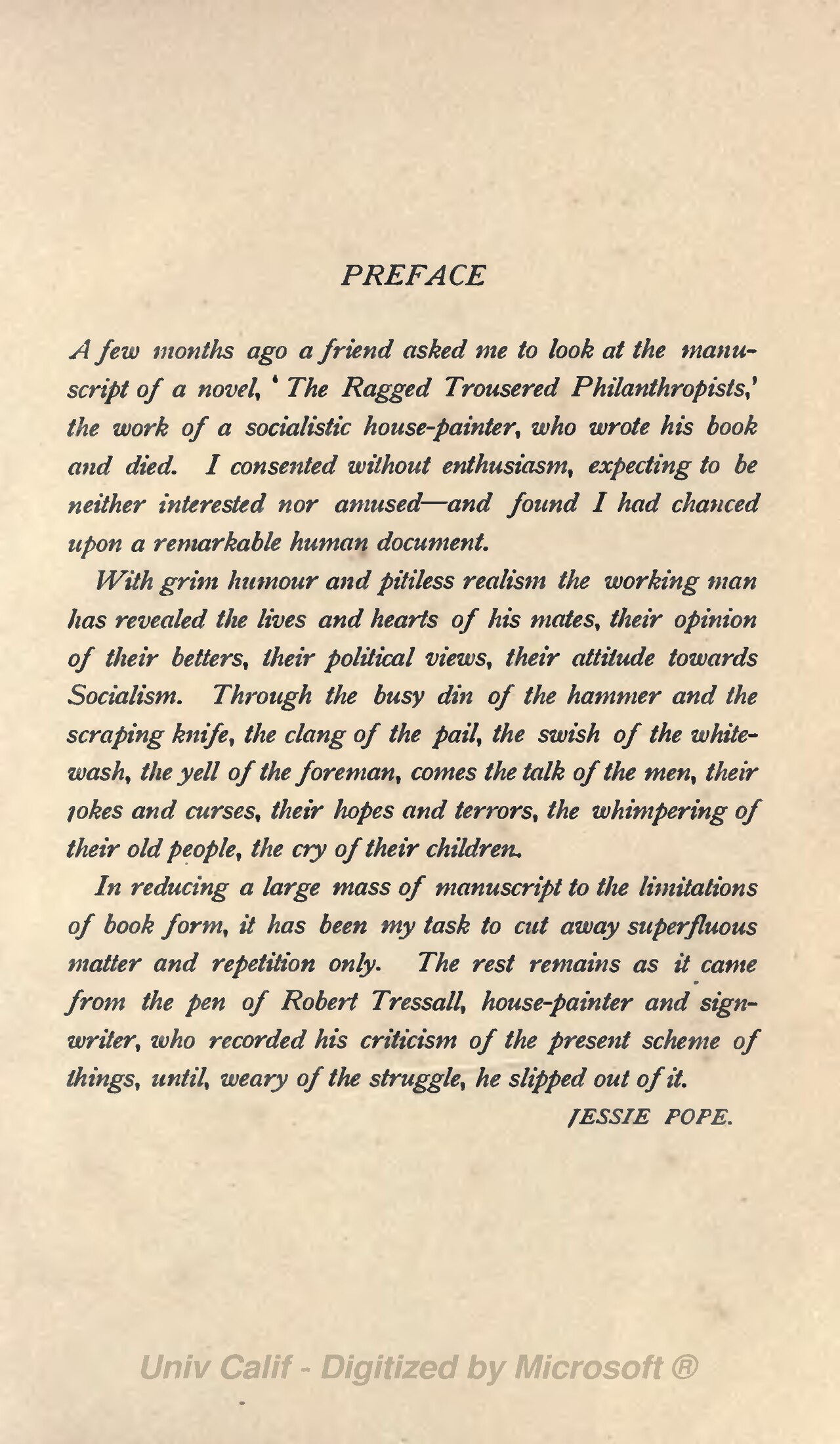
Jessie Pope told the first readers of The Ragged Trousered Philanthropists that she had removed “superfluous matter and repetition only.” The assurance appears in her preface to the 1914 edition. Turn to that edition’s last page, then compare the ending restored in 1955, and the word only becomes difficult to accept.[1][2]
In one version, the painter Frank Owen sits alone, terrified about his family’s future. In the other, he stands at a window with his family, waving to a departing friend. Between these positions lies more than a change of mood. The novel’s publication history altered what its account of poverty allowed readers to imagine happening next.
Robert Tressell, the pen name of Robert Noonan, died in 1911. His daughter Kathleen brought the manuscript to Pope’s attention; Pope took it to her publisher, Grant Richards, and prepared a shortened text. The novel entered print three years after its author’s death. Fred Ball’s recovery of the manuscript eventually made possible the much fuller edition published by Lawrence & Wishart in 1955.[3]
The discussion below includes both endings.
A welcome with conditions
Pope’s preface is an act of advocacy. She admits that she had expected little from a house painter’s manuscript and describes her surprise at finding a “remarkable human document.” She hears the book through its workplace sounds: tools, pails, the foreman’s voice, the men talking. Her introduction makes a case for attending to lives that a publisher’s audience might otherwise overlook.[1]
But document also offers a particular way of receiving the book. It emphasizes testimony: here is a worker showing outsiders what his world looks like. That framing can accommodate the suffering more easily than the sustained argument about how the world might be reorganized. This is a tension in the preface’s invitation, rather than proof of a concealed editorial motive.
Nor did the abridgment erase every political argument. The 1914 contents still include the Great Money Trick, Owen’s demonstration of exploitation through bread, knives, and a miniature economy.[1] Readers could encounter the novel’s challenge to capitalism in the shortened book. The decisive question is what happens when that challenge reaches the end of its available pages.
The last page becomes a verdict
Chapter XXXVI of the 1914 edition begins with a starving plasterer found in the road. It moves from this public death into Owen’s home, where deprivation is becoming visible in his son Frankie’s body. The boy quietly abandons a strength exercise he can no longer manage. He does not tell his parents because he does not want to distress them.[1]
The scene makes scarcity a problem of communication as well as food. Each member of the household tries to protect the others by keeping something back. Affection becomes a reason to conceal how badly things are going.
Owen stays up to finish a sign, then suffers a frightening hemorrhage. Alone in the silence, he imagines his son’s future under employers who will wear him out. His thoughts turn toward killing his family and himself. The edition stops with his belief that it would be merciful to “take them with him.”[1]
The distinction matters: this ending shows a contemplated act, not a completed one. Its force comes from withholding any subsequent event that might challenge Owen’s despair. A reader can resist his reasoning, but cannot turn another page to see it interrupted. The editorial stopping point gives a moment of extremity the weight of the book’s final judgment.
That is a substantial change even without a newly invented sentence. Where a narrative stops determines which of its possibilities is left standing.
What the restored future asks of Owen
The fuller text’s final chapter, Chapter 54, retains the illness and insecurity. Owen has not become healthy or prosperous. What changes is the presence of other people, and the tasks their presence makes imaginable.[2]
Barrington explains that he comes from a wealthy family and plans to return with a socialist campaigning van. Owen immediately finds a use for his trade: “I could paint some posters and placards.” Frankie wants to distribute handbills.[2] A political future begins as a practical allocation of work. The painter’s skill, previously sold under punishing conditions, can help address the conditions themselves.
Another interruption is smaller and more intimate. Owen and Nora have taken in a baby. When her fingers close around his, he recognizes that he cannot carry out the destructive plan he has entertained. The narrative allows dependency to exert a claim against his conviction that he already knows the merciful outcome.[2]
Barrington also leaves money. His letter asks Owen to receive it in the spirit in which he would offer help if their circumstances were reversed. That imagined reciprocity matters: the gift addresses him as someone capable of giving, although he presently needs to receive.[2]
There is an obvious difficulty here. Relief still arrives through a wealthy man’s generosity. The novel has not demonstrated a collective escape from the arrangements it condemns. Its last scene holds immediate assistance beside a promised political campaign, and the distance between them remains open. The restored ending is more interesting when that distance is allowed to show.
At the window, the family watches Barrington’s train cross the bridge. Beyond it, empty houses and darkening shops remain visible. Owen’s final vision of a socialist future rises out of this unrepaired town.[2] Hope has returned to the book, but as an expectation that exceeds what the plot has accomplished.
Readers arrived before restoration
The shortened novel had a substantial life of its own. A still shorter edition followed in 1918; Penguin’s inexpensive paperback appeared in 1940, well before the manuscript-based restoration.[3] The book’s readership cannot be divided neatly into people misled by the early text and people finally enlightened by the later one. The abridged versions helped carry the argument into circulation.
Later criticism also resists treating restoration as the removal of every difficulty. In her 2020 essay, Sally Minogue values the novel’s attention to working people’s homes and inner lives while questioning how often its ordinary workers appear intellectually passive. She identifies a pressure within its politics: a future built on changing consciousness must remain possible for people whom the satire repeatedly makes resistant to change.[4]
That criticism sharpens the difference between the endings. The 1914 stopping point leaves Owen imagining that he can protect his family only by removing their future. The fuller ending lets relationships interrupt that certainty and gives him a modest part in a project whose success is still ahead of him.
Pope helped the manuscript become a book people could read. Ball helped readers encounter a future those first published pages had closed off. Both facts belong to its history. So does the small, consequential discovery that restoring an ending can restore a character’s capacity to be answered.
Sources
- Robert Tressell, The Ragged Trousered Philanthropists. Grant Richards, 1914 — Jessie Pope’s unpaginated preface, Chapter XV and Chapter XXXVI; digitized University of California Libraries copy, available through Wikimedia Commons.
- Robert Tressell, The Ragged Trousered Philanthropists, fuller text associated with the 1955 Lawrence & Wishart edition — especially Chapter 54, “The End”; transcription by Einde O’Callaghan for the Marxists’ Internet Archive.
- Wordsworth Editions, “Robert Tressell” — Kathleen Noonan and Jessie Pope’s roles, the abridged editions, the 1940 Penguin publication, and Fred Ball’s manuscript recovery.
- Sally Minogue, “Sally Minogue celebrates The Ragged Trousered Philanthropists.” Wordsworth Editions, 2020 — domestic detail, political characterization, and the tension between satire and changing consciousness.