The men in these ghost stories check things. They send messages, inspect fastenings, search for concealed entrances, and ask another person to look. Their habits ought to make a railway cutting and a ship’s cabin reassuring places. Instead, each careful check makes the trouble harder to dismiss.
Charles Dickens’s “The Signal-Man” and F. Marion Crawford’s “The Upper Berth” arrange this discomfort differently. Dickens gives a conscientious worker information he cannot use. Crawford gives an experienced passenger the proof he demands, at considerable cost to his body. Read together, the stories ask how much protection knowing something actually offers.[1][2]
Both emerged from the Christmas publishing trade. Dickens’s story appeared in the 1866 extra number of All the Year Round, within Mugby Junction. The publishers’ note to Crawford’s 1894 book edition explains that its two stories had previously appeared in Christmas annuals.[1][2] Their machinery of suspense was made for readers who could enjoy a dangerous journey while staying comfortably at home.
Both endings are discussed below.
The person who knows the equipment
Dickens opens with a visitor calling down into a railway cutting: “Halloa! Below there!” The signalman looks along the track instead of up toward the speaker. Before we know anything about a ghost, an ordinary act of communication has gone slightly wrong.[1]
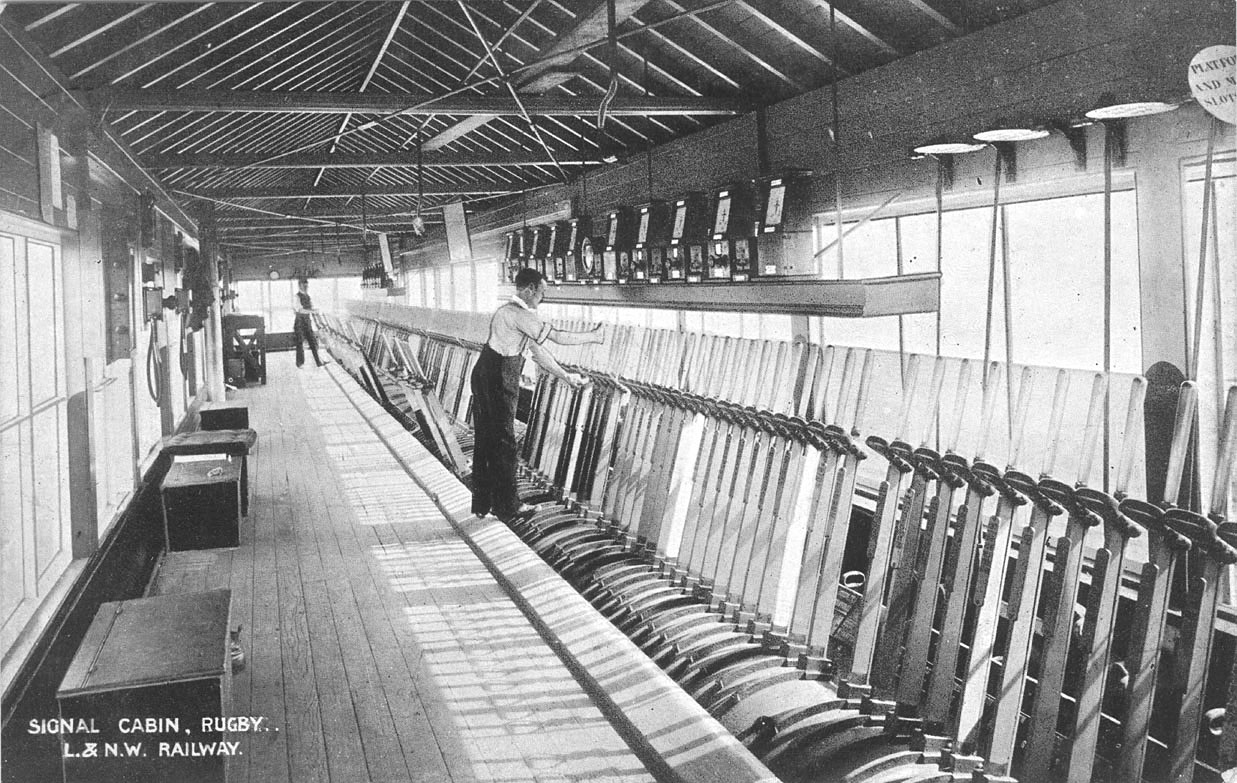
The visitor descends through wet stone into a confined world of rails, a tunnel, and a red light. Yet the signalman’s box contains familiar instruments of accountability: a record book, a telegraph, a bell. The man breaks off conversation immediately whenever duty requires his attention. Dickens lets the narrator observe his competence before hearing his extraordinary story. We acquire reasons to trust the witness before being asked to trust the haunting.[1]
Crawford makes credibility more social, and more comic. At a dull gathering, Brisbane rescues the conversation by announcing that he has seen a ghost. The frame narrator has already inspected his powerful hands, shoulders, and chest. His physical strength becomes a kind of advance guarantee: surely this man is difficult to frighten. Once Brisbane begins his account, his familiarity with Atlantic crossings supplies another credential. He knows the ships, the routines, and the disappointments of a cabin’s fittings.[2]
But assurance can make a person slow to listen. When the steward reacts strangely to his cabin assignment, Brisbane suspects drink or dissatisfaction with his tip. Later, faced with a porthole that will not remain closed, he angrily accuses the man of negligence. He keeps translating another person’s fear into a defect in service. His experience helps him recognize ordinary inconvenience; it also encourages him to insist that everything must belong to that category.[2]
The contrast matters. Dickens’s worker must persuade someone socially above him that his experience deserves attention. Crawford’s passenger must learn to take the people attending to him seriously.
A warning that cannot become an instruction
The signalman’s first response to the apparition is practical. He approaches it, searches the tunnel, inspects the signal, and telegraphs in both directions. Each answer comes back “All well.” A disastrous accident follows.[1]
The railway’s communication system has worked: a question has travelled, been understood, and received a reply. What it cannot accommodate is a warning whose relationship to time and place remains obscure. The ghost supplies urgency without enough information to direct a response.
During the second visit, the signalman imagines sending another alarm. He knows the question that would come back: “What Danger? Where?” He has no answer. His fear of being removed from his post follows from the same knowledge that makes him good at the job. A signal needs a definite meaning if others are to act on it.[1]
His complaint eventually turns toward the ghost itself. Why choose a solitary subordinate instead of somebody with “credit to be believed, and power to act”?[1] That sentence separates three things usually bundled together in a warning: perceiving danger, being believed, and being able to intervene. The signalman possesses the first and cannot secure the other two.
Dickens had survived the Staplehurst railway crash in 1865, the year before the story appeared.[3] That history gives the setting a particular weight, although it does not supply a single explanation for the ghost. On the page, the distress is concentrated in an impossible responsibility: the man feels charged with preventing an event he cannot locate.
Even the visitor’s humane response has limits. He decides to offer to accompany the signalman to a doctor. The plan takes the man’s suffering seriously while treating his mind as the place where help might work. Before the offer can be made, the signalman is killed by a train.[1]
An experiment that works too well
Brisbane has a more manageable question: who keeps opening his porthole? Crawford makes the fastening unusually vivid. The opening is secured by a screw and looped nut; when found open, it is also “fastened back.”[2] The repeated detail gives the disturbance an appearance of deliberate handling. This is something to inspect with fingers as well as eyes.
The steward already knows what happens. Brisbane nevertheless wants a demonstration he can accept on his own terms. He recruits the captain, and the ship’s carpenter helps search the cabin for concealed access. They tap boards, examine fittings, and dismantle the lower berth. The thoroughness creates suspense by steadily removing comfortable explanations.[2]
In Section IV, the captain sits against the bolted door so that he can testify that nothing entered there. He asks Brisbane to sign a statement of whatever occurs. These are preparations for evidence that can travel beyond the cabin, something the signalman has struggled to produce. The captain reduces their remaining possibilities to “imagination or something supernatural.”[2]
Then the nut begins to turn. The captain announces, “It moves!” and revises himself: “No, it does not.”[2] That small correction is more unnerving than instant certainty. We watch a competent observer hesitate over the precise instant at which an ordinary object becomes impossible.
The investigation finally supplies touch, smell, a second witness, and a broken forearm. Brisbane grapples with a wet, corpse-like being; he and the captain end up on the floor. Physical verification has arrived, but the investigators cannot control what they have verified. The huge body advertised in the frame proves vulnerable inside the cramped cabin.[2]
Who gets to leave
There is an important limit to this comparison. Brisbane can change cabins. The surgeon offers to share his accommodation; the captain offers alternatives too. Brisbane repeatedly chooses to remain. In her 2017 reading of the story, Ruthanna Emrys emphasizes this freedom to withdraw as one reason the danger remains pleasurable for an audience hearing a survivor’s tale.[4]
That observation complicates any simple story about transport institutions abandoning their passengers. The captain worries about the ship’s reputation and asks for silence, but he also offers Brisbane his own quarters and eventually joins the watch. The surgeon recommends leaving well before anyone has solved the mystery.[2] Sensible care is available without a complete explanation. Brisbane’s demand for certainty prolongs his exposure.
The signalman has no comparable invitation to exchange his dangerous station for a comfortable room. The place that terrifies him is also the place where his duty requires vigilance. His death leaves the visitor with a final verbal coincidence: the engine driver’s warning repeats the apparition’s cries and the words the visitor had privately attached to its gesture.[1] Recognition comes as a reconstruction of what has already happened. It cannot be sent back down the line.
Crawford allows a rougher, more practical ending. The carpenter screws the cabin door shut. The ship continues sailing; the captain never sails in her again, and Brisbane says he will not either. Prospective passengers are told the room is “engaged.”[2] The booking-office word becomes a dry joke about permanent occupancy. Nobody has explained the creature, but the living have at last stopped insisting on sharing its room.
Dickens leaves a warning without a usable instruction. Crawford leaves an instruction that the passenger could have followed earlier: move. The frightening gap in both stories opens between noticing danger and deciding what noticing obliges a person to do.
Sources
- Charles Dickens, “Mugby Junction, No. 1 Branch Line, The Signal-Man.” All the Year Round, Christmas extra number, 1866, pp. 20–25 — full text, including the three visits and the driver’s final testimony; Brigham Young University’s Victorian Short Fiction Project.
- F. Marion Crawford, “The Upper Berth,” in The Upper Berth; By the Waters of Paradise. G. P. Putnam’s Sons, 1894 — publishers’ note and Sections I–IV, pp. 3–70; Project Gutenberg transcription.
- Charles Dickens Museum, “The Signalman Synopsis” — context for Dickens’s experience of the 1865 Staplehurst railway crash.
- Ruthanna Emrys and Anne M. Pillsworth, “The Horror of Cocktail Parties: F. Marion Crawford’s ‘The Upper Berth.’” February 1, 2017, now hosted by Reactor — especially Emrys’s discussion of Brisbane’s freedom to leave and the story’s framing.
- Warwickshire County Record Office, “Rugby. Signal cabin, L.& N.W. Railway,” PH 352/152/213, dated 1900–1909 — archival photograph and catalogue description, via Our Warwickshire.