Some literary works survive adaptation because their plots are endlessly reusable. Others survive because they offer one unforgettable character whom every generation wants to recast. Pygmalion keeps adapting for a harsher reason. Shaw built a play in which accent functions as class evidence, improvement produces social dislocation as quickly as glamour, and the apparent fairy-tale ending is always shadowed by the question of where Eliza Doolittle is supposed to live once speech has moved her out of one world without safely installing her in another.[1][2][4]
That combination is unusually durable. The setup is legible in seconds: a flower girl, a phonetics professor, a bet, a makeover, a public test.[1][2] Yet the play survives not because the makeover is charming. It survives because Shaw keeps revealing the violence hidden inside charm. Higgins hears speech as a social machine; Eliza experiences transformation as a loss of habitat; the audience is left deciding whether polish is liberation, performance, or a more elegant form of captivity.[1][2][4]
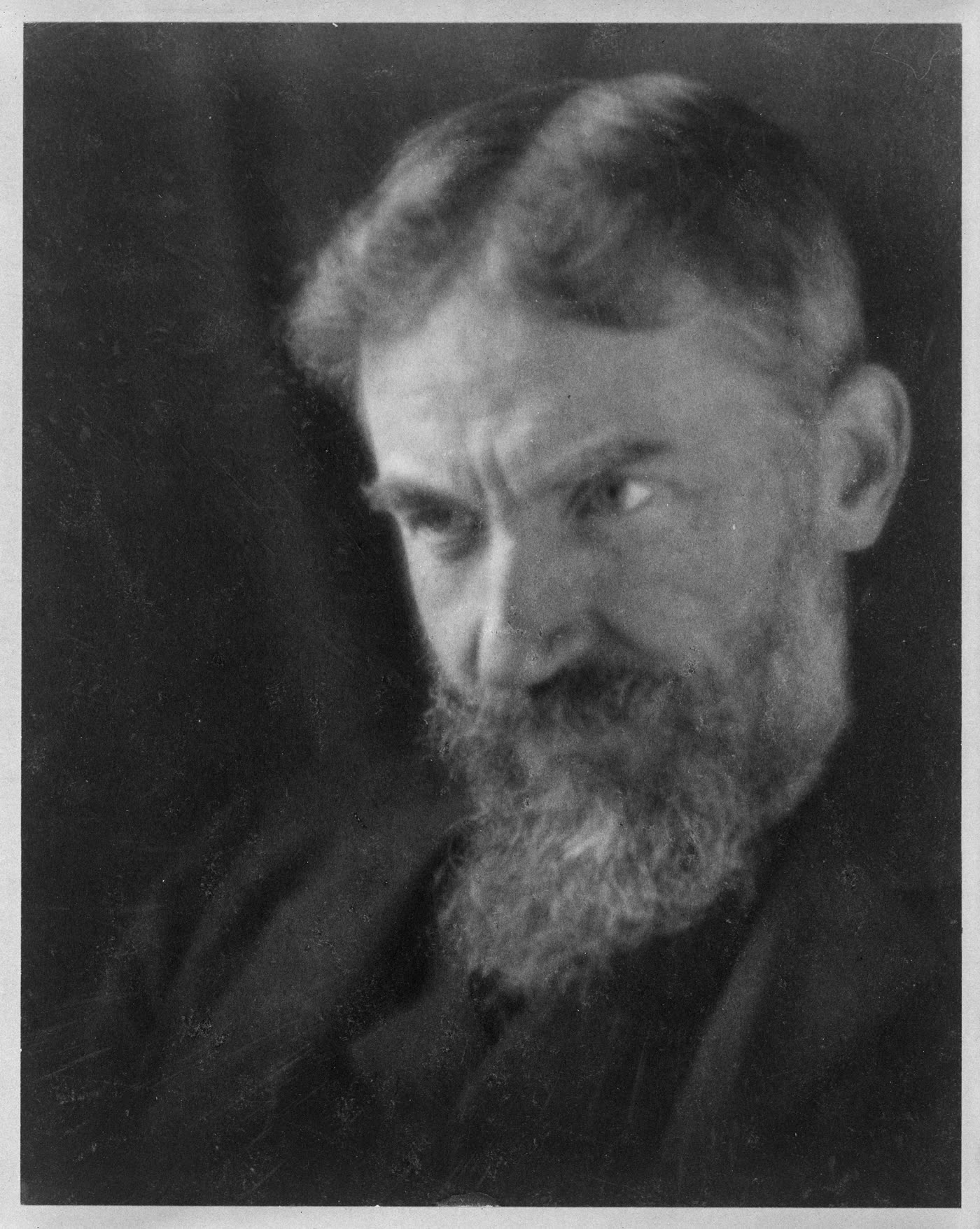
Image context: the cover uses a real photographic portrait of Shaw rather than a costume still from one of the better-known screen versions. That choice keeps the focus on authorship. The afterlife of Pygmalion is so strong that it can start to seem as if the premise emerged fully formed from performance culture itself. The photograph brings the argument back to the writer who made language into the instrument of class comedy and class injury.[3][7]
Higgins hears accent as destiny, which is why the premise travels so easily
Shaw tells you almost immediately what kind of world this is. Higgins does not merely notice Eliza's speech; he reads it as a whole social future. Looking at her in the opening scene, he says her "kerbstone English" will keep her "in the gutter to the end of her days."[1] That line is the real beginning of the play's afterlife. It turns pronunciation into fate. The wager that follows is not about etiquette in the light comic sense. It is about whether language can be used to reroute a human being through the class system.[1][2]
That is why the play has remained so portable across stage and screen. You can move the costumes, soften or sharpen the satire, add music, or lean harder into romance, but the premise always lands because many societies still hear speech as rank.[1][2][5][6] Accent can signal schooling, neighborhood, employability, legitimacy, or supposed intelligence before a character has finished one sentence. Shaw's setup stays alive because it dramatizes something audiences recognize at once: language is never only language in a stratified world.
The play's own preface presses the point harder. Shaw writes there that English people do not respect their language, and that an Englishman can hardly open his mouth without making another Englishman despise him.[1] Pygmalion is therefore not a decorative comedy about diction lessons. It begins as a comedy about social listening, about the speed with which a voice gets sorted, discounted, or promoted.
Eliza gives the play its moral afterlife because she refuses to remain an experiment
If Higgins supplied the premise, Eliza supplied the longevity. A lesser version of this story would end when she passes. Shaw makes that public success the point at which the real crisis starts. After the embassy triumph, Eliza is not a completed Cinderella figure but a stranded one. Her cry, "What am I fit for?" is the sound of the makeover plot breaking open from inside.[1]
That line matters because it exposes what adaptation must preserve if it wants more than surface pleasure. Eliza has learned to perform another class position, but she has not been given a stable social life to inhabit there. Soon she sharpens the point with the play's most devastating practical sentence: "I sold flowers. I didn't sell myself. Now you've made a lady of me I'm not fit to sell anything else."[1] Shaw converts the fantasy of self-improvement into an argument about employability, dependency, and the cruel joke of upward mobility without institutional landing space.
This is also where Pygmalion resists sentimental collapse. Britannica's summary of the play is useful because it keeps the central paradox plain: Eliza succeeds in high society and yet finds herself belonging fully neither to the class she learned to imitate nor to the class she came from.[2] Eliza Doolittle's separate Britannica entry compresses the whole afterlife into one line of continuity: the Cockney flower girl of the 1913 play becomes the same transformable figure in the 1938 film, the 1956 stage musical, and the 1964 film of My Fair Lady.[4] Those later forms endured because Eliza is more than a pupil. She is the human cost of successful transformation.
The afterlife keeps changing tone, but it cannot escape the return problem
This is where adaptation becomes revealing. The 1938 film helped prove that Shaw's plot could thrive in cinema, and My Fair Lady later proved that it could absorb song, become immensely popular, and still carry the basic social experiment intact.[2][4][5][6] Once that happened, Pygmalion stopped being only one early-twentieth-century play and became a reusable cultural grammar: training montage, accent discipline, public passing test, battle of wills, unresolved social reentry.
But every adaptation has to decide how much weight to give the play's sting. If the tone leans too far toward makeover delight, Eliza's predicament starts to look decorative. If it remembers only social cruelty, the buoyancy that makes the plot theatrically renewable disappears. The musical afterlife works not because it erases the class argument, but because it packages the argument inside forms of pleasure that audiences willingly revisit.[5][6]
That balance is already implicit in Shaw's best-known formulation late in the play: "the difference between a lady and a flower girl is not how she behaves, but how she's treated."[1] The sentence is famous because it sounds like a moral insight, but it is also an adaptation manual. Keep this sentence alive and the work stays modern. Lose it, and Pygmalion collapses into costume nostalgia. Shaw is saying that class is relational theater before it is essence. That is why the story can survive changes in medium. Medium changes are secondary to the social treatment script.
Why the play still feels current
The deepest reason Pygmalion keeps returning is that it understands reinvention as an unequal transaction. Institutions ask people to transform themselves all the time: speak differently, dress differently, acquire the right codes, become legible to gatekeepers.[1][2][4] What they offer in return is often conditional. A passed test does not dissolve hierarchy. It can simply produce a more polished outsider.
That is why Eliza remains difficult to domesticate. She is bright, funny, angry, wounded, strategic, and increasingly aware that being remade on someone else's terms is not the same thing as being recognized on her own.[1][2][4] Shaw's financially most successful play, as Britannica notes, generated the massive afterlife of My Fair Lady without exhausting the sharper original problem.[3][5] The songs, film versions, and star performances kept the story circulating. The play itself keeps the circulation honest.
So Pygmalion survives not because it promises transformation, but because it asks what transformation costs once applause is over. Accent remains a costume. Class remains a listening habit. The door back home no longer opens the same way. As long as that pattern remains legible, Shaw's play will go on finding new actors, new media, and new audiences ready to discover that the makeover was never the ending.[1][2][5][6]
Sources
- George Bernard Shaw, Pygmalion. Project Gutenberg text.
- Encyclopaedia Britannica, "Pygmalion" (play by Shaw).
- Encyclopaedia Britannica, "George Bernard Shaw."
- Encyclopaedia Britannica, "Eliza Doolittle."
- Encyclopaedia Britannica, "My Fair Lady" (musical by Lerner and Loewe).
- Encyclopaedia Britannica, "My Fair Lady" (film by Cukor, 1964).
- Wikimedia Commons, "File:Portrait of George Bernard Shaw LCCN2004674432.jpg" (source page for the lead photograph).