
Anne Carson is one of those writers whose reputation can become a fog around the work. She is called brilliant, hybrid, unclassifiable, difficult, learned, and genre-breaking, all of which are true enough and none of which tells you how the writing actually thinks.[2][3] That is why her Louisiana Channel conversation, published on YouTube as "Writer Anne Carson: Life is Not Fair," is worth returning to as a literature object rather than as auxiliary author-content.[1] It does not simplify Carson for the audience, but it does something better: it makes several governing habits of her work audible in plain speech. Art should move the mind rather than pin it in place. Thinking starts in doubt, and doubt is close to hesitation. Translation should not pretend that loss never happened. Family material only becomes useful when it has stopped being confession and has become form.[1][3][4][5]
Those points help explain why Carson has remained so singular across poetry, essay, translation, and prose. The MacArthur Foundation's profile describes her as a classicist who developed an independent voice as both poet and essayist, while the Poetry Foundation page tracks the unusual breadth of a career that moves between ancient Greek material, lyric essay, translation, and formally restless book-making.[2][3] But those institutional descriptions still flatten the felt method. The interview restores the pressure inside it. You hear a writer who distrusts static interpretation, prefers thinking in motion, and keeps returning to the places where language cannot fully close over what it handles.[1][2][3]
That is also why this is a strong video-curation subject. The clip is not just a record of an author appearance. It is a public demonstration of literary method. Carson's answers keep making the same wager her books make: meaning arrives not by smoothing contradiction away, but by keeping tension alive long enough for thought to change shape.[1][4][5]
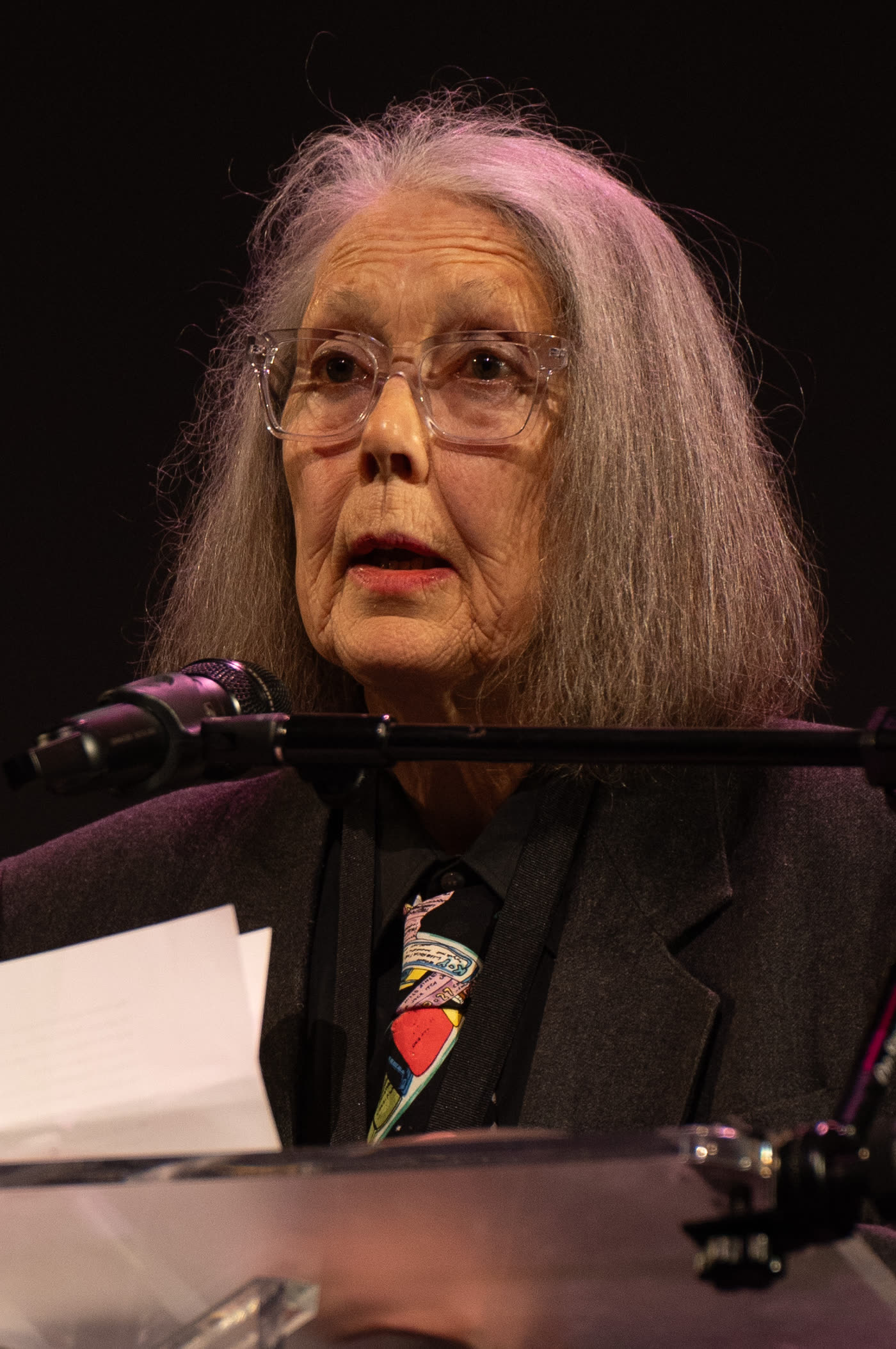
Image context: the cover uses a real 2024 Wikimedia Commons photograph of Carson at the National Book Awards finalist reading. That choice fits the article because the interview it studies relies on the same kind of force: not archival montage or stage effects, but concentration in a speaker's face and timing.[6]
Around 7:41, Carson gives the cleanest short definition of art in the interview: the mind wants to move
One of the strongest moments comes when Carson rejects the kind of thinking that merely sits on an idea until it turns inert.[1] "Your mind wants to move," she says, and the best thing a work of art can do is carry the mind with it somewhere unexpected.[1] That sentence is useful because it rescues Carson from a lazy category error. She is often filed under difficulty, as if the main experience of reading her were admiring intelligence at a distance. The interview suggests something much more physical. Carson is interested in mental motion, in the turn or displacement that lets perception become newly possible.[1][3]
That helps explain the durable force of books like Autobiography of Red.[4] The premise alone could have remained a clever exercise: a reinvention of the Geryon myth as a modern coming-of-age love story. Instead the book lives because Carson keeps a mythological frame in motion inside contemporary emotional weather.[4] The reader is never asked to admire a fixed allusion. The allusion moves, and because it moves, the feeling moves with it. The same is true across her broader body of work as described by the Poetry Foundation profile: classical inheritance is never displayed as scholarly furniture; it becomes a live current inside contemporary language.[3]
What the video makes audible is that Carson's famous intelligence is inseparable from this appetite for displacement. Art matters because it prevents the mind from becoming too sure of where it already is.[1] In that sense her work is not difficult because it loves obscurity. It is difficult because it refuses mental stasis.
Around 17:53 to 18:35, doubt stops looking like weakness and starts looking like the beginning of thought
The interview's philosophical center arrives when Carson turns to Descartes and notes that if you really look at the sentence, it begins not with certainty but with doubt: "I doubt, therefore I think, therefore I am."[1] A few seconds later, the interviewer offers the formulation that best unlocks Carson's work: everything starts in doubt, or perhaps in hesitation.[1] Carson agrees that hesitation is part of the same structure.[1]
This matters because Carson's writing is often discussed as if it were the product of unusual command alone: command of Greek, command of form, command of reference, command of tonal shifts. The interview proposes the opposite origin story. Thought begins where mastery breaks. Carson does not build from stable knowledge outward. She builds from the place where language has to pause, turn, or admit incompletion.[1][2][3]
That habit is visible in the shape of her books. The MacArthur profile emphasizes her independence of voice, but the independence itself seems tied to an unwillingness to begin from ready-made certainty.[2] Carson's essays and poems often look like they are testing what a sentence can bear before it hardens into doctrine. Even when the tone is dryly comic, the underlying method is serious: hesitation is not a decorative mannerism. It is the ethical condition of thinking without bullying the subject into submission.
That is one reason the interview rewards slow watching. In a festival setting, doubt is usually something speakers try to clean away in order to sound authoritative. Carson instead lets doubt remain productive.[1] She sounds amused by it, but she does not trivialize it. The result is a poetics in which uncertainty is not a gap before the real argument. It is the real argument's engine.
Around 44:49 to 46:11, translation becomes a practice of leaving the blanks visible
The richest technical passage in the interview comes when Carson talks about translation, silent things, and blank spaces in writing.[1] Speaking about Sappho, she explains that she leaves blanks because the historical text has been lost to us; making a smooth, complete story out of fragments would be false to the condition in which the work survives.[1] She adds that such gaps also belong to "the cognitive procedure of translation," because the translator keeps encountering words that cannot simply be imitated in another language.[1]
This is a remarkably compressed account of Carson's whole practice. It clarifies why Nox remains so central to her reputation.[5] New Directions describes the book as an epitaph in the form of a book, a facsimile of a handmade object created after the death of her brother, working through loss by way of Catullus 101.[5] That description matters because it places grief, translation, and material form inside one structure. Loss is not something the writing solves. Loss determines the form the writing must take.[1][5]
The video sequence makes the same principle explicit. Carson refuses the fantasy that translation exists to erase damage.[1] Instead, translation becomes the art of showing where damage lives without surrendering the possibility of relation. The blanks are not empty decoration. They are evidence. They record that literature sometimes reaches us as remainder, shard, interruption, and surviving pressure rather than as finished wholeness.[1][5]
This is also where Carson's classical scholarship and her contemporary poetics become impossible to separate. Textual criticism, visual spacing, and lyrical intelligence are not three different toolkits.[1][2][3] In her work they converge on the same refusal: do not lie about what is missing just to make the reading experience feel complete.
Around 55:48 and after, autobiographical material matters only after it has stopped being merely private
Late in the interview the discussion turns to mothers and to the recurrence of mother figures across Carson's books.[1] Her answer is revealing precisely because it is not confessional. She acknowledges one real-life carryover, even noting that her own mother did smoke, while insisting that the rest of the personality is not simply the same from work to work.[1] She distinguishes the mother in Autobiography of Red from the later and differently weighted family material elsewhere.[1][4]
That distinction matters. Carson is often read through autobiography because the books make family, eros, death, and grief feel unnervingly close. But the interview pushes against the easy assumption that closeness equals direct transcription.[1] It suggests a stricter standard. Life supplies pressure, detail, and perhaps recurring obsessions; literature begins only when those elements are rebuilt into a form that can think beyond the private scene.
That helps explain why Carson's familial writing avoids the flat authority of memoir-as-disclosure. Even when the material feels intimate, it has been reworked through myth, translation, essayistic inquiry, collage, or radical formal constraint.[3][4][5] The goal is not to report the self more sincerely. The goal is to make a structure in which feeling can become legible without being merely confessed.
Seen that way, the interview's title, "Life is Not Fair," lands differently.[1] It is not only a remark about biography or suffering. It is almost a statement of method. Life does not arrive already proportioned, already translated, already interpretable. Carson's writing keeps returning to that unfairness and then making forms tough enough to hold it without falsifying it.
That is what makes the video worth embedding in a literature post now.[1] It is a rare case where a major writer explains, in public and without flattening herself, the habits that make the books feel unmistakably hers. Art moves the mind. Doubt begins thought. Translation leaves the wound visible. Family becomes literature only after form has remade it. Those are not four separate insights. They are one method heard from different angles.
Sources
- Louisiana Channel, "Writer Anne Carson: Life is Not Fair," YouTube video.
- MacArthur Foundation, "Anne Carson" (MacArthur Fellows profile).
- Poetry Foundation, "Anne Carson."
- Penguin Random House, "Autobiography of Red by Anne Carson."
- New Directions Publishing, "Nox."
- Wikimedia Commons, "File:Anne Carson, poet, at the 2024 National Book Awards finalist reading 0 (cropped).jpg" (source page for the lead photograph used in this article).