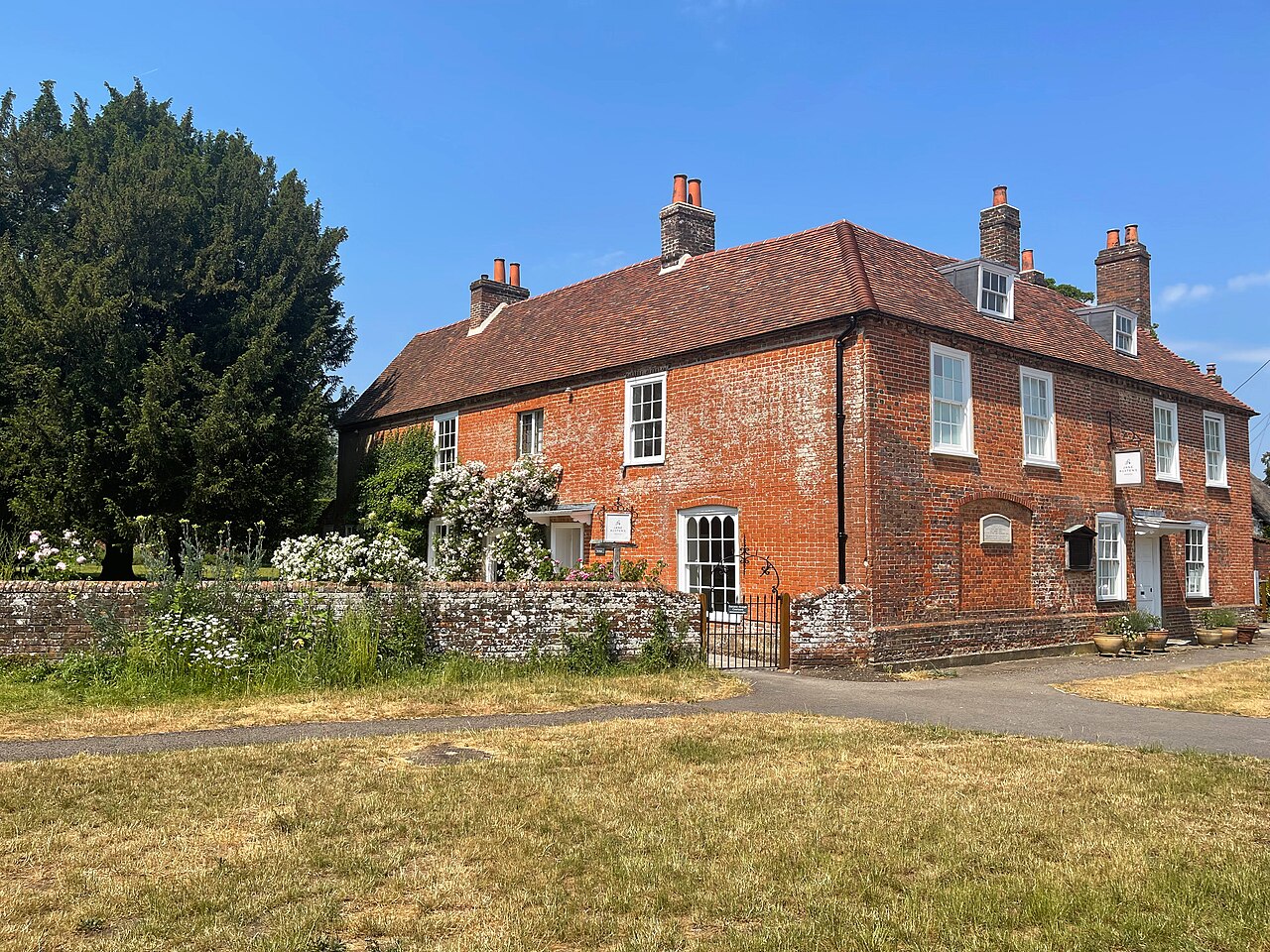
Mansfield Park has never enjoyed the easy affection that follows Pride and Prejudice or Emma. Even institutions that admire it tend to introduce it with a warning label. The New York Public Library calls it Austen's "most controversial novel," while Britannica describes it as her darkest and boldest book, with a heroine many readers find excessively proper and a moral atmosphere that feels markedly more severe than the rest of the canon.[3][5] That split response is part of the novel's meaning, not an accident of modern taste. Austen published the book in 1814, after drafting it in Chawton, and its first print run sold out quickly before a slower second edition exposed how unevenly its appeal traveled.[2] The novel's afterlife has unfolded under the same pressure ever since: readers keep coming back because the book's quiet surface holds unusually abrasive questions about class, performance, and empire.[2][3][4]
The cover image therefore uses a real photograph of Jane Austen's House rather than a later film still.[6] The point is not heritage tourism for its own sake. It is that Mansfield Park is one of Austen's most inwardly made books and one of her most argumentative. Chawton gives the right visual key: a composed domestic exterior behind which a great deal of social unease is being arranged into form.[2][6]
1. The novel begins by making charity feel like a rank machine
The first reason Mansfield Park remains difficult is that Austen refuses to let benevolence look innocent.[1] Fanny Price is brought to Mansfield under the language of family duty, yet Sir Thomas states the governing rule with chilling clarity: "they cannot be equals."[1] Before Fanny even arrives, he also predicts that the household must be prepared for her "gross ignorance" and "very distressing vulgarity of manner."[1] The point is not merely that certain characters are snobbish. The point is structural. The novel asks what happens when a child is raised in comfort while being continuously reminded that the comfort is conditional.[1]
That setup explains why Fanny divides readers so sharply.[3][5] If one wants a sparkling heroine who converts the room to her own scale, Fanny can look passive, narrow, and over-scrupulous. If one reads the book as a study in dependency, her watchfulness starts to look exact. Austen gives her very little social margin for error, so moral and perceptual discipline become the forms of strength available to her.[1][3] The seriousness of the novel begins there. It is not abstract piety descending from above. It is the inner style developed by someone who has been taught to measure every gesture against a hierarchy she did not design.[1]
Britannica's overview of Austen's mature novels is useful on this point. In Mansfield Park, the earlier satiric sparkle is still present, but it is subordinated to a more serious comedy of character and society.[4] That shift matters because the book's wit no longer exists mainly to reward readerly superiority. It exists alongside conditions that do real damage. Fanny is not simply shy; she is produced by an environment in which gratitude and diminishment are made to coexist.[1][4]
2. The theatricals episode is where the novel makes performance feel dangerous
The second source of the book's afterlife is the Lovers' Vows episode, still one of the sharpest set pieces in Austen.[1][3] Sir Thomas leaves for Antigua, supervision loosens, and the Mansfield circle starts turning itself into an amateur theater. On the plot level, the episode is easy to summarize: rehearsal creates opportunities for flirtation, pairing, vanity, and exposure.[1] On the level of form, though, Austen is doing something harsher. She lets the household begin performing feelings before it has admitted them. The stage becomes a machine for testing how much impropriety can be smuggled through the language of taste and amusement.[1][3]
This is exactly where Fanny's reputation as a prig is made and unmade. Readers who dislike her often begin here, because she does not merely decline to join the fun; she seems to resist the mood of liberating play itself.[3] Yet the novel keeps proving that she is reading the situation correctly. The theatricals are not dangerous because acting is sinful in some blanket sense. They are dangerous because rehearsal gives desire a provisional legitimacy. People can stand too close, speak too warmly, and tell themselves it is only a part.[1][3]
Britannica's summary puts the matter neatly: Lovers' Vows represents moral and social improprieties, and Fanny's refusal helps identify the compromised values that the rest of the house is willing to normalize.[3] That is why Sir Thomas's return shuts the whole experiment down so abruptly.[1] The novel does not treat private play as a harmless interlude between major events. It treats it as the moment when the house reveals what it becomes once authority leaves the room.
3. Empire enters the book as an economic fact and a conversational failure
The third and most enduring pressure point is the one that has done the most to renew the novel's critical life: Antigua, slavery, and the famous silence around both.[1][2][3] Jane Austen's House notes plainly that the Bertram fortune is tied, at least in part, to a "West India estate" and that the novel touches colonialism and slavery through Sir Thomas's business in Antigua.[2] Britannica goes further, arguing that the novel's country-house order is sustained by empire and slave labor, and that Austen keeps the reference to slavery conspicuous rather than incidental.[3]
What matters is the method. Austen does not convert Mansfield Park into a plantation novel. She lets imperial finance sit at the edge of domestic conversation and then shows what the edge can reveal. When Fanny says she asked about the slave trade, she adds that there was "such a dead silence."[1] That is one of the most discussed moments in the book because it refuses both melodrama and innocence. The silence does not erase the subject. It records the household's inability, or unwillingness, to sustain speech where the basis of its comfort becomes morally legible.[1][3]
This is also why the book's seriousness feels more modern than its decorum first suggests. Readers do not have to choose between a "moral" novel and a "political" one. Austen has already fused the two. Rank at Mansfield is local, but its security is not merely local.[1][2][3] The estate's manners, marriages, and drawing-room scruples sit inside a larger imperial economy that the novel refuses to explain away. That pressure is one reason the book continues to attract criticism, defense, and reinterpretation long after other Austen plots have settled more comfortably into romance.
4. The reception history keeps circling the same problem: what kind of strength is Fanny allowed to have?
The reception dossier becomes clearest when you look at the range of answers later readers and adapters have given to Fanny Price.[3][5] NYPL's shorthand, "most controversial novel," captures the durable fact that many readers do not know what to do with a heroine whose power is grounded less in wit than in steadiness.[5] Britannica's adaptation summary traces the same issue in another medium: the 1983 BBC version was relatively faithful, the 1999 Patricia Rozema film made Fanny more confident and outwardly forceful, and the 2007 television adaptation compressed the whole problem into a much shorter runtime.[3] Each version answers, implicitly, how much visible agency modern audiences require before they will grant a heroine centrality.
That recurring adjustment tells you what the book keeps challenging. Mansfield Park does not offer transformation in the usual satisfying register. Fanny does not conquer the room through sparkle, and Austen does not flatter the reader by making the right moral vision instantly glamorous.[1][3] Instead she stages a more uncomfortable proposition: that acuity may belong to the quiet dependent, that a household can be indicted by its amusements, and that empire may appear most forcefully in a pause. The novel's afterlife has been built out of readers returning to that discomfort, resisting it, and then finding that the resistance itself is part of the experience.
That is why the book still matters. Its first edition sold out, its second moved more slowly, and its reputation has never fully stabilized.[2] Yet the instability is productive. Mansfield Park keeps surviving because it does not let moral seriousness become simple reassurance. It makes seriousness feel social, theatrical, and economic all at once. Fanny Price remains difficult because Austen designed the book so that difficulty would be the true measure of what Mansfield is trying not to see.[1][2][3]
Sources
- Jane Austen, Mansfield Park. Project Gutenberg HTML text.
- Jane Austen's House, "Mansfield Park."
- Encyclopaedia Britannica, "Mansfield Park."
- Encyclopaedia Britannica, "Jane Austen: Austen's novels: An overview."
- The New York Public Library, "Mansfield Park."
- Wikimedia Commons, "File:Jane Austen's House, Chawton, Hampshire, U.K..jpg" (source page for the lead photograph).