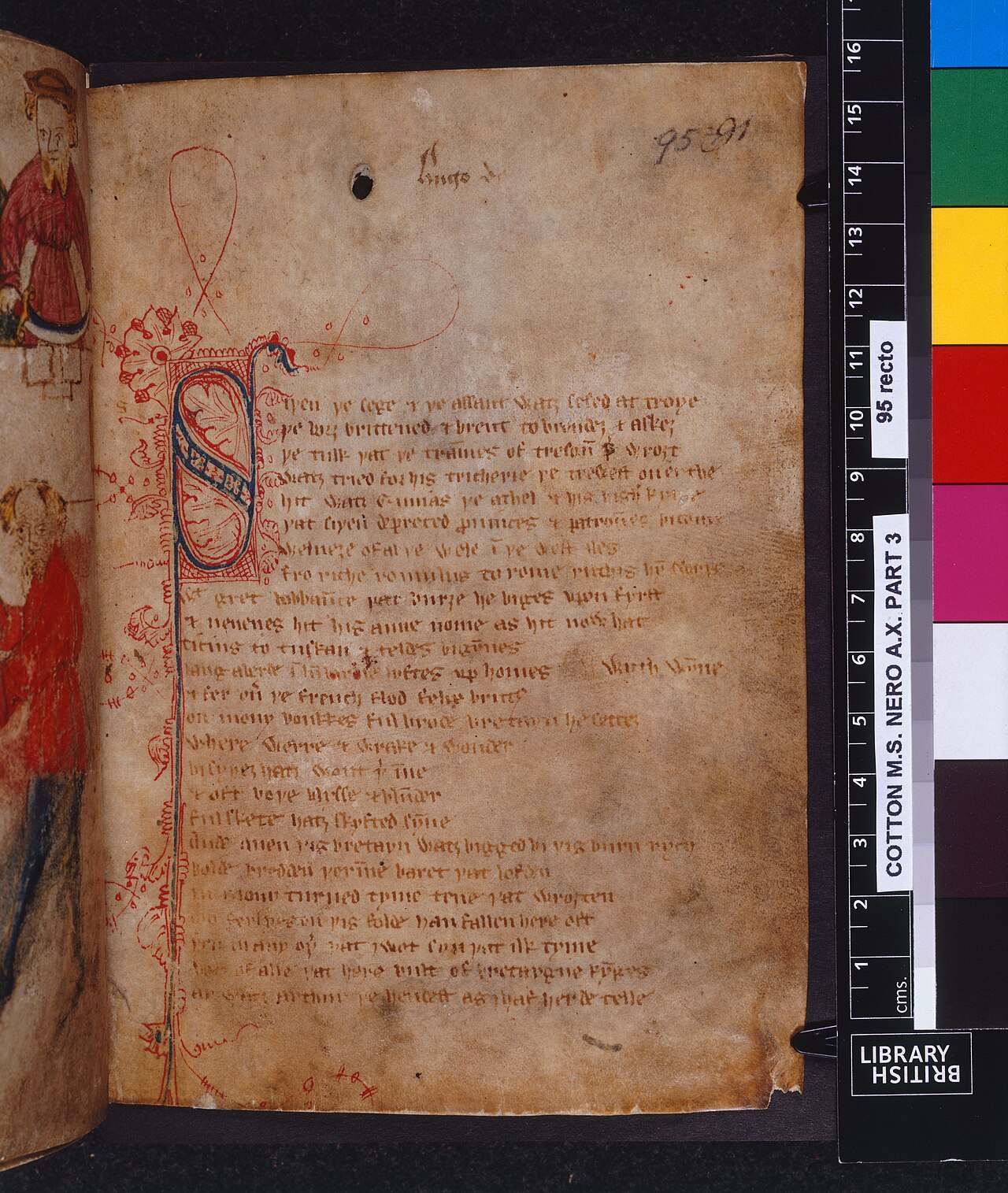
The surprise of the Pearl-Gawain manuscript is not only that two famous Middle English poems survived in one small codex. It is that Pearl and Sir Gawain and the Green Knight feel like opposite experiments in the same moral laboratory. One begins with a bereaved speaker who has lost a child figured as a pearl. The other begins with a glittering court and a green stranger who turns holiday play into a binding covenant.[2][3] One asks whether love can release what it cannot recover. The other asks whether honor can survive the fear of death.
The British Library catalogue identifies Cotton MS Nero A X/2 as the manuscript containing Pearl, Cleanness, Patience, and Sir Gawain and the Green Knight, with Pearl on folios 41r-59v and Gawain on folios 94v-130r.[1] That codex fact matters. Modern readers often meet the poems separately: elegy in one classroom week, Arthurian romance in another. Bound together, they look less like unrelated masterpieces and more like paired studies of fidelity under pressure. Pearl turns faith inward, toward grief, doctrine, and the dreamer's refusal to accept distance. Gawain turns faith outward, toward oath, courtesy, bodily risk, and the social meaning of a hidden fault.
The poems also share a taste for formal pressure. The standard edited tradition, represented by The Poems of the Pearl Manuscript, treats the four works as a demanding Middle English cluster: alliterative, regionally marked, and densely patterned.[6] In Pearl, the pattern is circular and jeweled. The opening phrase, "Perle, plesaunte," announces not just a lost object but a verbal obsession: pearl as child, jewel, purity, payment, theological figure, and rhyme-engine.[2] In Gawain, the pressure is contractual. The Green Knight's challenge begins as spectacle, but once he says, in Jessie Weston's prose retelling, "Make we our covenant," the poem has changed from marvel into audit.[5]
The mourner who wants possession back
Pearl begins after a loss but before acceptance. The dreamer is not simply sad; he is possessive. He has misplaced the "spot" where the pearl fell, and the poem's opening movement turns mourning into searching, as if attention might reverse death.[2][4] When the dream vision brings him to the maiden across the stream, the encounter seems at first to give grief what it wants: sight, speech, recognition. Sophie Jewett's translation catches the ache in the speaker's question, "Art thou my pearl for which I mourn," but the maiden's reply immediately resists his grammar of ownership.[4]
That resistance is the poem's deepest kindness and its hardest discipline. The maiden does not deny love. She denies the mourner's right to treat heavenly life as an extension of his earthly possession. Her repeated correction is not cold theology pasted onto grief; it is the poem's way of protecting love from becoming a demand. The dreamer wants reunion on terms his body can understand: cross the river, touch the lost one, keep the pearl again. The maiden answers with a different economy. Loss has not made the pearl valueless. It has moved her beyond his keeping.
This is where the poem's beauty becomes bracing rather than merely consoling. The jeweled landscape, white garments, river boundary, and New Jerusalem do not make grief easy. They make grief intelligible as a problem of perception. The dreamer sees glory and still wants to convert it into access. His failure is not that he loves too much; it is that he mistakes love for custody. The poem's theological argument may feel remote to a modern reader, but its emotional structure remains immediate: someone we love has become unreachable, and the mind keeps inventing ways to turn vision into possession.
The knight who wants survival without disclosure
Gawain gives that inward problem a public, comic, and dangerous counterpart. Gawain's first covenant with the Green Knight is visible, verbal, and witnessed by the court.[3][5] He agrees to exchange blows and later to seek the Green Chapel. At Hautdesert, the second covenant is more domestic: the host will give Gawain whatever he wins in the hunt, and Gawain will give the host whatever he wins inside the castle. The poem then sets the bedroom and the hunting field in alternating motion, letting courtesy, temptation, jokes, and fear all test the same word: truth.
The green girdle matters because it is so small. Gawain refuses the lady's ring, but he accepts the lace once she claims it can preserve his life.[5] That difference is crucial. He is not bribed by wealth; he is bent by mortality. The fault is therefore more interesting than simple lust or greed. He keeps the kisses-exchange well enough to preserve the appearance of the game, but withholds the object that would reveal his fear. His public honor remains polished while his private accounting has gone false.
The Green Knight's correction exposes the size of that small concealment. Gawain responds with extravagant self-condemnation, calling down shame on cowardice and covetousness; the Green Knight laughs more generously than Gawain judges himself.[5] Yet the wound is real because the poem's standard is not perfection. It is truthful reckoning. Gawain is allowed to live, but he cannot return to Camelot with the same fantasy of himself. The girdle becomes a portable memory of the gap between reputation and trial.
Two forms of keeping faith
Read beside each other, Pearl and Gawain make loss the condition that reveals character. The dreamer loses a child and must learn that faith is not a claim check for recovery. Gawain nearly loses his life and must learn that faith is not the same as reputation. Both poems turn on a crossing that cannot be faked: the stream in Pearl, the journey to the Green Chapel in Gawain. In both cases, the protagonist wants the benefit of fidelity while resisting its full cost.
The difference lies in where the correction comes from. Pearl corrects the mourner through vision and doctrine. The maiden's authority is luminous, scriptural, and remote from ordinary social bargaining.[4] Gawain corrects the knight through game, hospitality, exposure, and laughter. Bertilak's final explanation turns the plot into a staged test, but it does not erase Gawain's agency.[5] The poems are therefore not offering one lesson in two costumes. They are asking how keeping faith changes when the pressure is grief in one case and fear in the other.
Their shared manuscript makes that question richer. Cotton MS Nero A X/2 preserves a poet, or poetic circle, fascinated by thresholds: riverbank, castle bedroom, chapel, court, dream, confession, covenant.[1][6] A threshold is where a person discovers what cannot be carried across unchanged. The mourner cannot carry ownership across the river. Gawain cannot carry an unexamined heroic self across the Green Chapel. Both can return, but only after a form of dispossession.
That is why the poems still feel modern without being flattened into modern psychology. Pearl knows that grief can disguise itself as devotion. Gawain knows that honor can disguise fear as discretion. Neither poem despises its human subject. The dreamer wakes bereaved but instructed. Gawain comes home ashamed but alive, wearing the sign of his fault. In both endings, the person who survives is not the person who gets everything back. The survivor is the one who accepts that love and truth are not proven by possession, but by what one is willing to release.
Sources
- British Library Archives and Manuscripts Catalogue, "Cotton MS Nero A X/2: Four anonymous poems in Middle English: Pearl, Cleanness, Patience and Sir Gawain and the Green Knight."
- University of Michigan Library Digital Collections, "Pearl," Corpus of Middle English Prose and Verse.
- University of Michigan Library Digital Collections, "Sir Gawain and the Green Knight," Corpus of Middle English Prose and Verse.
- Sophie Jewett, The Pearl: A Middle English Poem, A Modern Version in the Metre of the Original. Project Gutenberg.
- Jessie L. Weston, Sir Gawain and the Green Knight: A Middle-English Arthurian Romance Retold in Modern Prose. Project Gutenberg.
- Malcolm Andrew and Ronald Waldron, eds., The Poems of the Pearl Manuscript: Pearl, Cleanness, Patience, Sir Gawain and the Green Knight. Liverpool University Press product page.
- Wikimedia Commons, "File:Cotton Nero A X-2 - 095r.jpg" - British Library scan of Cotton MS Nero A X/2, folio 95r.