Margaret Cavendish tells us how to sort The Blazing World, then writes a book that will not stay sorted. In her address to women readers, she calls its three modes “Romancical,” “Philosophical,” and “meerly Fancy.”[1] The labels promise a procession: adventure first, ideas next, fantasy last. What follows behaves less like three rooms than a set of doors left open between them.
A kidnapped woman crosses the North Pole into another world and becomes its Empress. Her court turns into a parliament of animal-shaped specialists. The author enters her own fiction as a disembodied scribe. Minds manufacture worlds, discard them, and start again. Then the Empress takes the inventions of her peaceful realm back through the polar passage and uses them to burn fleets, towns, and an entire world's resistance into submission.[1]
The jolts are the design. Cavendish keeps changing the scale at which a world can be possessed: first as territory, then as a field of knowledge, then as an interior act of imagination, and finally as an object of military control. Recent criticism is right to describe the work's genres as hybrid rather than merely piled together.[2] Romance, natural philosophy, satire, utopia, autobiography, and conquest alter one another as they meet. The book's structure makes imaginative freedom exhilarating—and then makes it answer for what it wants to rule.
The polar crossing turns captivity into authorship
The opening resembles a compressed romance stripped of courtship. A merchant abducts a young woman from a shore; a storm drives his vessel north; the kidnappers freeze; the survivor passes between joined poles into a second world. Bear-men receive her, other hybrid peoples relay her across islands, and the Emperor marries her and grants her sovereign power.[1]
That sequence matters because the protagonist begins as somebody else's seized object. She does not navigate the boat, select the destination, or even receive a name. Geography performs the first reversal for her. The narrow polar passage kills the men who attempted to possess her and delivers her into a society ready to treat her difference as authority.
Cavendish announces the same reversal outside the plot. Denied the occasions available to Henry V or Alexander, she says she has “made One of my own.”[1] The new world is therefore both setting and verb: a place the heroine enters, a polity the Empress orders, and a book its author makes. The romance plot does not simply carry us toward marvels. It converts forced transport into world-making.
The conversion is intentionally excessive. The Empress receives absolute power almost as quickly as she once lost bodily freedom. That speed should make a reader cautious. The Blazing World is often taught across utopian, science-fiction, feminist, and philosophical traditions, and English Heritage notes that Cavendish used fiction to bring natural-philosophical argument toward women excluded from its professional language.[4] Yet the heroine's elevation is not a democratic correction. One woman's freedom arrives as sovereignty over everyone else.
The court stops the journey and turns knowledge into dialogue
Once the Empress establishes schools, the outward voyage pauses. Species become disciplines: bear-men practice experimental philosophy, bird-men astronomy, worm- and fish-men natural philosophy, spider- and lice-men mathematics, fox-men politics, and parrot-men rhetoric and logic.[1] The book's unit of motion changes from island to interview.
This can feel like plot giving way to a catalogue. Formally, it is more active than that. Each guild brings a method of knowing into the throne room; the Empress questions it; disagreement appears; she judges. The repeated audience scene lets abstract controversy acquire voices, bodies, professional vanity, and comic timing. Philosophy becomes drama without ceasing to be philosophy.
The telescope episode shows the method at its sharpest. The bear-men's instruments multiply incompatible reports about the sun, earth, moon, and stars. The Empress calls the glasses “false Informers” and orders their destruction; the bear-men defend the pleasure and employment produced by dispute.[1] Neither side gives us a neutral scientific verdict. Instrument, observer, ruler, and institution each distort the result differently.
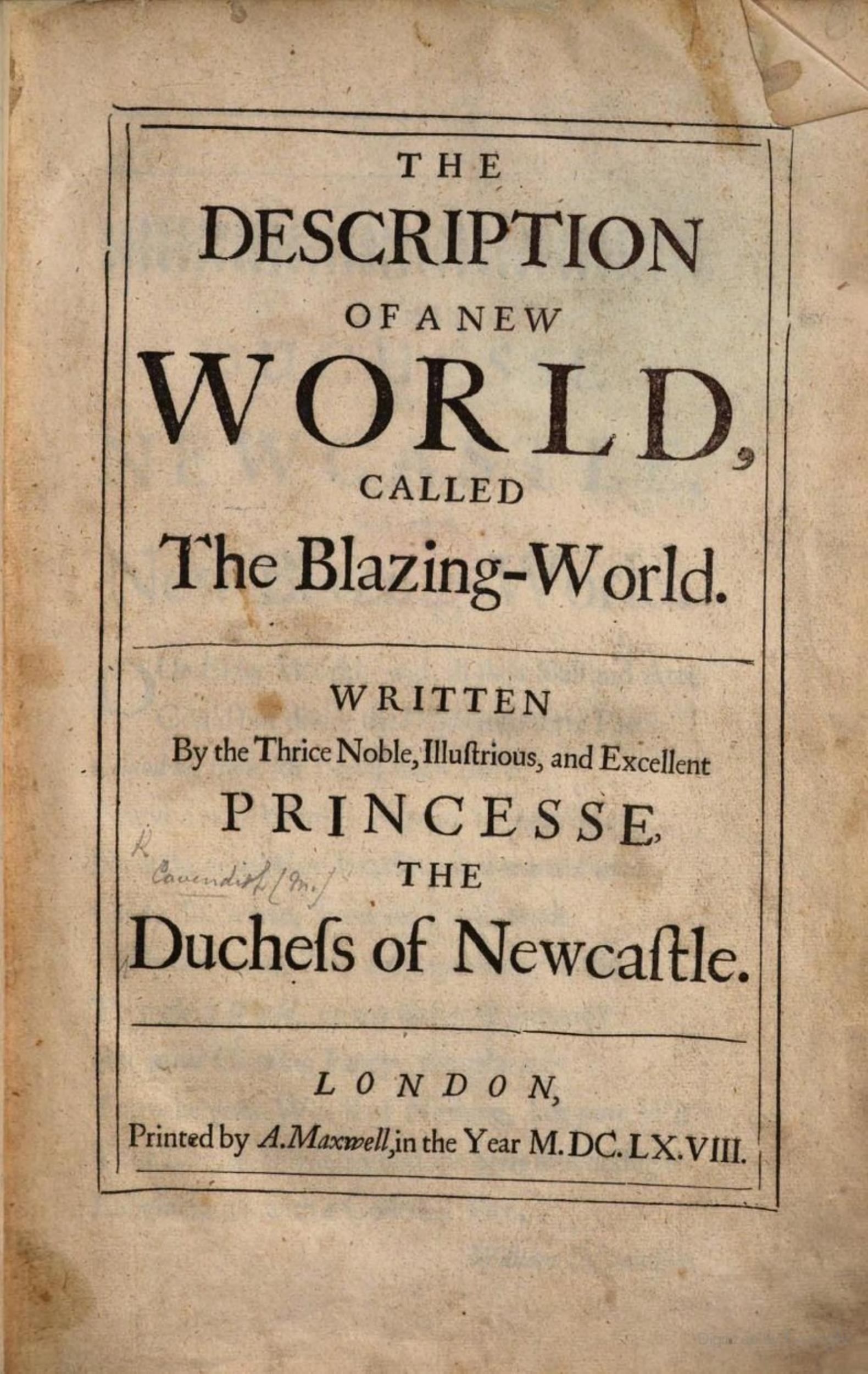
That unresolved scene connects the fiction to the volume beside which it first appeared. The Blazing World was published with Observations upon Experimental Philosophy in 1666; a separate edition appeared in 1668.[2][4][6][8] Marina Leslie argues that the fiction's acts of world construction are themselves experiments in Cavendish's natural philosophy.[3] The change of genre is thus a change of apparatus. Where a treatise can state an objection, the court dialogue can stage what happens when evidence becomes an institutional performance before power.
The Empress's response also exposes the political danger in the scene. She allows argument to continue only if it remains inside the schools and does not disturb government or religion.[1] Inquiry is welcome as counsel, not as a rival source of authority. The philosophical middle expands the number of possible explanations while the monarchy works to contain their consequences.
The author enters when expert authority runs out
The book's strangest hinge begins with a writing problem. The Empress wants a spiritual scribe. Ancient philosophers are too attached to their systems; modern men such as Galileo, Descartes, Hobbes, and Henry More would “scorn to be Scribes to a Woman.”[1] The spirits recommend the soul of Margaret Cavendish instead.
This entrance is comic self-promotion, but it also changes the narrative's ownership. The Duchess becomes adviser, favourite, intimate friend, and the means by which the story we are reading can supposedly be reported. Author, character, witness, and scribe overlap without becoming perfectly identical. The Stanford Encyclopedia of Philosophy cautions against assuming that every statement made by the narrator or the fictional Cavendish straightforwardly declares the historical writer's settled view.[5] The self-insertion complicates authority rather than merely certifying it.
It also prepares the most revealing contraction of scale. The Duchess longs to conquer a material world of her own. Spirits redirect her inward: she can “create a World within your self.”[1] What follows is a miniature history of systems. She attempts worlds after Thales, Pythagoras, Plato, Epicurus, Aristotle, Descartes, and Hobbes. Demons interfere, numbers confound her, ideas demand puppeteering, atoms create fog, vortices make her dizzy, and colliding bodies give her a headache. She dissolves each model.[1]
Only after refusing borrowed patterns does the Duchess make a world from rational, self-moving matter—Cavendish's own philosophical commitment.[1][3][5] The passage is formally ingenious because theory becomes revision. A philosophy is no longer just a claim to accept or reject; it is a world the mind tries to inhabit. Failure is registered as bad weather, visual confusion, physical pressure, or narrative impossibility.
The book has now moved from one discovered territory to infinitely revisable inner worlds. Ownership no longer requires kidnapping, succession, or conquest. It requires composition. The Duchess can carry her world with her, show it to the Empress, and help her friend make another without surrendering her own. For a moment, plurality solves the political problem that absolute monarchy could not: two creators can possess complete worlds without competing for the same ground.
The military return tests the innocence of fancy
Then Cavendish sends the Empress back out.
Under its printed second-part heading, the book restarts travel and converts speculative wonders into weapons.[1] Fish-men tow golden submarines through the polar passage. Bird- and fish-men carry fire-stones that make air and sea blaze. The spectacle first terrifies enemy sailors into prayer; then the stones ignite fleets. Towns that refuse tribute are burned from above and below. The Empress's native king becomes master not merely of his enemies but of global trade and, finally, the world.[1]
This return prevents the inward-world episode from becoming a comfortable celebration of imagination as harmless private liberty. The same formal mobility that permits a woman to escape prescribed authority also supplies an empire with overwhelming force. A 2024 study of Cavendish's teaching afterlife emphasizes the work's productive place in conversations about female world-making.[7] The ending makes that conversation harder and better: it asks what world-making looks like to those who must live inside someone else's design.
The conquest is not an accidental lapse from an otherwise peaceful utopia. The Blazing World has already equated harmony with one ruler, one religion, and restricted public dispute. The military sequence takes that preference for unity across the pole. Scientific societies provide intelligence; natural marvels become logistics; theatrical light becomes psychological warfare; commerce becomes the lever of submission. Form joins domains that modern readers may want to keep morally separate.
That joining is why the book cannot be reduced either to a simple feminist utopia or to a warning against female ambition. Cavendish gives women intellectual and imperial agency on a scale her culture denied them, while allowing that agency to reproduce monarchy, coercion, and dynastic loyalty. The contradiction is not resolved by choosing the “real” Cavendish from among her fictional voices. It is made legible by the journey from romance to dialogue to inward creation to war.[2][3][5]
The epilogue gives the reader a world, with a warning
The final movement steps outside the plot once more. Cavendish calls herself both Empress and Authoress, prefers composing worlds to conquering them, and invites dissatisfied readers to create alternatives in their own minds.[1] The invitation sounds generous after the devastation of the military return. It also comes with a proprietary joke: readers must not usurp her worlds.
That tension completes the structure. The opening asks how a woman gets into another world. The philosophical court asks who can explain it. The Duchess episode asks who can write one. The conquest asks what possession costs. The epilogue asks whether many authors can make worlds without treating imagination as another empire.
The answer is conditional, not tidy. Worlds may multiply more peacefully in minds than on maps, but even imagined sovereignty carries habits of command. Cavendish's lasting formal achievement is to make the book keep changing shape before any single fantasy of mastery can look innocent.
Sources
- Margaret Cavendish, The Description of a New World, Called The Blazing-World, Project Gutenberg eBook no. 51783—full text used for the preface, court dialogues, inward-world sequence, military return, and epilogue.
- Jing-fen Su, “Hybridity of Genres in Margaret Cavendish's The Blazing World,” The Wenshan Review 16, no. 1 (2022)—peer-reviewed account of the work's intertwined romance, utopia, satire, science fiction, and political allegory.
- Marina Leslie, “Mind the Map: Fancy, Matter, and World Construction in Margaret Cavendish's Blazing World,” Renaissance and Reformation 35, no. 1 (2012)—world-making, genre experiment, and imagination as a material-philosophical method.
- Megan Leyland and Keith Allen, “Margaret Cavendish,” English Heritage—publication context, experimental philosophy, women readers, the Royal Society, and the work's modern genre afterlife.
- David Cunning, “Margaret Lucas Cavendish,” Stanford Encyclopedia of Philosophy, Summer 2024 archive—natural philosophy, intelligent matter, political authority, fictional self-insertion, and interpretive boundaries.
- Internet Archive, The Description of a New World, Called The Blazing-World (London, 1668)—title page of the British Library copy digitized by Google and used as the article image.
- Vanessa L. Rapatz, “A World of her own Invention: Teaching Margaret Cavendish's Blazing World in the Early British Literature Survey and Beyond,” ABO 14, no. 1 (2024)—open-access study of the book's teaching and reception across romance, utopia, gender, and science fiction.
- Folger Shakespeare Library, catalogue record for Observations upon Experimental Philosophy (London, 1666)—bibliographic evidence for The Blazing World sheets, separate title page and register, second-part structure, and epilogue.