This essay reveals the story's ending.
The decisive intelligence in “The Passing of Grandison” is almost never allowed a private thought. Charles W. Chesnutt takes readers from a Kentucky plantation to New York, Boston, Niagara Falls, and back again while keeping Grandison—the enslaved man whose name is in the title—outside the point of view. White men interpret his face, inspect his speech, arrange his journeys, and congratulate themselves on understanding what he wants. He answers them. He does not explain himself to us.
That refusal is the story's finest instrument. Published in Chesnutt's 1899 collection The Wife of His Youth and Other Stories of the Color Line, “The Passing of Grandison” initially sounds like a comic tale about Dick Owens, an idle planter's son attempting an act of heroism to win Charity Lomax.[1] Its language keeps offering Dick the privileges of a protagonist: desire, interior monologue, a romantic test, even a journey north. Grandison seems to occupy a supporting role inside Dick's adventure. Only at the end do we discover that he has been using that role as cover.
The revelation does more than reverse the plot. It makes the reader rehear the story. Loyalty becomes a performance, apparent simplicity becomes withheld information, and dialect becomes language calibrated for a dangerously confident audience. Martha J. Cutter calls this a narrative as well as a racial form of “passing”: the story itself passes as one kind of tale while Grandison passes as the person his enslavers expect to see.[2] Chesnutt's sharper trick is to make control of the voice and control of the person look almost identical—until they come apart.
The opening appoints the wrong hero
The first sentence announces that an extraordinary deed was done to please a woman. The next explains why Dick tried to send one of his father's enslaved men to Canada.[1] That grammar quietly distributes importance. Dick is the named actor; Grandison is the object being moved. Emancipation is reduced to an eccentric courtship errand, and the story's apparent question is whether a lazy young man can finally accomplish something.
The narrator encourages this mistake with an impeccably dry courtesy. Dick is “extremely indolent, in a graceful and gentlemanly way.” When a judge calls him lazy as the Devil, the narration pauses to say that the comparison is unfair to the Devil.[1] The sentence does not denounce inherited wealth. It gives Dick's idleness the polished cadence of a society that has enough time to ornament it.
This is how the satire often works: the voice borrows a character's flattering description, carries it one clause too far, and lets the praise expose itself. Dick regards his scheme as hard labor because he must create opportunities for another person to take a mortal risk. He wants the moral credit of freeing someone without asking what freedom would require of that person. Even his sympathy preserves ownership's syntax. Grandison is somebody Dick can dispose of, and success must arrive on Dick's schedule.
By attaching the narration so closely to this comic nonhero, Chesnutt hides another plot in plain sight. Dick has the thoughts, but Grandison has the plan. One is legible because he assumes the world belongs to him; the other must remain illegible because being correctly read could destroy him.
The master's questions contain their answers
Before the trip, Colonel Owens interviews Grandison to decide whether he is safe to take north. It is not an inquiry. It is a script made of questions that permit only confirmation: Has he always been treated well? Has he always had enough to eat? Grandison answers “Yas, marster” until the colonel expands the prompt and invites him to compare enslavement favorably with freedom.[1]
Grandison then gives the performance his listener has requested. His answer repeats the plantation's fantasy that belonging to someone is protection from shame. The colonel receives it as gratitude and soon declares him “abolitionist-proof.”[1] The phrase sounds like a product certification. By speaking exactly as the colonel expects, Grandison makes himself portable.
The scene asks for care from a modern reader because Chesnutt represents Grandison's speech through nineteenth-century literary dialect. The Charles W. Chesnutt Archive preserves those spellings rather than supplying a regularized version. Its editors note both that Chesnutt's variations may be deliberate and that translating them into standard English could erase ambiguities integral to the reading experience.[3] That editorial choice helps clarify what the story is doing: spelling difference is highly visible, but intention is not.
It would therefore be too easy to treat every dialect line as a transparent transcript of Grandison's actual voice—or, after learning the ending, as a cipher with one securely recoverable secret meaning. When he anxiously asks whether abolitionists will try to steal him, the colonel hears proof of fear. On a second reading, the question can sound like reconnaissance: will contact be possible, and what does the master expect him to do? The later escape makes that inference plausible. The story never confirms it from inside Grandison's mind.
That boundary matters. Grandison's skill is not that readers can translate each sentence into an opposite sentence. He gives power language it recognizes, adding just enough enthusiasm to make the colonel stop looking. His voice is effective because its audience believes performance and person must be the same thing.
Dick hears fidelity; the story records timing
In the North, the narration adopts Dick's racial assumptions with an increasingly poisonous smoothness. He expects Black hotel workers to infect Grandison with the “virus of freedom” and assumes a supposedly innate gregariousness will do the work for him.[1] Freedom, in that vocabulary, is neither a right nor a decision. It is a contagion that Dick hopes Grandison will catch.
But Grandison keeps returning with polished boots, brushed clothes, and hot water. When Dick secretly directs Boston abolitionists toward him, the story shows the approaches but withholds the conversations. We see a man follow Grandison around a corner. We later see Grandison talking to a clergyman. Then Grandison reports the encounters to Dick as unwelcome harassment.[1] What was actually said in the unobserved space never reaches us.
The omission is more revealing than an explanatory monologue would be. Grandison may be gathering information, testing allies, maintaining cover, or doing several of these things at once. Chesnutt makes Dick's inability to know into the reader's formal condition. We cannot step outside the peril that makes concealment necessary merely because we sympathize with escape.
Dick, meanwhile, converts everything he sees into evidence of stupidity. The cruelest moment comes when he imagines punishing Grandison for failing to seize the freedom Dick has never openly offered. The would-be liberator's impatience begins to sound like his father's violence.[1] Their politics differ, but their grammar of mastery is shared: both believe they know Grandison's interests better than Grandison does, and both become angry when he will not make their interpretation come true.
At Niagara, the landscape misreads him too
Niagara Falls should be the story's grand threshold. On the Canadian side, Dick finally states the legal fact: Grandison could walk away and Dick could not take him back. Grandison asks to cross the river again. Left alone beside the cataract, he appears to fall asleep with his face to the sun.[1]
The scene makes spectacle compete with strategy. Dick sees a man oblivious to the roar, the scenery, and the “insidious voice of sentiment.”[1] The mock-romantic phrase lets him imagine that even the landscape is trying—and failing—to awaken Grandison to liberty. Yet the real obstacle is not an insufficiently sublime view. Freedom for Grandison is not a solitary walk away from a distracted tourist. Betty, his parents, and his siblings remain on the plantation.
Here the ending changes what waiting means. What Dick calls wasted opportunity may be Grandison's refusal of a freedom too small for his purpose. The distinction cannot be proved at Niagara; Chesnutt supplies no aside announcing that the sleeper is acting. It becomes legible only when Grandison returns to Kentucky, deepens the colonel's confidence, and later leaves with his family. The story trains us to recognize intelligence through sequence rather than confession.
This is also why Grandison's temporary return is so audacious. He arrives travel-worn and tells a tale of abduction and escape from Canadian abolitionists—but readers do not hear it directly. The colonel retells it, embellishes it, compares it to Walter Scott, and suggests that a Southern author should write it up.[1] Grandison has designed a story perfectly suited to his master, then allows his master to take over its narration. The colonel's vanity becomes a publishing mechanism for the disguise.
The last paragraphs change the verbs
For most of the tale, white characters do the speaking and Grandison is watched. The final movement reverses that distribution without granting him a conventional speech of self-revelation. One Monday morning, he and his family are gone. The colonel's world can describe them only as lost assets and a disastrous ledger entry; the narrator lets that commercial language disclose the human obscenity it treats as loss.[1]
Then the verbs begin to move north. The fugitives run. Allies clear tracks and set signals on the Underground Railroad. The pursuing colonel repeatedly thinks he has them, but they slip away. In the final view, a steamboat is already receding across Lake Erie toward Canada. Grandison points the colonel out to a crew member, who waves derisively; the colonel can answer only with a powerless shake of his fist.[1]
Grandison still receives no summarizing speech. He does not explain which earlier lines were feints, what he learned in Boston, or when the family plan began. Instead, the story gives him distance, direction, company, and the power to make his former master the object of someone else's gaze. The man who claimed to understand Grandison perfectly has become a figure pointed out from a departing boat.
Cutter's account of narrative passing explains why this ending feels larger than a surprise twist: the tale has manipulated not only identity but the reader's confidence in reading identity.[2] The Charles W. Chesnutt Archive's preservation of the text keeps that difficulty present at the level of spelling and voice.[3] And Chesnutt's later canonical recovery—represented by the Library of America's comprehensive 2002 volume—places the story within a career devoted to exposing the legal and social fictions of race, not merely within the tradition of comic trick tales.[4]
The title's “passing,” then, is not a single border crossing. Grandison passes through the colonel's examination, through Dick's sentimental experiment, through abolitionist contact, through Canada and back, through the role of grateful returnee, and finally beyond the narrative reach of the people who owned him. He does not win by finding an unguarded moment to speak freely. He wins by understanding that, around men certain they can hear his nature in his voice, the safest language is the language they have already written for him.
Sources
- Charles W. Chesnutt, “The Passing of Grandison,” in The Wife of His Youth and Other Stories of the Color Line (Houghton, Mifflin, 1899), Charles W. Chesnutt Archive — complete primary text and original pagination.
- Martha J. Cutter, “Passing as Narrative and Textual Strategy in Charles Chesnutt's ‘The Passing of Grandison,’” in Passing in the Works of Charles W. Chesnutt (University Press of Mississippi, 2010) — narrative passing, misreading, and racial construction.
- Charles W. Chesnutt Archive, “Statement of Purpose,” section on dialect regularization — editorial rationale for preserving dialect variation and ambiguity.
- Library of America, Charles W. Chesnutt: Stories, Novels, and Essays, edited by Werner Sollors (2002) — edition record, contents, and account of Chesnutt's critical afterlife.
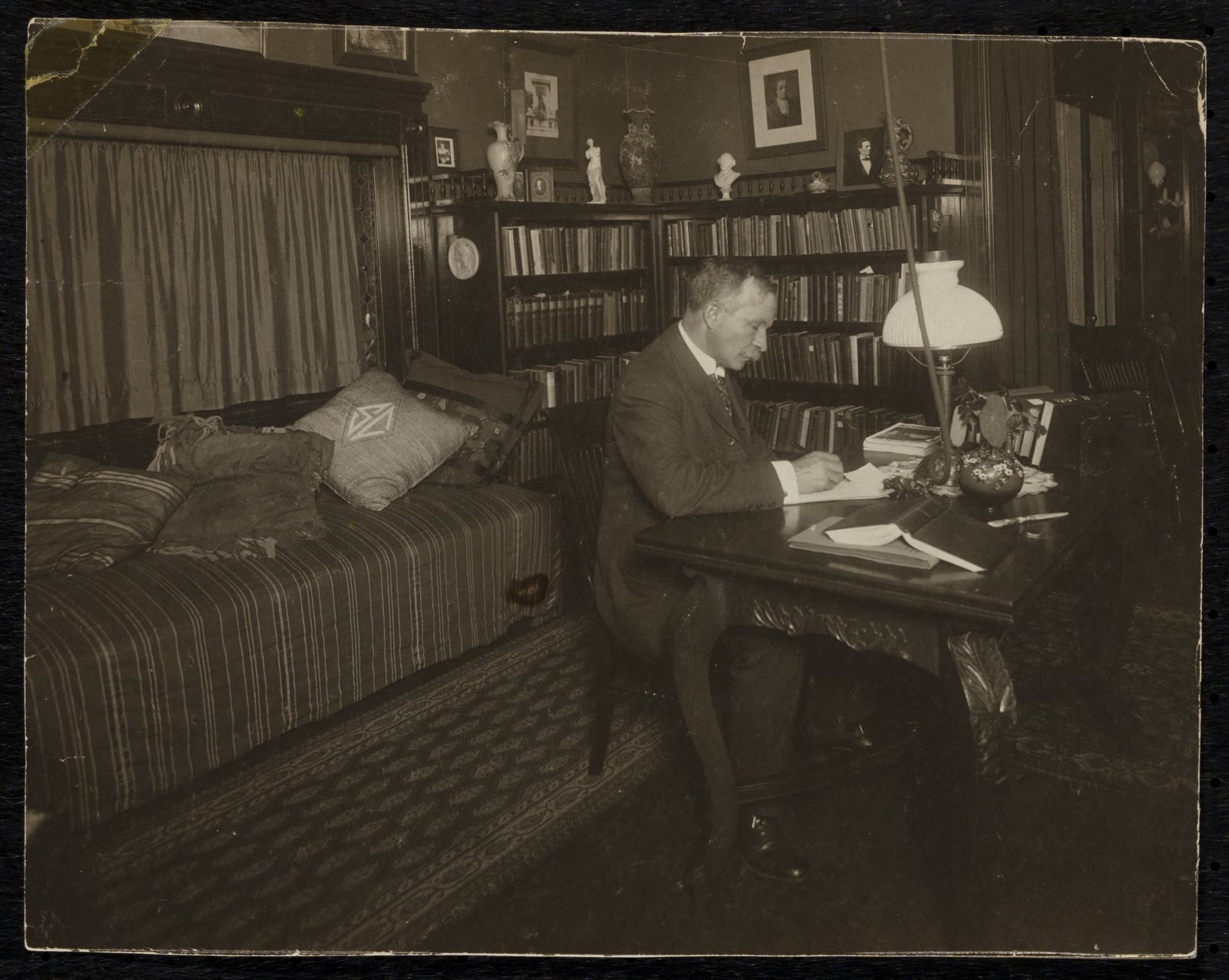
- Wikimedia Commons, “Chesnutt's Library at 9719 Lamont Avenue” — circa-1905 archival photograph from the Cleveland Public Library collection via the Digital Public Library of America.