This essay discusses the novel's ending.
The most revealing word in Rhoda Nunn's political vocabulary is not freedom. It is women. She is at her clearest when she speaks of a class, a cause, a future: women must acquire professions, women must stop treating marriage as rescue, women must become strong enough to alter what men expect of them. George Gissing gives those convictions practical weight in The Odd Women. Rhoda helps run a training school, knows what office work demands, and can show a frightened visitor an alternative to dependency.
Her trouble begins when the plural becomes singular. One hesitant pupil, one disgraced former student, one possible lover—even Rhoda herself as a woman in love—cannot be managed as cleanly as “women” can. Faced with an individual whose need interrupts her theory, she often treats sympathy as weakness and uncertainty as dishonesty. The novel does not use that brittleness to discredit her cause. It does something more interesting: it makes a reformer discover that consistency and integrity are not always the same thing.
Published in 1893, The Odd Women arrived amid arguments about the “surplus” unmarried woman, useful employment, education, and the New Woman. Dorothy Zaborszky places its school close to the practical concerns of Victorian feminists such as Barbara Bodichon and Jessie Boucherett, even while noting the long dispute over whether Gissing's novel is feminist or anti-feminist.[2] Gillian Sutherland's history of middle-class women at work supplies the reality beneath the fiction: the period's changes were carried not only by a sensational public type called the New Woman, but by growing numbers of teachers, clerks, and other white-collar workers negotiating class and respectability.[4] Rhoda is compelling because she belongs to both scales at once. She is an emblem, but she also knows how long it takes to learn a machine.
From “surplus” to reserve
When Monica Madden visits Rhoda at Queen's Road in Chapter IV, Rhoda does not begin with a manifesto. She takes her into a bare room containing two Remington typewriters. She explains that useful speed means at least fifty words a minute and that profitable competence may require six months of practice. Monica's first objection is equally concrete: six months of training means six months without wages.[1]
Only then does Rhoda reveal the larger design. Britain, she says, has roughly half a million more women than men—so many “odd women” who cannot be paired off. Where pessimists see futile lives, she sees a “great reserve” waiting to enter the world's work.[1] The military-economic word is brilliant. A reserve is not refuse. It is capacity withheld by bad organization. Rhoda converts a demographic insult into a theory of unused power.
The scene also exposes her characteristic impatience. Before the grand language arrives, she watches Monica's hesitation with dissatisfaction. She can diagnose the structure that made the girl timid, yet she is tempted to despise the timidity that structure produced. Her invitation therefore contains pressure as well as liberation: become capable, quickly, and in the form the school recognizes. Marisa Palacios Knox has shown how late-Victorian culture could recast professional women's emotional detachment as a kind of morbidity.[3] Gissing neither accepts that diagnosis nor simply reverses it. Rhoda's discipline is a source of life, but she has deliberately trained it into armor.
Hardness becomes a credential
Rhoda jokes to Monica that her object is “to make women hard-hearted.”[1] The joke turns severe in the case of Bella Royston, a former pupil who became a married man's mistress and later appealed to Mary Barfoot for help. Mary wants to receive her again. Rhoda opposes the plan: Bella, she argues, chose knowingly, would compromise the other pupils, and belongs outside an institution devoted to self-respect. Mary yields on readmission but continues supplying Bella with money and finds her a business position. Bella then dies by suicide, leaving a note that she chose death over the struggle to recover her position.[1]
There is a defensible institutional question here. Mary and Rhoda have limited resources and a defined educational purpose; a training school cannot meet every kind of crisis. But Rhoda is not content to defend a boundary. She insists that she feels no compassion and would despise herself if she did. Mary answers with the novel's sharpest diagnosis of her friend: “You have hardened your heart with theory.”[1]
Rhoda's reply reveals more than the coldness. If Bella had been her sister, she says, grief would have blinded her to the larger issue. Because Bella was not, Rhoda remained free to speak the impersonal truth. Feeling, in that account, is merely a distortion produced by proximity. The possibility that proximity may disclose a truth—the weight of desperation, the difficulty of return, the difference between a bad decision and a worthless person—never enters her method.
That is why she makes an illuminatingly flawed leader. Her theory names a structural injustice that polite feeling had failed to repair. Yet she begins to treat the absence of feeling as proof that her judgment is structural. The “reserve” is precious in the aggregate; one woman who cannot keep formation becomes, in Rhoda's emotional accounting, unworthy of sympathy even while Mary continues to provide material aid. Gissing lets the contradiction hurt without pretending that Rhoda's practical work is therefore fraudulent. The school continues to create routes into paid life. Its success and its exclusions are true at the same time.[1][2]
Everard wants equality to kneel
Everard Barfoot sees Rhoda's hardness and mistakes it for invulnerability. He admires her intelligence, stamina, and contempt for convention, but his attraction grows as a contest. The narrator is explicit: Everard's proposal of a union without legal marriage is initially a test, while what he desires is her “unconditional surrender.”[1] Even their most apparently equal exchange carries the old vocabulary. When Rhoda questions him and he promises to answer truthfully, she praises his answer as spoken “like a man.” Her compliment shows how readily moral directness remains coded as masculine, even by the woman challenging that code.
Jacqueline Banerjee argues that the novel's men are not merely obstacles placed before emancipated women; their failures of self-command warn that men, too, must change for a new social order.[5] Everard is the cleanest example. He likes independence as a quality in Rhoda and dislikes it as power over their relationship. He wants the exceptional woman, then designs an experiment in which her exceptionality will be proved by submitting to him.
Rhoda is not merely his victim. She helps convert intimacy into a tribunal. On Seascale beach after their Wastwater walk, she asks for guarantees about his past and tests the exact moral reach of his promises. Later, a false suspicion that Monica has been involved with Everard confirms the danger Rhoda already half expects. Her jealousy is painful partly because it resembles the “ordinary” feminine response she has trained herself to scorn. Rather than admit that love makes knowledge uncertain, she tries to decide whether her own emotion disqualifies the self who feels it.[1]
The affair fails, then, for a subtler reason than incompatible beliefs about marriage. Both characters make love carry an argument about who they are. Everard needs Rhoda's surrender to certify his power; Rhoda needs perfect consistency to certify her independence. Neither leaves the other room to change without treating change as defeat.
“That was not what you said”
Their final meeting in Chapter XXX is a duel over revision. Everard now asks Rhoda to marry him legally. She reminds him that this was not his offer at Seascale. “What do the words matter?” he asks. “That was not what you said,” she replies.[1]
The exchange can make Rhoda look trapped by her old doctrine: when the conventional proposal she once might secretly have wanted arrives, she refuses it and insists on the scandalous free union that Everard no longer wants. But words matter because he used them to construct the trial. At Seascale he offered freedom while privately intending to measure surrender; now he edits the offer after months of silence and expects its emotional meaning to remain intact. Rhoda's precision is not pedantry. It is a refusal to let him rename the past for his convenience.
This is the moment when she becomes most convincing in the singular. She is no longer announcing what marriage means for the majority of women. She is reading one man's conduct and deciding that the terms between these two people have changed. Her declaration that she no longer loves him may be partly defensive—the threatened sob that follows makes certainty impossible—but the boundary is real. She does not owe him a marriage merely because refusing one has become painful.
Nor does Everard emerge as the uncomplicated modern partner whom ideology has cost her. He soon announces his engagement to the more conventional Agnes Brissenden, while acknowledging to himself that Rhoda's love was worth more than his.[1] The novel allows Rhoda's loss without turning Everard into the prize that would have completed her.
One child revises the plural
Gissing's final image gives Rhoda no speech platform. Three months after Monica's death, she visits Alice Madden, who is caring for Monica's motherless baby. Rhoda carries the child around the garden, asks after Alice and Virginia's plan to open a small school, and reports that her own work with Mary is flourishing; they need larger premises and are preparing a paper. Public purpose has not been punished out of her.[1]
Then the registers meet. To Alice she says, “Make a brave woman of her.” Alone with the sleeping infant, her eyes dim and she murmurs, “Poor little child!”[1] Brave woman belongs to the future Rhoda knows how to organize. Poor little child answers the vulnerable person in her arms. Neither phrase cancels the other.
The scene is not a covert conversion to domestic destiny. Rhoda does not adopt the baby, abandon the school, or discover that all along she wanted only motherhood. Instead, Gissing lets her feel an individual life without immediately making it a test case. The child is at once the residue of Monica's destructive marriage, a future pupil for Alice's school, and a person too small to bear anyone's theory. For once, Rhoda can hold need and possibility together.
That ending helps explain the novel's unsettled reception. Critical accounts have continued to debate its ideological allegiance, while work on professional women and emotional detachment shows why Rhoda cannot be reduced either to a feminist mouthpiece or to a cautionary “unwoman.”[2][3] She is strongest where the novel is strongest: where an argument for economic independence acquires rooms, wages, machines, friendships, vanities, and costs.
Rhoda begins by rescuing “odd women” from the grammar of failed pairing. Her great imaginative act is to make the leftover plural into a reserve. The ending suggests a harder education: no plural deserves allegiance if it cannot make room for the singular. In the last garden, the cause does not shrink. It acquires a face.
Sources
- George Gissing, The Odd Women, Project Gutenberg eBook 4313 — complete primary text used for chapter references, scene details, and short quotations.
- Dorothy Zaborszky, “Victorian Feminism and Gissing's The Odd Women: ‘Why Are Women Redundant?’,” Women's Studies International Forum 8, no. 5, 1985, pp. 489–496 — feminist context, work, and the novel's contested ideological reception.
- Marisa Palacios Knox, “The Valley of the Shadow of Books: George Gissing, New Women, and Morbid Literary Detachment,” Nineteenth-Century Literature 69, no. 1, 2014, pp. 92–122 — professionalization, reading, and cultural anxiety about female detachment.
- Gillian Sutherland, In Search of the New Woman: Middle-Class Women and Work in Britain 1870–1914, Cambridge University Press, 2015 — historical context on clerks, teachers, white-collar work, class, and respectability.
- Jacqueline Banerjee, “A Shot across the Bows: George Gissing's Warning to Men in The Odd Women,” The Victorian Web, 2022 — Rhoda and Everard, masculinity, and the novel's reciprocal demand for change.
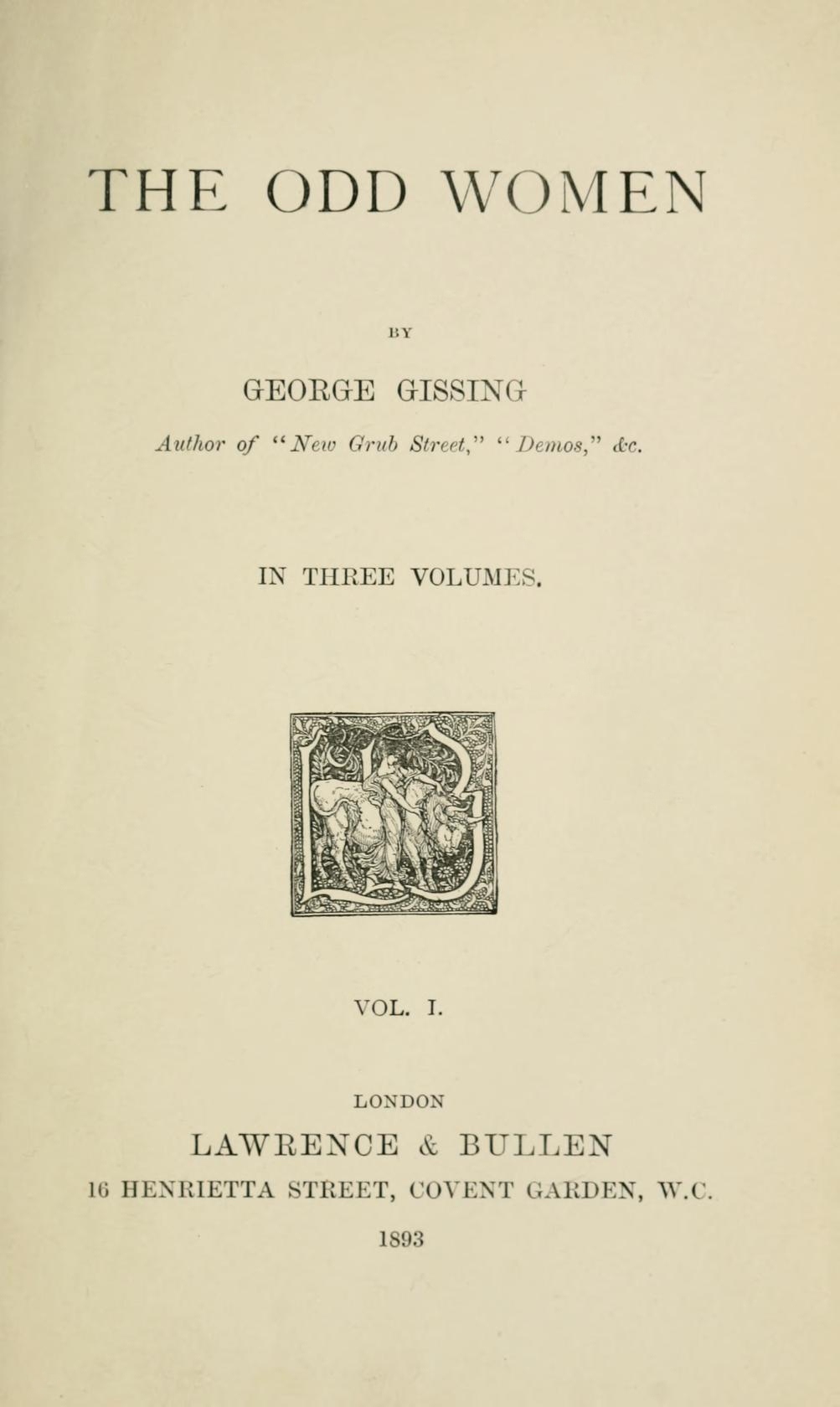
- Wikimedia Commons, “The Odd Women, first edition title page” — source page and provenance for the 1893 Lawrence & Bullen archival scan used as the article image.