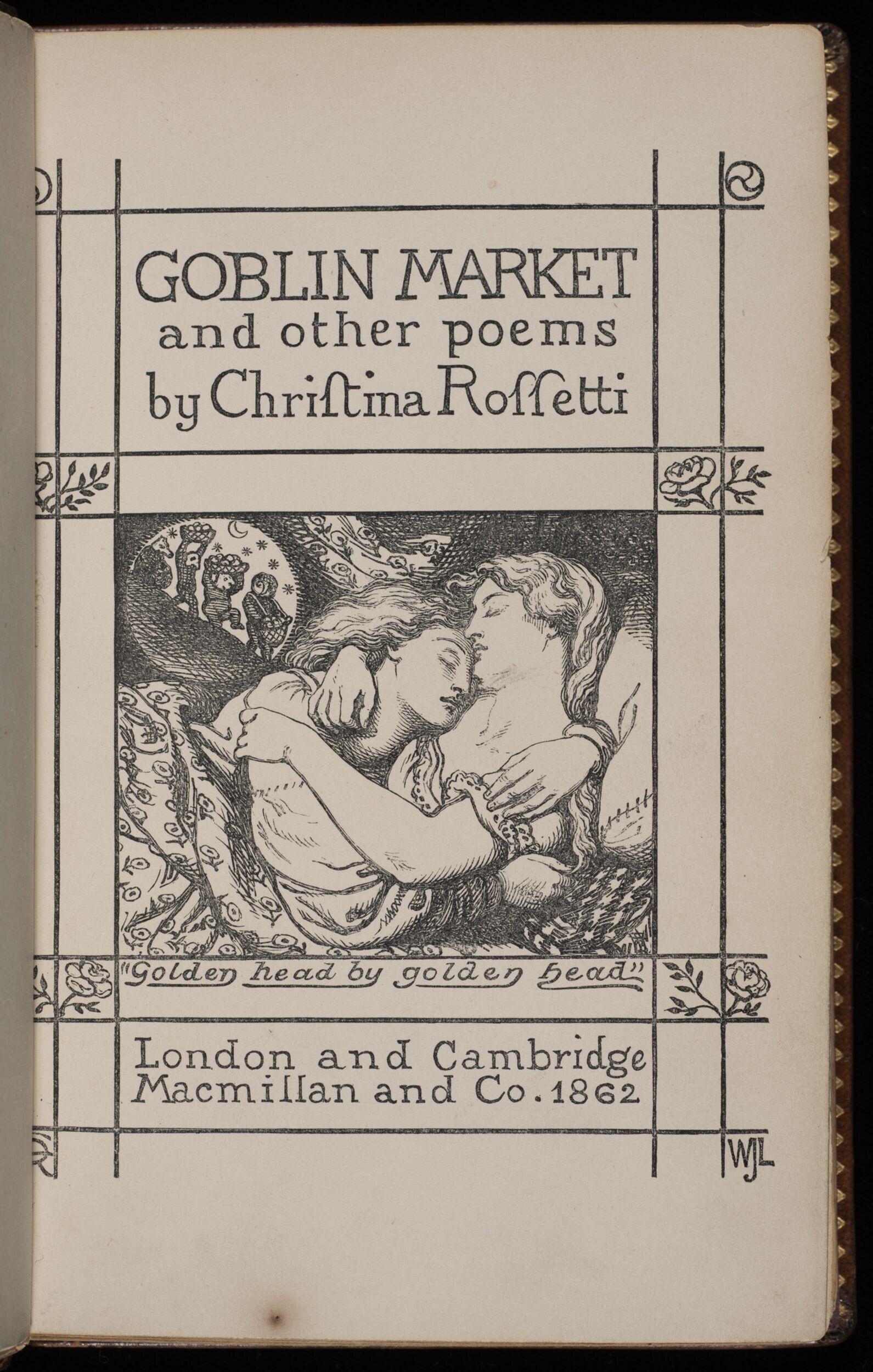
The goblins in Christina Rossetti's Goblin Market advertise fruit, but the poem keeps turning purchase into a transaction the buyer cannot control. Their cry—“Come buy, come buy”—sounds like an ordinary invitation. Their goods arrive in baskets and dishes. Laura names the practical problem: she has no coin. Yet every object that enters this market changes category. Hair becomes money. Fruit becomes appetite. A coin offered for takeaway fruit is ultimately thrown back. The same juice that first consumes Laura later saves her.
That instability is why the poem survives every attempt to pin it to a single moral. First published as the title work of Rossetti's 1862 collection, it was received as fairy tale, allegory, sensuous art object, religious narrative, and eventually a central text for feminist and economic criticism.[2] Each reading catches something real. None quite exhausts a poem whose objects will not hold still long enough to become tidy emblems.
A map of three motifs—the fruit, the golden curl, and Lizzie's silver penny—shows the mechanism more clearly. The danger is not appetite by itself, nor commerce by itself. It begins when the goblins reserve the right to decide what counts as payment, what counts as consent, and whether a buyer may leave with the thing she has bought. Laura's body is folded into their price. Lizzie defeats them not by pretending the market is absent, but by insisting on a boundary it cannot tolerate.
Fruit: abundance without a season
The poem opens with a catalogue before it gives us a plot. Apples, quinces, lemons, oranges, berries, figs, dates, grapes, and pomegranates tumble through lines 5–30. The list is geographically and seasonally impossible: northern berries share a stall with southern citrus; fruits that ripen at different times are all ready at once. Rossetti makes the offer feel inexhaustible by making the verse nearly breathless. Short lines, chiming names, and repeated imperatives turn produce into sound before Laura ever tastes it.[1]
This is the goblins' first conversion. Fruit normally carries evidence of a place, a season, labor, and limits. Their fruit arrives without an accountable orchard. Laura wonders about the soil and wind that could have produced it, but receives no provenance. The catalogue supplies variety in place of history. Everything is ripe; nothing has had to grow.
That distinction helps keep the symbolism precise. The fruit can evoke forbidden knowledge, sexual desire, intoxicants, luxury imports, or the glamour of commodity culture because Rossetti has designed it to exceed any ordinary crop. The peer-reviewed COVE edition records how the poem's religious, erotic, social, and economic meanings have accumulated rather than replacing one another.[2] Ashley Miller likewise describes a long critical debate over whether the marketplace necessarily endangers women, then redirects attention toward how acts of looking and tasting redistribute agency between people and things.[3] The fruit is powerful not because it decodes neatly, but because its sensory excess outruns every origin story offered for it.
Laura's first feast, in lines 128–140, makes abundance contract into solitude. The verse repeats the action of sucking until her lips are sore. She throws away the rinds but saves one seed, as if a kernel might let her reproduce the experience on her own terms. It never germinates. The fruit has created a consumer without creating a renewable good.
The morning after, the household still contains honey, milk, wheat cakes, butter, and cream. Those foods belong to shared work: the sisters milk, knead, churn, feed, fetch, and eat within a cycle that can begin again. Goblin fruit belongs to no such cycle. Once Laura has tasted it, only Lizzie can still hear the sales call. Appetite does not enlarge Laura's world; it seals her inside a private sensation that cannot be communicated or replenished. Miller's account of perception is useful here: the incomparable taste subjects Laura to the object and cuts her off from the sensory world she formerly shared.[3]
The golden curl: when the customer becomes currency
At the point of sale, Laura says she has no copper or silver. The goblins answer that she has “much gold upon your head” and ask for a curl. Across lines 102–140, the language of money slides onto the body with frightening ease. Her hair is precious metal, the tear she drops is rarer than a pearl, and the fruit sits in a heavy golden dish. The scene seems to glitter because every surface has acquired an exchange value.[1]
But a lock of hair is not a coin. Money is meant to be replaceable: one penny can stand for another penny. Hair is attached, intimate, and finite. To pay, Laura must cut off part of herself. The goblins therefore do more than exploit a customer who lacks cash. They rewrite the distinction between the person buying and the thing being sold.
Terrence Holt's 1990 study made exchange itself central to the poem's critical vocabulary, and later scholarship has kept returning to the question of whether women can enter this market without becoming merchandise.[3][4] The curl gives that question a physical form. Laura appears to choose the bargain, but the merchants alone invent its terms. They convert her body into tender only after learning that ordinary tender is unavailable.
The motif returns during her decline. Her remaining hair grows thin and grey while the kernel she carried home stays barren; neither body nor seed replenishes what the bargain depleted. This is not a mechanical punishment in which one clipped lock causes every later change. It is a visual accounting system: the poem makes depletion legible in the same material the goblins called wealth. What looked like surplus gold turns out to have been living tissue.[1]
Rossetti's brother Dante Gabriel understood how strongly hair organizes the poem. He designed the frontispiece around the purchase with a golden curl and the title page around the sisters lying “golden head by golden head.” The Rossetti Archive dates those designs to 1861, during preparation for the first edition.[5] One image makes hair alienable; the other makes it a resemblance shared without being spent. Before the reader reaches line 1, the book has already offered two economies of gold.
The silver penny: a price the sellers refuse
Lizzie does not go to the glen empty-handed. In lines 324–389 she puts a silver penny in her purse, listens and looks deliberately, and asks the goblins for fruit to carry home. Her plan looks more like a cash transaction than Laura's embodied barter did: a buyer offers a coin and asks for portable goods.[1]
The goblins refuse. They invite her to sit, feast, and become their guest. When she repeats the transaction—either sell the fruit or return the fee—their hospitality instantly becomes assault. They tear her clothes, pull her hair, bruise her, and press fruit against her mouth. The violence is already latent in the sales pitch; the penny merely exposes it.[1]
Why do they return the coin? The goblins give one answer in lines 376–379: fruit carried away would lose its bloom, dew, and flavour.[1] Yet that explanation also protects their control over the conditions of consumption. If Lizzie can exchange a coin for fruit and walk away, she—not they—will decide where and by whom it is eaten. They instead demand that purchase, eating, and bodily access occur together, under their supervision. Their market has merchandise and sales language, but no dependable right of exit.
The poem's coin is not simple legal tender, however. Jill Rappoport notes that a silver penny was no longer regular currency in Britain by the 1850s and 1860s. She traces its other resonances through fairy payment and Maundy money, a ritual currency associated with Christian service and giving; she also preserves the more prosaic possibility that one silver penny is merely insufficient beside Laura's gold.[7] The returned penny therefore does not decode the scene by itself. It makes competing exchange systems audible at once.
Control is this essay's inference from the sequence, not a fact the narrator announces. It fits the goblins' acceptance of Laura's embodied payment, their refusal to let Lizzie carry a purchase away, their violence when she asks for the coin back, and their final return of the penny while they kick the fruit aside. Rappoport's gift-economy reading pulls in another direction: Lizzie arrives with a coin whose cultural associations already exceed commercial payment, then completes her rescue through service no price could settle.[7] The object tests the market's terms precisely because it belongs securely to none of these explanations.
The penny survives the encounter unchanged. At lines 439–454 it bounces in Lizzie's purse, and its jingle becomes music as she runs home.[1] That small sound answers the goblins' earlier sales chorus. Their jingle tries to make wanting compulsive; her jingle marks a transaction they failed to impose. The coin's value lies less in what it buys than in keeping the difference between sale and service unresolved.
The closed mouth: refusal that still carries something home
Lizzie's resistance is easy to flatten into a lesson about purity, but the poem makes it stranger and more active. She does not remain safely outside the market. She goes in, sees the merchants, offers money, endures their attack, and returns bearing the very juice Laura needs. Her achievement is not untouched withdrawal. It is controlled contact.
Rossetti builds the confrontation out of objects that refuse their assigned function. The penny cannot buy. The goblins claim their fruit cannot travel in an apron without losing its freshness, yet its juice travels on skin. Lizzie's body is treated as an object by the goblins, but it does not become their commodity. Compared at line 409 to “Like a lily in a flood,” she holds her mouth shut while everything around her moves.[1] Miller argues that this scene complicates the usual equation of objecthood with powerlessness: Lizzie makes surface, transport, and refusal into forms of agency.[3]
The mouth is the decisive border. Laura's first encounter turns looking into tasting and tasting into an appetite without limit. Lizzie will not “open lip from lip.” The phrase makes refusal minute and muscular: she cannot stop the juice touching her face, but she can prevent the goblins from defining that contact as consumption.[1]
When she reaches Laura, however, the boundary changes purpose. Lizzie invites her sister to kiss and taste the juice in lines 464–474. The invitation is intimate, even startling, but it reverses the market's grammar. The goblins offered fruit to capture a consumer; Lizzie carries it to someone whose need she already knows. They tried to force an open mouth; she offers her bruised surface and leaves Laura able to respond.
The fruit changes with the relation. What was impossibly sweet becomes bitter on Laura's tongue, an antidote rather than a repeat pleasure. Rossetti does not explain this as chemistry. The transformation belongs to narrative ethics: the substance obtained through the goblins' asymmetrical bargain isolates, while substance carried through chosen care reconnects. Fruit has not acquired one final symbolic meaning. Its effect depends on who controls its passage between bodies.[1]
Golden heads together: value after the market
The closing lines leap forward to Laura telling the story to children. Readers often remember the coda's claim that there is “no friend like a sister,” and the line can sound tidier than the feverish poem preceding it.[1] COVE's reception history helps explain why the ending has supported readings of Christian redemption, female solidarity, domestic restoration, and more radical alternatives to masculine exchange.[2]
The motifs make the coda less simple. Laura has not forgotten appetite; she turns the experience into a warning that can circulate. Lizzie's rescue has not destroyed the fruit; it has changed who may carry it and toward what end. Hair, once clipped into payment, returns in the first edition's title-page image as the visual rhyme between two resting heads. A penny comes home precisely because it purchases nothing. Value survives, but no longer on the goblins' terms.
That is why Goblin Market is more durable than a prohibition tale. It never asks the reader to believe that wanting can be abolished. Its most dangerous objects are also its most beautiful, and its rescue depends on bringing some of that danger home. The poem's sharper distinction is between an exchange that makes a person spend herself and a gift that lets one person risk herself for another without declaring the recipient a debt.
Sources
- Christina Rossetti, “Goblin Market,” in Goblin Market and Other Poems (Macmillan, 1862), University of Virginia Literature in Context — first-edition text, line numbers, and facsimile page images.
- Lorraine Janzen Kooistra and Antony Harrison, “Editorial Introduction to the COVE Goblin Market Edition” — publication history, genre, annotations, and critical reception.
- Ashley Miller, “Christina Rossetti's Radical Objectivity,” Victorian Literature and Culture 46, no. 1 (2018), 143–156 — material things, perception, exchange, and Lizzie's resistant objecthood.
- Terrence Holt, “Men Sell Not Such in Any Town: Exchange in ‘Goblin Market,’” Victorian Poetry 28, no. 1 (1990), 51–67 — JSTOR record for the poem's exchange-economy reading.
- The Rossetti Archive, “Goblin Market (various designs)” — production history of Dante Gabriel Rossetti's 1861 frontispiece and title-page designs.
- Victoria and Albert Museum, “Goblin Market and Other Poems,” object L.812-1933 — catalogue record and digitized title page of the 1862 edition used for the lead image.
- Jill Rappoport, “The Price of Redemption in ‘Goblin Market,’” SEL Studies in English Literature 1500–1900 50, no. 4 (2010), 853–875 — the silver penny as nonstandard coin, fairy and Maundy currency, and gift or service exchange.