For many English readers, the ninth-century Irish scholar and his white cat have always been in the same business. Pangur hunts mice; the scholar hunts words. They work through the night, contentedly parallel, each perfecting a private art.
That is the poem Robin Flower made in 1912, and it is difficult not to love. Its opening is a small machine for memorability:
I and Pangur Bán my cat,
’Tis a like task we are at:
Hunting mice is his delight,
Hunting words I sit all night.[5]
The rhyme catches cat with at, then delight with night. It names both objects of pursuit, turns scholarship into an active chase, and closes the room around two absorbed companions. But “hunting words” is not a phrase waiting intact in the Old Irish. Nor does the surviving text say that the scholar writes all night. Those are Flower's catches: brilliant additions that make the analogy immediate and quietly change what kind of worker sits beside Pangur.
Return to the Old Irish and a stranger pleasure appears. The scholar is not quite a poet stalking the perfect word. He is a reader confronting difficult meaning. The cat and the human do not simply perform the same action on different prey. Across eight compact stanzas, the poem patiently equips them with corresponding nets, eyes, problems, joys, and habits—then lets each practice alone.[1][2]
The first stanza keeps one craft unnamed
The opening in the Cambridge text reads:
Messe ocus Pangur bán,
cechtar nathar fria saindán;
bíth a menma-sam fri seilgg,
mu menma céin im saincheirdd.[1]
A close prose rendering gives “I and white Pangur,” then says that each attends to his own art. Pangur's mind is set on seilgg, hunting; the speaker's mind is on his saincheirdd, his particular or special craft.[1] The grammatical balance is already neat—his mind, my mind—but the activities are not yet made identical. The cat hunts. The scholar practices something the stanza declines to specify beyond craft.
Flower makes three clarifying moves at once. He supplies “my cat,” specifies the prey as mice, and converts the scholar's unnamed craft into word-hunting. “I sit all night” completes the rhyme and adds a cozy clock. The result is more pictorial than the original: before the first stanza ends, we can see the lamp, book, cat, and long vigil even though the Old Irish has not furnished that scene.
This is not a mistranslation in the useful sense of a mistake to be corrected. It is a theory of the whole poem placed in its first four lines. Flower has read forward, seen the scholar trap meanings and solve problems, then returned to the opening and named the craft “hunting words.” Pádraic Moran's parallel archive of versions makes the decision especially visible: more literal translators retain “special art” or “special craft,” while freer versions increasingly let the opening announce the analogy that the Old Irish develops by stages.[2]
First the cat's net, then the scholar's
The poem's fourth stanza supplies the mechanism Flower anticipates. A mouse sticks in Pangur's lín; in the next line, something falls into the scholar's lín. The same noun—net—crosses from floor-level predation into thought. Yet what the second net catches is not a word. The Cambridge translation calls it a “difficult rule of hard meaning.” Earlier editions compared in Moran's archive offer a difficult dictum, law, or problem.[1][2]
That scholastic roughness matters. Dliged can name a rule, principle, dictum, or authoritative formulation; it is at home in the work of grammar and learned commentary. The scholar's catch is therefore not necessarily a beautiful word for a poem. It may be the rule that finally construes a stubborn passage, the principle that makes a sentence yield sense. Flower's “my keen thought” taking “a meaning in its net” keeps the trap but replaces the technical object with a smoother drama of inspiration.[1][2][5]
The next stanza repeats the pairing through sight. Pangur directs his bright, full eye toward the wall or enclosure where prey may emerge. The scholar directs his own clear but weak eye toward the keenness of knowledge. Flower turns the second target into “the wall of knowledge,” extending the room's masonry into a grand metaphor. The Old Irish relation is less perfectly mirrored: one eye fixes a physical boundary, the other strains toward acuity itself.[1][5]
That weak eye is easy to lose, but it is one of the poem's best jokes. The scholar admires the cat's complete visual equipment while admitting that his own clarity is imdis, very feeble. He is not Pangur's superior because his quarry is abstract. The cat's competence is bodily and decisive; the human has to squint.
Rhyme makes equality sound easy
The original's form is part of the comparison. Its modern arrangement gives eight four-line stanzas in deibide, a demanding syllabic mode in which a stressed line ending answers an unstressed one; alliteration adds further binding. Ruben Moi notes that Flower preserves short, rhymed, end-stopped movement while replacing much of the original's compressed learned texture with the lucid bounce of a children's poem.[3]
That bounce does ethical work. Flower's couplets make the pair sound equal because every line promptly finds its mate. Cat answers scholar, pleasure answers pleasure, mine answers his. The translation's fluency turns noninterference into companionship: “So in peace our task we ply.”[5]
The Old Irish is affectionate, but its intimacy is less sociable. When the two are alone in the house, each has an “endless sport” on which to exercise skill. Neither hinders the other. Each likes his own dán—art, faculty, or gift—and “severally” rejoices in it. At the end, Pangur is master of the work he does every day, while the speaker attends to bringing what is difficult into clarity.[1]
This is not a scene of collaboration. Pangur does not inspire a solution, sit on the manuscript, or offer emotional support. The scholar does not praise the cat for keeping mice away from his pages. Their fellowship consists in parallel concentration and a generous lack of interference. The poem's surprisingly modern charm comes partly from refusing to make affection demonstrative. To respect Pangur is to allow that his craft is sufficient to him.
“Hunting words” also changes the scholar
Flower's phrase has had an enormous afterlife because it gives writers a ready self-portrait. The cat hunts the mouse; the poet hunts the exact expression. Later poet-translators could make that identification explicit, alter the meter, or test their own verbal dexterity against the old poem. Moi's study traces versions by Seamus Heaney and Paul Muldoon alongside Flower's influential rendering and argues that translation has become one of the ways Pangur Bán keeps renewing its literary identity.[3]
But the popular phrase also promotes the medieval speaker from reader to writer. The surviving poem places him beside a lebrán, a little book, diligently pursuing knowledge. His recurring verbs concern fixing attention, understanding a beloved hard question, and making difficulty clear. None of that excludes composition: the person who wrote these stanzas plainly possessed formidable craft. It does mean that the poem's dramatic speaker is defined by interpretation before he is defined by authorship.[1]
The distinction changes the room. In the word-hunting version, both occupants chase mobile prey. In the more literal version, Pangur waits for motion while the scholar works against resistance. A mouse darts or sticks; a difficult formulation does not flee but refuses to open. One craft culminates in a claw closing. The other culminates in clarity.
Gregory Toner's structural reading pushes against treating this as merely a cozy animal anecdote. As summarized by Cambridge, Toner sees the cat as a figure for the scholar's activity and the poem as a sophisticated reflection on creativity rather than casual domestic description.[1][4] Even so, metaphor need not erase the cat. Pangur's independence is what makes the comparison powerful: he is not a decorative emblem pasted onto intellectual work, but a second master whose precise difference gives the scholar a way to see his own practice.
The manuscript keeps the scale honest
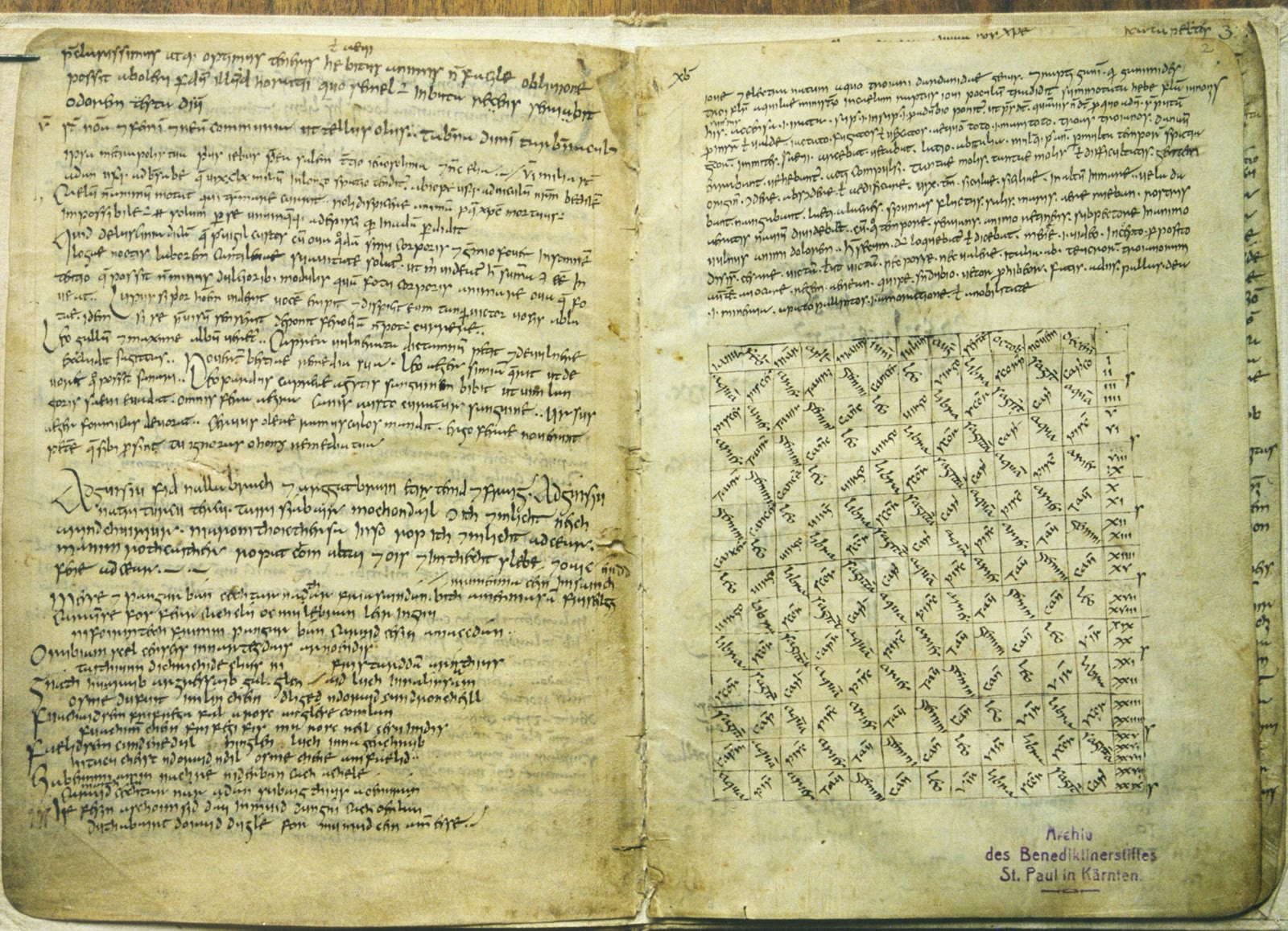
Only one medieval witness of Pangur Bán survives. It appears on folio 1v of the Reichenau Primer, a small ninth-century schoolbook written by an Irish scribe probably on the European continent and now held at the monastery of St Paul im Lavanttal in Austria. The page gathers the poem into a learned environment that also contains Latin and Greek material; in the archival scan, its opening words begin near the bottom of the left leaf.[1][2][6]
That physical placement resists two sentimental fantasies at once. This is not a grand illustrated page dedicated to a famous cat, and it is not evidence that medieval scholarship was sealed off from vernacular play. The Old Irish poem occupies modest space inside a multilingual working object. Its lightness and learning were never opposites.
The scan also restores something translations can conceal: Pangur Bán did not arrive as an English nursery lyric with perfectly aired quatrains. It survives as close writing on worn parchment, its portable form recovered through editing, dictionaries, pronunciation work, and repeated acts of translation. The cheerful clarity of Flower's version is an achievement, not the poem's natural condition.
Keep the catch—and notice the net
A reader need not give up “hunting words.” Flower's phrase has the rare virtue of being both inaccurate at the lexical level and deeply responsive to the poem's larger design. It catches the active symmetry, the pleasure of concentration, and the translator's own craft in four irresistible syllables.
It should not be allowed to end the reading. Behind that bright phrase is a poem more exact about difficulty: the scholar's unnamed craft, the duplicated net, the weak eye, the dearly loved hard question, the daily work of bringing obscurity toward clearness. Its companionship is built not on two creatures doing the same thing, but on each recognizing mastery in the other's different pursuit.
Flower gives us a writer hunting words through the night. The Old Irish gives us something quieter and perhaps more durable: a reader who loves what resists him, working beside a cat who already knows exactly where to look.
Sources
- University of Cambridge, Department of Anglo-Saxon, Norse and Celtic, “White Pangur: A scholar and his cat”—Old Irish text, word-level dictionary links, Gerard Murphy's close translation, pronunciation recording, manuscript context, and summary of Gregory Toner's interpretation.
- Pádraic Moran, The Parallel Pangur—the normalized Old Irish text and a side-by-side archive of scholarly, poetic, and multilingual versions with bibliographic links.
- Ruben Moi, “Pangur Bán, Translation, Postmodernism, Paul Muldoon,” Nordlit 49 (2022)—the poem's meter, manuscript setting, and translation afterlife from Robin Flower to later poet-translators.
- Queen's University Belfast research portal, Gregory Toner, “‘Messe ocus Pangur Bán’: Structure and Cosmology,” Cambrian Medieval Celtic Studies 57 (2009), pp. 1–22—peer-reviewed article record and scope.
- Robin Flower, “The Student and His Cat,” in Eleanor Hull, ed., The Poem-Book of the Gael (1912), Project Gutenberg—public-domain text of the influential rhyming English version.
- Wikimedia Commons, “Reichenauer Schulheft 1v 2r kl1”—archival scan of folios 1v–2r of the Reichenau Primer, including the sole surviving witness of Pangur Bán.