George Herbert's most famous rebel begins by hitting furniture. “I struck the board, and cry'd, No more,” the speaker of “The Collar” announces, then declares, “I will abroad.”[1] This is not the opening one expects from a poet embalmed by reputation as a mild country parson. The hand moves before the doctrine. A blow becomes a line; a line tries to become an exit.
Herbert's devotional poems repeatedly begin in that gap between what a believer is meant to know and what a person can presently say. Prayer meets silence. Sacred poetry becomes self-display. Shame turns hospitality into a trial. His speakers do not reason themselves smoothly back to order. Something interrupts them: a broken rhyme, a friend's whisper, a host's question, one word heard from beyond the speaker's furious monologue.
That pattern offers a better portrait of Herbert than serenity alone. He was a formidable rhetorician who became suspicious of rhetoric's wish to control its own effects. He built poems precise enough to register the instant when precision no longer belongs entirely to the poet.
The public orator knew how authority sounds
Before Herbert became rector of Bemerton, he spent nearly two decades at Cambridge and rose to Public Orator, the university's official voice on ceremonial and political occasions. The post put him near courtly ambition; priesthood redirected a life that might have continued through public office.[5] This biography matters less as a conversion from vanity to purity than as training in the pressure of address. An orator speaks for an institution, before an audience, in language expected to produce a response.
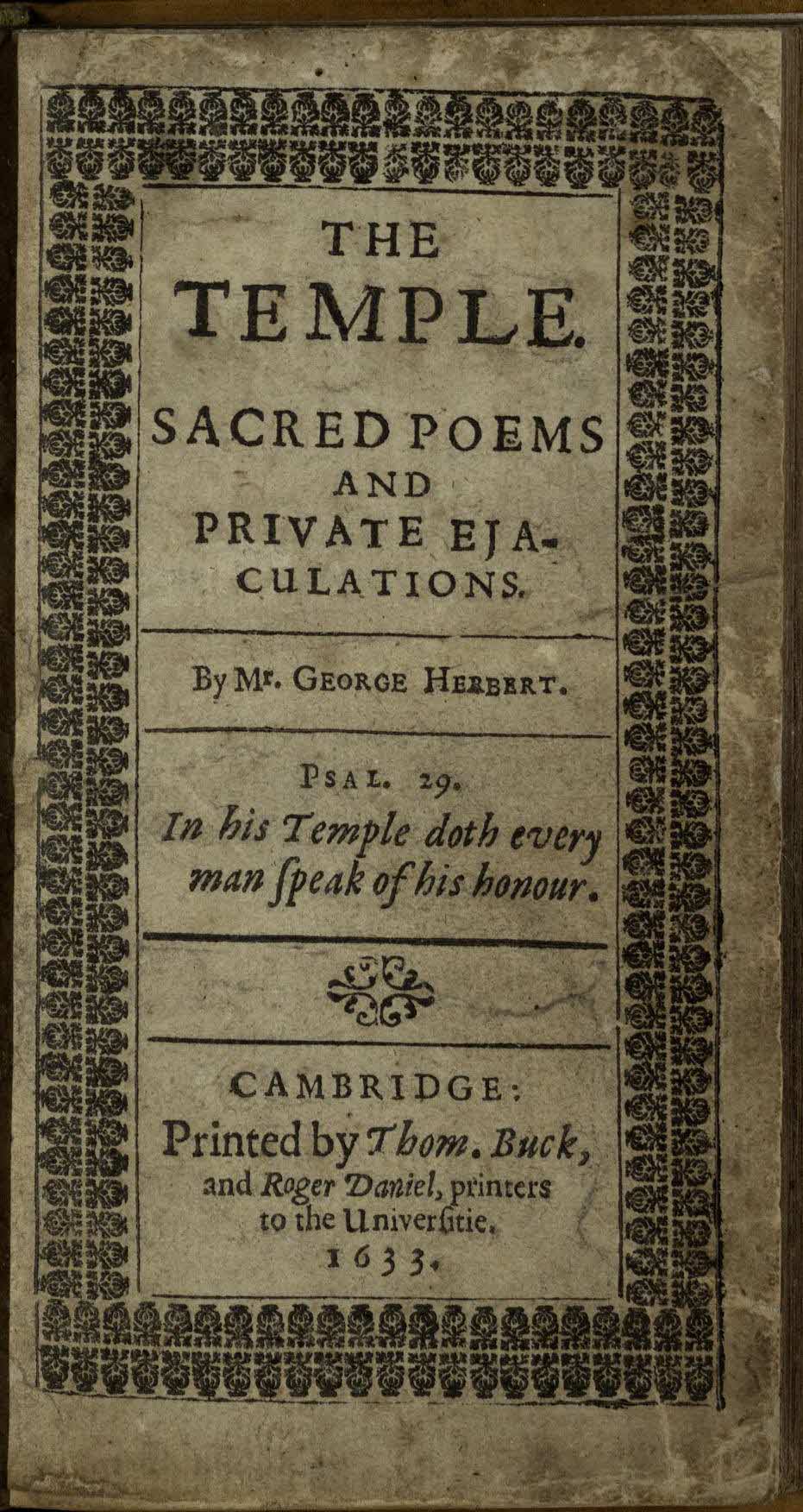
The English lyrics collected in The Temple turn those conditions inward. Who is speaking? On whose authority? What happens when an address receives no answer—or when the answer refuses the terms in which it was solicited? Herbert did not publish his English poetry during his lifetime. After his death in 1633, the small first edition appeared at Cambridge and became rapidly popular.[5][8] The book's modest physical scale suited carrying, rereading, and devotional use; its alphabetical index let a reader move among named conditions such as “Conscience,” “The Crosse,” “Love,” and “Mortification.”[8]
The textual history is less tidy than the familiar deathbed story of a single manuscript delivered for publication. The Catalogue of English Literary Manuscripts identifies two principal surviving witnesses: the Williams manuscript, containing early versions and Herbert's corrections, and the scribal Tanner manuscript, containing 167 poems later printed in The Temple. Neither is the “little Book” described by Herbert's first biographer.[6] That uncertainty is apt. Herbert's poems survive as carefully made verbal objects, but they distrust any account—including an author's account of himself—that closes too neatly.
“The Collar” gives rebellion its full voice
The speaker of “The Collar” does not merely complain about religious discipline. He drafts an emancipation speech. His “lines and life are free,” he says; he will leave the “cold dispute / Of what is fit, and not,” forsake his “cage,” recover lost years, and claim “double pleasures.”[1] Freedom arrives as a sequence of imperatives addressed to the self: recover, leave, forsake, take heed. He becomes his own commanding officer.
The verse looks as agitated as the argument. Long lines jut beside short ones. Questions, exclamations, and abrupt declarations prevent a settled stanza from forming. Yet the speech is not shapeless. Sound keeps fastening its claims together: “more” reaches “store” and “restore”; “pine” anticipates “wine”; “thorn” answers “corn”; “board” returns in “abroad.”[1] The rebel says he is free while rhyme keeps discovering attachments he has not abolished.
Even his images of deprivation carry the memory of abundance. A thorn implies a plant; dried wine implies a former vintage; drowned corn implies seed and harvest. The complaint that service has yielded nothing must name the very fruits it says are gone. This does not prove the speaker secretly agrees with the answer awaiting him. It shows that rebellion is composed from the same devotional vocabulary it attacks. He cannot imagine escape except through a transformed version of the world he inhabits.
Then the poem changes speakers:
Me thoughts I heard one calling, Childe:
And I reply'd, My Lord.[1]
The call is not an argument. It does not refute the lost harvest line by line, threaten punishment, or expose the rebel as insincere. “Childe” simply names a relationship that the monologue has excluded. “My Lord” accepts that relation in reply. The exchange is unequal but reciprocal: two forms of address, four words, one turn each.
Barbara Leah Harman's study of the poem cautions against treating the outburst as pure present-tense access to a mind. The rebellion is already framed by retrospective narration; the speaker remembers that he “heard” a call and answered it.[7] The ending therefore does not erase the speech that precedes it. The chastened speaker preserves his own revolt, down to its fiercest wording. Submission includes the decision to tell the whole disturbance.
“Deniall” lets failed prayer damage the rhyme
In “The Collar,” an outside voice stops a torrent of speech. “Deniall” asks what poetry can do when no voice arrives. Its first sentence makes spiritual and formal failure simultaneous: “When my devotions could not pierce / Thy silent eares; / Then was my heart broken, as was my verse.”[2] Prayer cannot get through, so the poem refuses to pretend that its own music remains intact.
For five stanzas, each final line hangs without the rhyme that the ear has been taught to expect. The first closes on “disorder”; later stanzas fall out on “alarms,” “But no hearing,” and “Discontented.”[2] These are not random roughnesses. Four preceding lines establish a pattern, and the fifth exposes the missing response. The reader waits at the same locked door as the speaker.
Herbert also refuses to idealize persistence. Unanswered devotion does not make the mind nobly steadfast. Thoughts “flie asunder”; some head toward pleasure, others toward “warres and thunder.” The soul lies “Untun'd, unstrung,” like an instrument that cannot answer the hand.[2] The poem knows that silence changes the person who must endure it. It scatters attention and makes even continued prayer feel mechanical.
The last stanza asks God to “cheer and tune” the speaker so divine favor and human mind “may chime, / And mend my ryme.”[2] On ryme, the withheld sound finally arrives: time, chime, ryme. Form does not illustrate a truth already possessed. It enacts the requested repair at the last possible instant. Whether one reads that closure as answered prayer or as the poet's hope taking audible shape, the distinction remains important: Herbert does not report that harmony returned and then decorate the report. He makes us feel its absence before permitting it.
“Jordan (II)” catches the poet decorating devotion for sale
Silence is not the only threat to sacred speech. Fluency can also go wrong. In “Jordan (II),” the writer begins with “heav'nly joyes,” then watches his language “burnish, sprout, and swell.” He curls a plain intention with metaphors and decks the sense “as if it were to sell.”[3] The problem is not ornament by itself. It is the moment expression turns into merchandise, with the poet admiring how persuasively the goods have been dressed.
The joke is that Herbert describes this excess beautifully. Notions queue to offer their service. Drafts are rejected as too slow or too dead. The writer “weave[s]” himself into his subject like flame working through air.[3] A supposedly plain critique of poetic ingenuity arrives in three polished sestets, using the very craft it distrusts.
Herbert escapes neither by publishing the showpiece unchanged nor by replacing poetry with a flat maxim. He introduces a second voice. A friend whispers, “How wide is all this long pretence!” and advises him to copy the sweetness already written in love.[3] The whisper matters as much as its counsel. Correction comes quietly, from beside the writer, while he is bustling. The friend does not seize the pen; he changes what the poet can hear in his own performance.
Nor does the intervention make craft disappear. The friend's rebuke completes the poem's rhyme and metaphorical design. Herbert's simplicity is achieved, not innocent. The lyric stages a writer using elaborate means to discover where elaboration becomes evasive. Its final “save expense” is both spiritual economy and an expert craftsman's punch line.[3]
“Love (III)” will not let shame finish its case
“Love (III)” moves the interruption to a doorway. Love welcomes; the soul draws back. Every time the guest produces a reason for exclusion, the host answers it. Am I worthy? “You shall be he.” I cannot look at you. “Who made the eyes but I?” My damaged sight deserves shame. “And know you not … who bore the blame?”[4]
The guest's logic is not foolish. He accurately recognizes ingratitude and harm. What fails is his claim to control the consequences. Shame wants to be judge, sentence, and usher: it will decide who belongs, where the guilty should go, and what service might repay the debt. Love interrupts not by denying guilt but by refusing to let guilt become the highest authority in the room.
The final exchange turns argument into hospitality. The guest offers service; Love commands him to sit and eat.[4] That imperative is essential. A softer poem might permit the ashamed person to hover helpfully near the table, preserving self-condemnation as humility. Herbert makes reception harder than punishment. The guest must stop managing his status and accept food he did not earn.
The poem's dramatic form prevents either side from becoming an abstract proposition. Love watches, approaches, takes a hand, smiles, questions, and serves. The guest answers, objects, revises, and finally acts. The closing “So I did sit and eat” is plain because the struggle has already occurred in dialogue.[4] Grace becomes credible not as a slogan but as the other speaker's sustained refusal to abandon the exchange.
The “holy poet” remains a divided speaker
Later accounts of Herbert often made his life exemplary: worldly promise yielded to priestly duty; the orator became the country parson; conflict found balance. That arc is real enough to orient a reader, and modern profiles still emphasize the tension between the public career Herbert might have pursued and the vocation he accepted.[5] But the poems do not become richer when treated as evidence that the tension was permanently solved.
They are richer because Herbert gives self-division technical dignity. Anger gets syntax and rhyme. Distraction determines stanza shape. Vanity is allowed its best metaphors. Shame presents a coherent brief. The answering voice does not win by making those states sound ridiculous. It enters after they have been fully articulated and alters the relation in which they are heard.
This is also why Herbert's formal control feels unlike mere polish. He does not use craft to keep disturbance outside the poem. He builds a form capable of being struck by it. A jagged monologue contracts into dialogue; an unrhymed sequence finds its chime; a crowded poetic workshop makes room for a whisper; a theological argument ends in the physical verbs sit and eat.
Across these poems, devotion is not uninterrupted attention. It is the practice of becoming interruptible. The speaker speaks hard enough to discover the limits of his own voice, then leaves—or is given—space for an answer he could not have authored alone.
Sources
- George Herbert, “The Collar,” in The Temple (1633), Christian Classics Ethereal Library—primary text used for quotation and formal analysis.
- George Herbert, “Deniall,” in The Temple (1633), Christian Classics Ethereal Library—primary text and original stanza layout.
- George Herbert, “Jordan (II),” in The Temple (1633), Christian Classics Ethereal Library—primary text used for the account of poetic ornament and correction.
- George Herbert, “Love (III),” in The Temple (1633), Christian Classics Ethereal Library—primary text used for the dialogue and closing action.
- Poetry Archive, “George Herbert”—biographical overview of Cambridge, Bemerton, vocation, and the tensions dramatized in the poems.
- Peter Beal, “George Herbert,” Catalogue of English Literary Manuscripts 1450–1700—account of the Williams and Tanner manuscripts, their authority, and the lost “little Book.”
- Barbara Leah Harman, “The Fiction of Coherence: George Herbert's ‘The Collar,’” PMLA 93, no. 5 (1978)—abstract and bibliographic record for the poem's retrospective frame and divided account.
- Gabriel Sewell, “Reading the Collections, Week 14: George Herbert, The Temple (Cambridge: Thomas Buck and Roger Daniel, 1633),” University of St Andrews Special Collections—first-edition history, physical description, and source photograph for the article image.