The most arresting person in Rebecca Harding Davis's Life in the Iron-Mills is made from factory waste. Hugh Wolfe, a Welsh furnace tender, steals hours from sleep to carve a crouching woman out of korl, the pale, porous refuse left after iron is smelted. When a mill owner, a doctor, and an educated visitor discover the figure, they admire its straining muscles and demand its meaning. Hugh gives them three words: “She be hungry.”[1]
The answer seems simple until he adds that she is “not hungry for meat.”[1] Then the sculpture becomes dangerous. Bodily need would let its wealthy spectators imagine an equally bodily remedy—a meal, a wage, a charitable gift. Hugh instead gives hunger a larger object he cannot quite name: beauty, knowledge, scope, a life in which his powers could become more than exhausted possibility. The korl woman does not merely ask to be rescued from the mill. She asks why a society capable of recognizing her form cannot imagine an obligation to the person who made it.
That is the novella's philosophical force. Davis turns hunger into a test of interpretation, then shows every available interpreter failing it. The owner sees labor as a contract, the philanthropist sees a genius who ought to improve himself, and the intellectual sees a social problem worth diagnosing. All three can read the statue. None will answer it.
A body made from what the furnace rejects
Korl is the right material because it has already been sorted out as valueless. Pig iron enters commerce; korl accumulates beside the furnaces. Hugh reverses that accounting. What the mill calls refuse becomes the medium through which a worker represents a need the mill cannot price.[1]
The conversion is not clean or triumphant. Hugh works with a blunt knife after his shift, sometimes destroying a figure once it disappoints him. He has neither training nor studio, and Davis does not romanticize deprivation into a superior art school. The mill gives him material while consuming the time, health, and steadiness required to master it. His sculpture is evidence of capacity and of the conditions that keep capacity unfinished.
The figure also refuses the polished body its visitors expect from art. She is muscular, coarse from work, crouched rather than serenely posed. Her hands grope; her face resembles a starving animal's. Yet the men immediately bring the language of connoisseurship into the furnace. They discuss anatomy, gesture, type, and execution while half-naked workers continue around them. Their aesthetic sensitivity is real. Davis makes it morally inadequate.
This is the first turn in the theme of hunger: recognition is not nourishment. To say that Hugh has talent changes nothing if admiration remains a private feeling enjoyed by the person who can leave. Jean Pfaelzer's account of Davis's wider work emphasizes her embrace of ordinary life and her attention to degraded labor under heavy industry.[2] In this scene, the commonplace does more than supply a new literary subject. It exposes the comfortable habit of treating another person's thwarted life as an interesting object.
Three spectators, three ways to decline
The mill owner Kirby offers the hardest refusal. He limits his duty to pay day and treats whatever happens outside the wage bargain as none of his affair. The position sounds modern because it separates a formally completed transaction from all the conditions that make one party desperate enough to accept it. Once wages have been paid, illness, education, beauty, and the shape of a worker's future become somebody else's department.[1]
Doctor May rejects that coldness but produces a gentler failure. He tells Hugh that a man may make himself whatever he chooses. Hugh answers with the novella's smallest devastating question: “Will you help me?” May praises self-making until self-making requires another person's money, time, or institutional access. He then retreats from the single case into the scale of the problem: why raise one person when thousands remain? The arithmetic is not false. It is simply used at the moment action becomes possible.[1]
Mitchell, the cultivated visitor, understands both failures. He recognizes the sculpture's spiritual hunger and mocks Kirby's market morality and May's self-congratulating charity. But his clarity becomes its own luxury. “Money has spoken!” he announces, as though the exposure of hypocrisy were an adequate answer.[1] He can see through everyone in the room, including himself, and that knowledge gives him another way to remain a spectator.
Together, the three men form a compact theory of evasion. The owner narrows responsibility. The philanthropist inflates aspiration. The critic reveals the contradiction. No one changes Hugh's options. Davis's point is not that interpretation is useless; the novella itself is an act of interpretation. It is that insight becomes another consumable pleasure when it never crosses into obligation.
When money becomes the guessed answer
The visitors' talk does not remain abstract. Deborah, Hugh's cousin, has followed them into the mill and hears money named as the barrier between Hugh and another life. When Mitchell later drops his wallet, she takes it for Hugh. Her act is theft, and the story never turns it into a painless piece of redistribution. Yet it carefully builds the moral trap around the crime: the men have identified the gate, admitted that it is locked, and left the key on the floor.[1]
Hugh receives the stolen money as if a riddle has finally yielded. That response is more tragic than simple greed. Cash appears able to convert an admired possibility into movement—to buy distance from the furnace, education, tools, time. But because the money enters his life as property severed from legitimate opportunity, it converts his hunger into criminal evidence. The social order that cannot recognize a claim on Hugh's talent can recognize a claim on Mitchell's wallet immediately.
The asymmetry sharpens the korl woman's question. Property has procedures, officers, a courtroom, and a sentence. Wasted ability has witnesses. Hugh is not destroyed because nobody sees him. He is destroyed after several powerful people see him accurately enough to know what is being lost.
That is why the sculpture seems to ask, “What shall we do to be saved?”[1] The plural matters. Hugh needs release, but the spectators are also on trial. A culture that can admire suffering without interrupting it requires a moral rescue of its own.
The reach—and boundary—of Davis's “we”
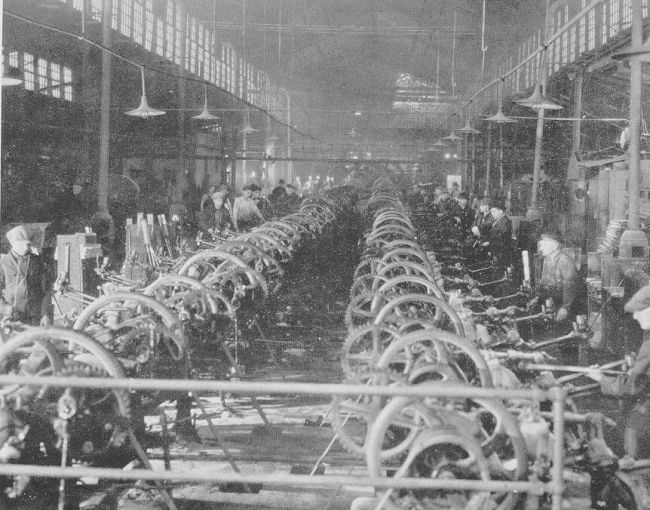
Davis published the novella anonymously in the Atlantic Monthly in April 1861, as the United States moved into civil war. She had grown up in Wheeling while it changed into a smoke-heavy industrial center, close enough to its mills to write as an observer of their physical world but not as a mill worker herself.[1][4] A 1926 LaBelle Cut Nail Works photograph belongs to a later phase of that industrial history, but its banks of workers inside belt-driven machinery preserve the scale by which a body can seem both visible and replaceable.[6] That close-outsider position helps explain the narrative's unusual address: it repeatedly pulls a comfortable reader toward the furnace, then asks whether looking has altered anything.[5]
The story's sympathy is powerful, but its claim to speak for a whole class needs a boundary. Eric Schocket argues that the novella's images of industrial subjection and possible salvation draw on antebellum racial language, aligning the mobility available to its Welsh workers with an emerging idea of working-class whiteness.[3] That reading does not cancel the korl woman's demand. It prevents the demand from becoming effortlessly universal.
Kirby names slavery, caste, and Blackness only to wash his hands of every social question. The narrative exposes his evasion, yet it also channels its fullest interiority and its fragile route toward rescue through white immigrant characters. The responsible reading therefore holds two propositions together: Davis makes industrial workers visible as persons whose beauty and intellect exceed the wage relation, and the story's imagination of whose thwarted life can stand for humanity is shaped by the racial order surrounding its publication.[3]
This limit matters to the theme of hunger because appeals to common humanity are never automatically common. The question is not only whether privileged spectators respond to need. It is also whose need they are prepared to recognize as a philosophical question rather than as background.
An unfinished work that keeps looking back
The novella fell from view before Tillie Olsen helped return it to readers in the 1970s; later editions and scholarship placed Davis within histories of realism, labor writing, women's writing, and environmental criticism.[2][5] That recovery suits a story obsessed with discarded material. Korl becomes sculpture; an anonymous periodical work becomes a book passed between generations of readers.
But recovery should not supply the happy ending the plot withholds. Hugh dies in prison. Deborah survives within a Quaker community. The sculpture remains behind a curtain in the narrator's library, carrying Hugh's “unfinished work” into a room of comparative comfort.[1] Preservation saves the object, not the maker.
That distinction is the source of the story's pressure even now. The korl woman is not proof that exceptional talent deserves escape while ordinary workers do not. She exposes the cruelty of requiring a masterpiece before deprivation becomes legible. Hugh's sculpture makes his inner life visible, but his claim never depended on being secretly extraordinary. Food, rest, education, beauty, and a future large enough for human powers are not prizes awarded by a patron who happens to notice.
The figure's hunger remains difficult because no single word finishes it. Call it art and the body disappears. Call it poverty and the desire for beauty disappears. Call it genius and the other workers disappear. Davis keeps those needs inside one rough form. The result is less a symbol to decode than a gaze to withstand: a worker's creation looking back at everyone pleased to understand it.
Sources
- Rebecca Harding Davis, “Life in the Iron Mills,” The Atlantic Monthly (April 1861)—primary text, original publication context, and the korl-woman scene.
- Jean Pfaelzer, ed., A Rebecca Harding Davis Reader: “Life in the Iron Mills,” Selected Fiction, and Essays. University of Pittsburgh Press, 1995, via JSTOR—critical and career context.
- Eric Schocket, “Discovering Some New Race: Rebecca Harding Davis's ‘Life in the Iron Mills’ and the Literary Emergence of Working-Class Whiteness,” PMLA 115, no. 1 (2000)—racial boundary of the novella's class language.
- Ohio County Public Library, “Rebecca Harding Davis”—local biography and Wheeling's transformation into a smoke-filled mill town.
- JSTOR Daily, “Life in the Iron Mills as Fiction of the ‘Close-Outsider Witness’” (2020)—Davis's relation to Wheeling labor and the work's 1970s recovery.
- Ohio County Public Library, “Nail Cutting Machines at LaBelle Nail Works”—source page for the archival 1926 Wheeling factory photograph.