
On December 12, 1972, Firing Line taped an episode in Jackson, Mississippi, under the title "The Southern Imagination." The guest list made the premise almost too neat: Eudora Welty, whose fiction had made Mississippi speech, errands, rooms, and family weather into exact art; Walker Percy, whose novels moved Southern inheritance through alienation, Catholic thought, medicine, and modern drift; and a panel of Mississippi-based teachers pressing the question from inside the region rather than from a distance.[1][2]
The hour could have hardened into a museum label. A host asks what makes the South special; two Southern writers answer; everyone leaves with a few usable phrases about memory, defeat, place, and manners. What survives instead is stranger and better. Welty and Percy keep loosening the frame. They do not deny place. They make place harder to use. The episode matters because it catches two writers refusing to let "Southern literature" become a decorative category while also refusing to pretend that region, race, violence, class, and inherited speech are optional background.[1][2]
That tension is why the recording belongs in a literature archive rather than only in media history. The conversation is not a clean theory of the South. It is a live demonstration of how literary intelligence behaves when a category becomes too available. Welty answers slowly and concretely, often bringing abstract questions back to people, voice, and perception. Percy reaches for wider historical and philosophical explanation, then keeps returning to the mystery of why regional writing became legible beyond the region. Between them, the episode turns Southern imagination into a problem of attention: what can a writer hear from inside a place that a public label cannot hear at all?[1][2]
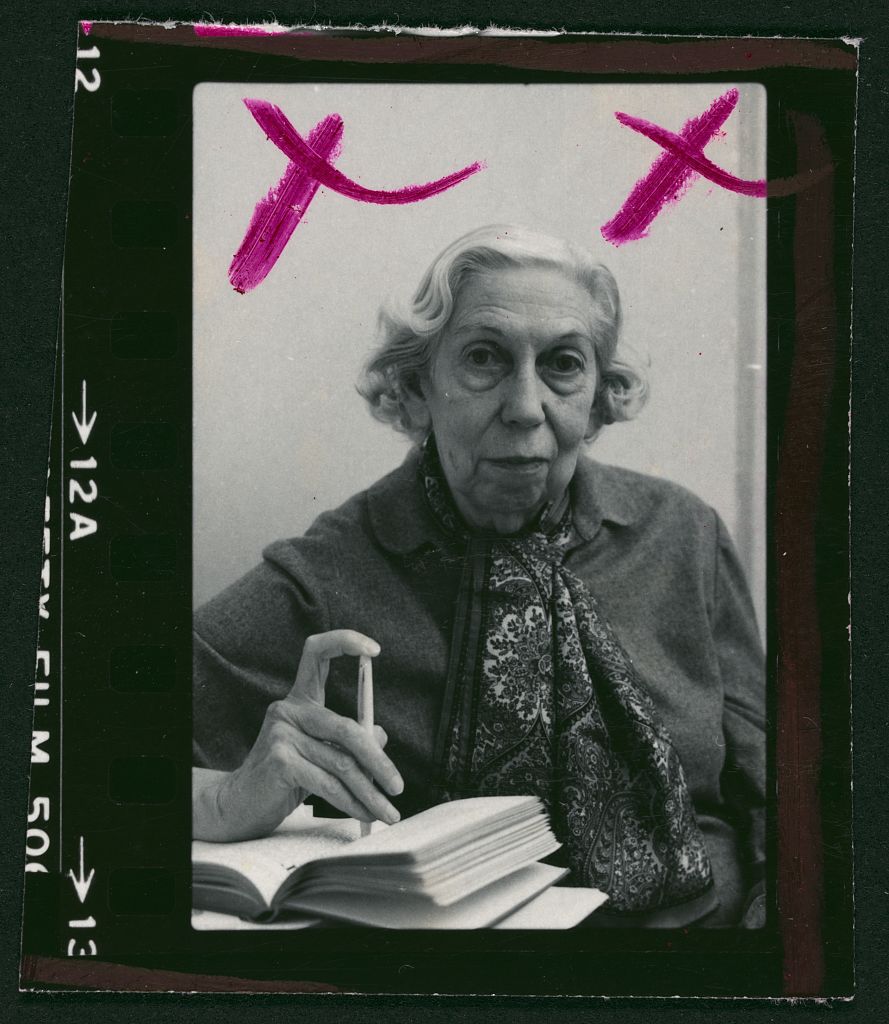
Image context: the cover uses a real 1980 Library of Congress portrait of Eudora Welty by Bernard Gotfryd. It is not a diagram, poster, or generated substitute. The image is relevant because this article studies Welty as a public literary presence in an archival television conversation; the book in her hands and the seated composure match the episode's argument about attention, speech, and craft.[6]
Historical context: Southern writing was already canon, argument, and burden
By late 1972, Southern literature was not waiting for recognition. Faulkner had already become the unavoidable giant; Welty had published A Curtain of Green, The Golden Apples, The Ponder Heart, and the newly Pulitzer-winning The Optimist's Daughter; Percy had won the 1962 National Book Award for The Moviegoer and followed it with The Last Gentleman and Love in the Ruins.[4][5] The question facing the episode, then, was not whether Southern writing existed. The question was what that label still explained once the writing had become part of American and international literary conversation.
The Hoover item record gives the episode a useful archival frame. It identifies Jackson as the place of recording, lists Welty and Percy among the guests, and summarizes the discussion around the distinctiveness of Southern literature and whether that distinctiveness still held.[2] That setting matters. The conversation is not staged from New York, Boston, or a generalized public-broadcast studio. It takes place in Mississippi, in front of people for whom the question carried local pressure. The archive therefore preserves more than author opinion. It preserves a regional self-interrogation at a moment when Southern writing had already become exportable.
The broader Firing Line context sharpens the point. Hoover's exhibition essay describes Buckley as a host whose program often placed writers inside debates about language, politics, and culture; the same page names Welty and Percy as part of the show's literary roster and characterizes their exchange as a genteel hour on "The Southern Imagination."[3] That description is accurate but incomplete in the best way. The civility of the room does not flatten the stakes. It makes the discomfort more legible. Questions about craft keep touching questions about racial violence, national misunderstanding, defensive memory, and the risk of treating the South as a ready-made literary brand.[1][2][3]
Video provenance
The embedded video is Hoover Institution Library & Archives' YouTube upload of Firing Line with William F. Buckley Jr.: The Southern Imagination.[1] The Hoover Digital Collections record identifies the program as S0073, created December 12, 1972, recorded in Jackson, Mississippi, with Welty, Percy, Jerry Ward, Dan Hise, Gordon Weaver, and Buckley listed in the record.[2] Hoover's broader account of the Firing Line archive explains that the institution holds the broadcast records and has made many full-length programs available through digital collections and YouTube.[3] That gives this clip the provenance an archival spotlight needs: institutional collection, episode number, location, date, and named participants.
Close reading: what the hour makes audible
The first thing to notice is Welty's resistance to speed. In a television format built for claims, she often seems to protect the interval before speech. That delay is not uncertainty. It is method. Her fiction depends on the same discipline: the refusal to convert a person into a case before the scene has been heard. Library of America's Welty page gives a compressed view of the range: "A Worn Path," "Why I Live at the P.O.," The Golden Apples, The Optimist's Daughter, and One Writer's Beginnings all sit under the same name.[4] The video shows how that range connects to her public manner. She does not speak as a regional mascot. She speaks as a writer whose loyalty to place passes through accuracy of human perception.[1][4]
That is why one of the episode's strongest moments comes when Welty turns away from demands that she should have written more directly "against" the South's public injustices and says that what she was writing about was "human beings."[2] The phrase can sound modest if isolated. In context it is sharper. Welty is not excusing avoidance. She is defending the level at which fiction does its moral work. To write human beings is not to float above history; it is to refuse the shortcut by which history becomes an emblem and people become illustrations.
Percy's role in the hour is different. He is more willing to generalize about historical change, and the Hoover description preserves his useful phrase about a "spark jumping" around 1920, when Southern writing began to move beyond defensive or romantic regional habits.[2] That image is revealing. Percy is interested in the moment when local material becomes more than local explanation. The Moviegoer already performs that conversion: a New Orleans stockbroker's ordinary drift becomes a philosophical search conducted through movies, manners, malaise, and comic unease.[5] In the video, Percy's regional argument keeps pressing toward form. Southern fiction matters when region becomes a way of testing universal disturbance without dissolving into abstraction.[1][5]
The strongest exchange between their temperaments is not a disagreement so much as a difference in literary weather. Percy wants to name the historical charge that made the South artistically productive after catastrophe, guilt, defeat, and cultural lag. Welty keeps returning the conversation to felt life: how people speak, how they are seen, how one writes injustice without converting fiction into a placard.[1][2] Together they make a useful correction to lazy regional reading. The South is neither a quaint reservoir of colorful speech nor a single moral exhibit. It is a field of pressure where comedy, cruelty, intimacy, class, Black and white life, memory, and evasive public language collide.
The panel's presence matters here. Jerry Ward, Dan Hise, and Gordon Weaver keep the discussion from becoming only a celebrity exchange between host and novelists.[2] Their questions push the room toward pedagogy and accountability: what students hear, what the region asks of its writers, what a phrase like "Southern imagination" includes and excludes. The archive captures a literary category being handled in public by people who know it can be useful and damaging at the same time.
One reason the episode still feels alive is that it refuses a clean split between aesthetics and politics. Welty's insistence on human beings has aesthetic force because it defines fiction's scale. Percy's historical map has political force because it asks why a defeated and burdened region produced art that outsiders recognized as their own disturbance.[1][2][5] Both positions keep the literature central. They do not treat novels and stories as decorations laid over sociology. They treat form as the place where social knowledge becomes bearable enough to examine.
Why this archive still matters
The recording matters now because regional labels remain tempting shortcuts. Readers still ask what a place "means" before they have listened to the people, cadences, silences, and evasions through which place becomes experience. The 1972 episode slows that impulse down. Welty and Percy do not let Southern literature become a tourism brochure, a guilt ledger, or a club password. They make it a discipline of attention.[1][2]
That discipline is the literary afterlife of the episode. Welty's public stillness and Percy's restless abstraction show two ways of protecting fiction from simplification. One begins with exact human perception; the other begins with historical unease and philosophical appetite. The hour is strongest when those methods share the room. It reminds us that "the Southern imagination" is not a theme to be collected. It is a listening test, and the archive lets us watch two writers keep passing it sentence by sentence.[1][4][5]
Sources
- Hoover Institution Library & Archives, "Firing Line with William F. Buckley Jr.: The Southern Imagination," YouTube video.
- Hoover Institution Digital Collections, "The Southern Imagination" (Firing Line Program S0073 item record).
- Jean McElwee Cannon, Hoover Institution Library & Archives, "On the Firing Line" (archive and literary-guest context).
- Library of America, "Eudora Welty" author page.
- Penguin Random House, "Walker Percy" author page for Library of America editions.
- Library of Congress Prints & Photographs Online Catalog, "(Eudora Welty, half-length portrait, seated with book)" by Bernard Gotfryd.