People sometimes describe Our Mutual Friend as one of Dickens's late baggy novels, full of brilliant scenes that do not quite belong to one design. That verdict misses the engineering. The book is built out of two storage systems that do opposite kinds of work. The Thames keeps yielding bodies, rumors, and mistaken identities; the dust heaps keep turning refuse into property, inheritance, and social leverage.[1][2][4] Once those two systems are in frame, the novel stops looking sprawling for the sake of sprawl. It starts to look like a machine for asking how Victorian society recognizes value only after it has been sunk, buried, or disguised.
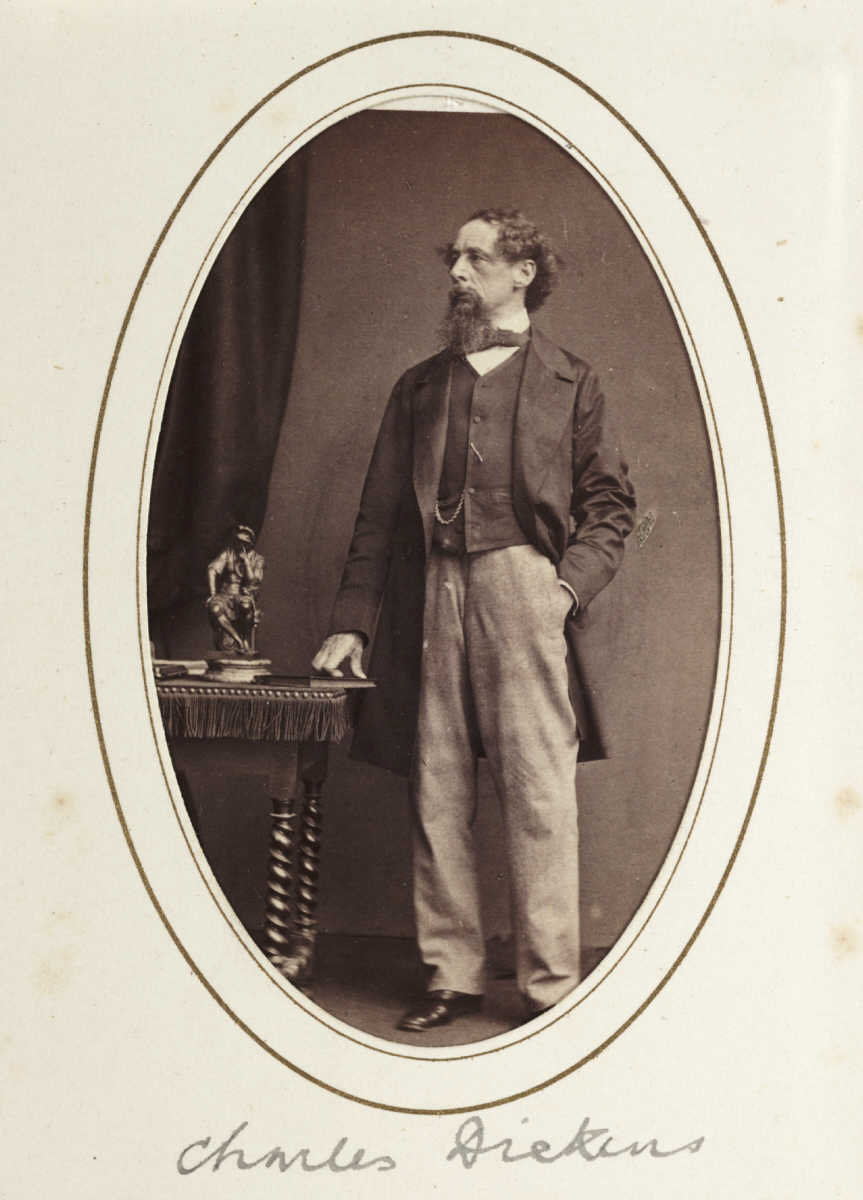
The lead image uses a real 1865 photographic portrait of Dickens from Wikimedia Commons.[5] It suits this essay because the novel belongs to the period Britannica treats as his late, still-adventurous phase, when the fiction becomes large, inclusive, and structurally deliberate rather than merely crowded.[4] The face in the photograph is useful here: composed, famous, and public, yet attached to a novel obsessed with the dirty underside of wealth.
1) The novel opens as a recovery operation
Dickens does not begin with an inheritance lawyer, a drawing room, or a sentimental household. He begins with a dirty boat on the Thames, with Gaffer Hexam and Lizzie working the river for the dead.[1] That choice is structural before it is atmospheric. The story starts where identities are least secure. A body dragged from the water may be evidence, may be a mistake, may be a fortune, may be a trap. Before the plot can ask who deserves money, it asks how a person becomes legible at all.
This is why the opening feels so powerful even when readers forget the details of the Harmon plot. The river is the novel's intake valve. It takes what respectable society would rather not see and sends it back into circulation: corpses, murder gossip, labor, police attention, and chance recognition.[1][2] When John Harmon is believed to have died and the body in the river becomes the basis of a whole inheritance chain, Dickens is already showing his method. Plot in Our Mutual Friend begins with retrieval under bad conditions.
The emphasis on retrieval also explains why Lizzie Hexam matters so much. She is not merely one moral center among many. She belongs to the novel's first principle. She lives where value arrives caked in mud, stripped of ceremony, and mixed with danger.[1] Her whole plotline keeps the book anchored to that world of precarious recovery even when the action moves into parlors and dining rooms.
2) Dust heaps make money look like delayed refuse
If the river provides the novel's intake, the dust heaps provide its logic of stored value. At the Veneerings' dinner table, Mortimer Lightwood gives the history of old Harmon in the harshest possible shorthand: the man's “geological formation was Dust.”[1] The line is funny because it is so excessive; it is also exact. Harmon has built his fortune out of what society throws away. Coal-dust, bone-dust, crockery dust, sifted dust: Dickens insists that wealth here is not abstract capital but matter sorted, accumulated, and resold.[1][2]
That material basis changes the feel of the inheritance plot. In many Victorian novels, money arrives in the form of papers, investments, or estates that appear already laundered into gentility. Our Mutual Friend keeps reminding the reader that its wealth was once a heap. The Boffins inherit not clean prestige but the afterlife of waste.[1][2] That is why the novel can keep crossing between satire and disgust without losing coherence. Its richest people are never far from rubbish.
This is also why the title of the later chapter sequence, “The Golden Dustman,” matters structurally.[1] Dickens is not merely decorating the book with eccentric labels. He is telling you that money in this novel remains mixed with residue. When characters chase inheritance, they are chasing something already compromised in form before anyone has behaved well or badly around it.
3) Dickens keeps moving between three social surfaces
The book's middle can look diffuse until its spaces are put side by side. First there is the river edge, where Hexam labor and the Harmon mystery begin. Second there is the Veneering world, introduced with the famous phrase “bran-new people in a bran-new house,” where money tries to appear frictionless, fashionable, and recently manufactured.[1] Third there is Boffin's world, where inherited dust must be translated into furniture, literacy, domestic habit, and social aspiration.[1]
These are not disconnected settings. They are three versions of the same question. What does money look like when it is raw, when it is cosmetically new, and when it is awkwardly re-domesticated? Dickens does not answer by choosing one world and discarding the others. He keeps cutting among them so that each social scene exposes the others' frauds.[1][2][4] Veneering polish looks thinner once you remember the river. Boffin benevolence and later apparent coarseness matter because the dust fortune behind them never stops feeling unstable. The river itself keeps returning as the place where false endings can be broken open.
That is why the novel's famous inclusiveness is not the same thing as looseness. Dickens wants readers to feel that London society is one circulation system, not a stack of sealed compartments. Bodies, gossip, money, and names all move across class lines. The book's size is therefore part of its form. A narrower novel could have given you the Harmon mystery. This one gives you the whole city that makes such a mystery plausible.
4) The disguise plot is not an ornament; it is the testing apparatus
John Harmon returned openly would have produced a much simpler book. By returning as John Rokesmith, Dickens turns the inheritance plot into an experiment about recognition.[1][2] Who can see value without the certificate attached to it? Who loves money, who loves rank, who loves conduct, and who confuses one for another? The disguise is not there only to delay revelation. It is the device that forces Bella, the Boffins, and the reader into a long sequence of misreadings.
The same is true of Boffin's apparent moral deterioration later in the novel. On first encounter, that stretch can seem like one of Dickens's elaborate contrivances. Structurally, however, it belongs to the same testing logic. Bella cannot simply be told that money is corrupting; she has to see what a money-drunk household would feel like from inside.[1] The plot therefore stages falsified greed in order to produce real moral perception. Dickens likes melodrama here because melodrama lets motives become legible at scale.
This helps explain why Our Mutual Friend often feels less like a detective novel than like a sorting process. The point is not just to reveal the hidden truth. The point is to watch different kinds of mistaken valuation burn off over time: Bella's flirtation with luxury, the Veneerings' performance of social reality, Wegg's petty parasitism, even the city's willingness to treat a found body as sufficient closure.[1][2] Recognition in this novel is always delayed because value itself has been socially misfiled.
5) The serial form keeps turning stored matter back into action
The Project Gutenberg text preserves the architecture that first readers encountered: four books, monthly-part rhythm, and chapter titles that behave almost like running signals.[1] “The Man from Somewhere,” “Our House,” “The Golden Dustman Falls into Bad Company,” “What Was Caught in the Traps That Were Set”: Dickens repeatedly names action as emergence, capture, storage, or reversal.[1] The chapter list alone tells you that this is a novel about latent matter becoming event.
Seen this way, the later scale of the book is a strength. Britannica describes Our Mutual Friend as a large, inclusive late novel, and that largeness is exactly what allows Dickens to keep river labor, social satire, inheritance law, and romantic revision inside one structure.[2][4] The V&A note on the manuscript's survival at the Morgan Library is a small but useful reminder that this was not casual overflow; it was a major late construction, carefully made inside Dickens's final completed phase.[3][4]
So the novel's deepest form is neither the mystery alone nor the marriage plot alone. It is conversion. Rivers become evidence. Dust becomes money. Names become disguises. Social theatre becomes diagnosis. And, by the end, inheritance becomes something that can finally be moralized only after Dickens has dragged it through labor, fraud, shame, and delayed recognition.[1][2] That is why Our Mutual Friend lasts. It understands that a society built on salvage will keep mistaking residue for foundation unless a novel teaches it how to read its own waste.
Sources
- Charles Dickens, Our Mutual Friend, Project Gutenberg ebook 883.
- Encyclopaedia Britannica, "Our Mutual Friend."
- Victoria and Albert Museum, "Charles Dickens' manuscripts and proofs."
- Encyclopaedia Britannica, "Charles Dickens - Final novels: A Tale of Two Cities, Great Expectations, and Our Mutual Friend."
- Wikimedia Commons, "File:Charles Dickens, c.1865. (7893554032).jpg" (source page for the lead photograph).