Nella Larsen's Passing is short enough to invite summary and sharp enough to resist it. The premise is usually stated quickly: two light-skinned Black women, Irene Redfield and Clare Kendry, meet again after childhood; Irene lives in Harlem with a Black husband and children, while Clare has entered white marriage and lets her racist husband believe she is white.[1][4] That outline is accurate, yet it leaves out the novel's method. Larsen does not treat passing as a single deception held in one character's body. She turns it into an atmosphere: a pattern of rooms, temperatures, glances, invitations, jokes, silences, and sudden exits.
This is why the novel still feels modern. NYPL's exhibition note describes Passing as an intimate psychological portrait of two women navigating race and gender, and its collection essay places Larsen at the center of Harlem's cultural world through her work at the 135th Street Branch, now the Schomburg Center for Research in Black Culture.[2][3] Britannica's biographical outline adds the hard brevity of the career: Quicksand in 1928, Passing in 1929, a Guggenheim Fellowship in 1930, and then public literary silence.[4] In that small span, Larsen built a fiction in which social identity is neither private essence nor public label alone. It is pressure moving through the body.
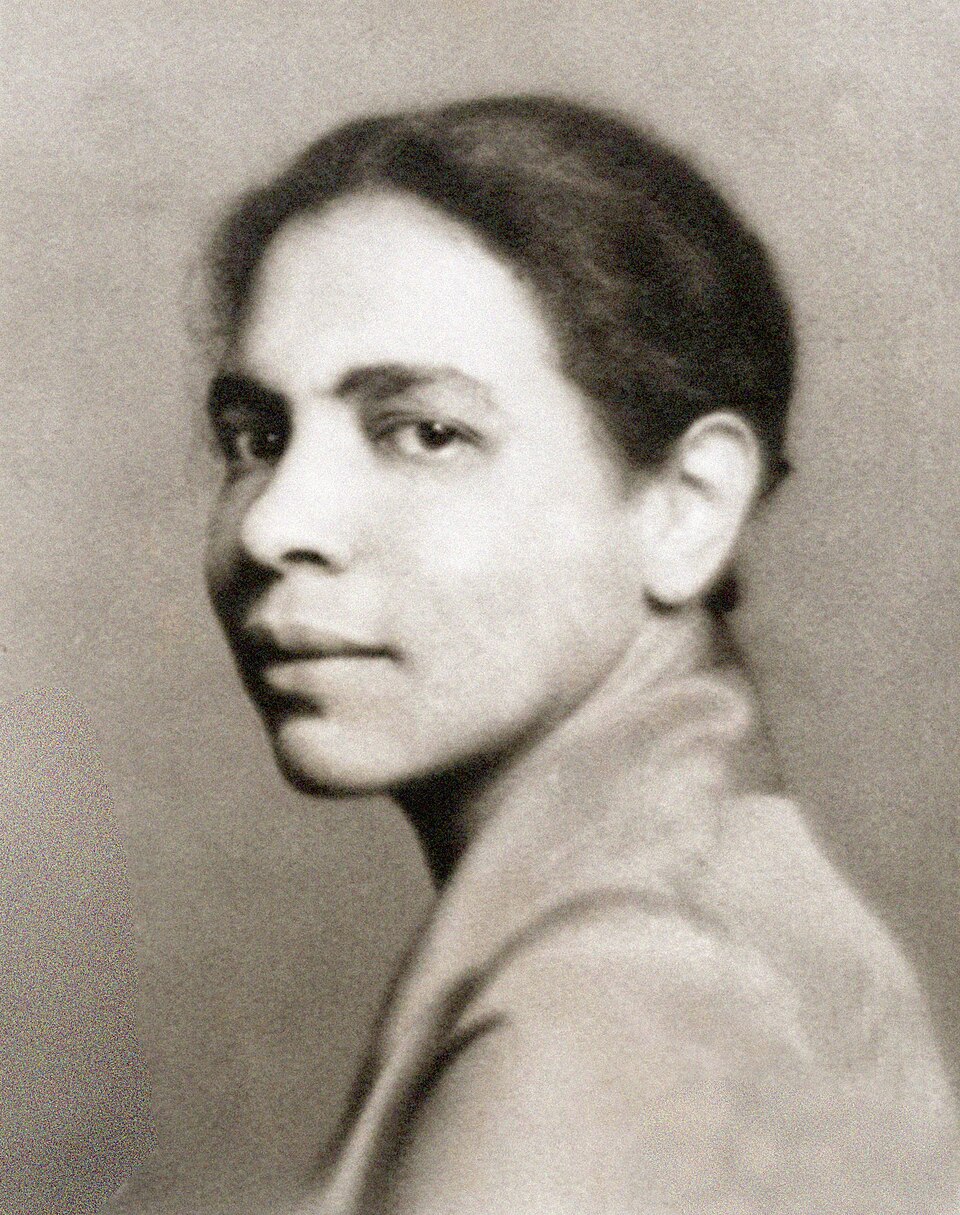
Image context: the cover uses James Allen's 1928 photographic portrait of Larsen from Wikimedia Commons. A real archival portrait is the right visual grammar here because the essay follows a novelist who made controlled surfaces feel electrically unstable: posture, dress, looking, and being looked at all matter.[5]
The heat arrives before the danger is named
The Drayton Hotel scene begins with weather, not confession. Irene has gone to the roof garden because Chicago heat has become physically intolerable, and the scene's brilliance lies in how quickly that ordinary discomfort becomes social exposure.[1] Irene is already passing in a limited, situational way. She has entered a white space because no one has read her as Black. The act is casual enough that she can frame it to herself as convenience rather than betrayal; she wants relief from the sun, a place to sit, a cold drink. But Larsen makes the relief unstable from the first page of the encounter. Cooling off depends on being misrecognized.
That is the first important distinction. Clare's passing looks total, theatrical, life-organizing. Irene's looks incidental. Yet the hotel scene quietly removes the moral comfort of that difference.[1] Irene knows the rules of the room because she is using them. She reads the waiter's deference, the other patrons' indifference, and the safety that comes from being taken for a white woman. Her anxiety starts when she notices another woman watching her, and the old fear surfaces: the look may be recognition, exposure, accusation, or desire.
Larsen's prose is exact about the time lag between being seen and knowing what kind of seeing is taking place. Before Clare is named, she is a gaze. Irene feels watched, then studied, then threatened. The novel turns the eye into an instrument before it turns the scene into reunion.[1] That order matters. The Drayton encounter is not dramatic because one secret is discovered. It is dramatic because identity first appears as a sensory problem. Heat, light, thirst, fabric, and glances make the body legible before language catches up.
Clare enters as attraction and warning at once
When Irene recognizes Clare Kendry, the encounter shifts from racial risk to a more complicated social magnetism. Clare is not merely a woman who has crossed the color line. She is a woman who understands performance as pleasure, appetite, and leverage.[1] Her presence unsettles Irene because she carries danger with charm. She can make the forbidden feel intimate; she can make catastrophe sound like an invitation.
This is where readings of Passing flatten when they reduce Clare to symbol. Clare is a racial-passing figure, but Larsen writes her as motion. She reappears, leans in, asks for contact, crosses thresholds, and keeps refusing to remain in the category Irene assigns her.[1] She is at once childhood memory, erotic disturbance, class provocation, racial scandal, and social performer. Irene's response is equally layered. She disapproves of Clare, but the disapproval does not purge fascination. It gives fascination a socially acceptable outer shell.
The novel's famous tea-table cruelty, where Clare's husband uses a racial slur as a pet name for his wife, shows Larsen's control at its coldest.[1] The scene is often remembered for the ugliness of John Bellew's language, and rightly so. But its deeper horror is structural. The insult works because everyone in the room must collaborate with the performance. Clare laughs. Irene and Gertrude remain present. Bellew enjoys his own ignorance as domestic comedy. The scene produces a tiny theater in which racial violence can appear as marital teasing as long as the truth remains unsaid.
That is why manners are so terrifying in the novel. They do not soften brutality; they give brutality a table setting. A reader can feel how much social labor goes into keeping the room intact: smiles, pauses, controlled bodies, acceptable topics, and a shared refusal to break the script.[1][2] Irene's horror has no clean outlet because the etiquette of the room makes open speech feel like the transgression, while Bellew's racism remains protected by ignorance and hospitality.
Irene's respectability is also a form of editing
Irene often reads herself as the stable center of the book: mother, wife, Harlem hostess, careful organizer of social life.[1] That self-image is not false, but it is partial. Larsen lets us see how much editing Irene performs to keep that image usable. She edits her annoyance into politeness, her fear into management, her jealousy into moral judgment, and her uncertainty into plans.
The result is a narrative voice that feels controlled and unreliable in a very specific way. Irene does not simply lie to the reader. She arranges experience until it can be borne. When Clare's letters arrive, Irene wants to refuse them; when Clare enters Harlem life, Irene wants boundaries; when Brian, Irene's husband, responds to Clare with warmth and curiosity, Irene begins converting social discomfort into marital suspicion.[1] Each stage may contain some truth, but the sequence reveals a mind trying to preserve order by choosing which meanings are admissible.
This is one reason the book belongs with modernist fiction as much as with Harlem Renaissance social realism.[2][3] Larsen is not only documenting the risks of passing in the 1920s. She is studying consciousness under pressure. Irene's mind keeps trying to govern a social field that has exceeded her categories. Clare is not only risky because she may be exposed as Black in a white marriage. She is risky because she exposes the fragility of Irene's own categories: Black security, bourgeois discipline, marital order, maternal duty, social pride, and heterosexual domestic confidence.
The brilliance is that Larsen never has to announce all of this as argument. She lets the surface do the work. A letter becomes an intrusion. A party becomes a test. A glance becomes evidence. An invitation becomes a threat that still feels attractive.[1] The novel's psychology lives in these small conversions.
The window concentrates the whole book
The final window scene has generated decades of debate because Larsen refuses to assign it a single, stable explanation.[1] Clare falls. Bellew has arrived. Irene is present. The room is charged with racial exposure, marital suspicion, and panic. The novel gives the reader enough pressure to feel causality everywhere and enough withholding to prevent any one cause from closing the case.
That ambiguity is not an evasion. It is the form of the book arriving at its limit. From the Drayton roof garden onward, Larsen has shown identity as something produced between body and room, gaze and name, wish and rule.[1] By the end, the social room cannot hold what it has gathered. Clare's body crosses the line from interior to exterior, visibility to disappearance, social performance to physical fact. The window is therefore not just a plot device. It is the architectural version of passing: a threshold that promises passage and delivers exposure.
Irene's relation to the fall is terrifying because the novel keeps motive, impulse, fear, and accident in the same charged field.[1] If one insists on a detective answer, the book becomes smaller. If one treats the ending as mere mystery, it also becomes smaller. Larsen's point is sharper: a social system built on enforced surfaces produces events for which moral accounting remains necessary and unstable at the same time.
That is why Passing does not age like a period problem. Its details belong to the 1920s: Harlem networks, hotel roof gardens, racial classification, bourgeois respectability, and the specific violence of American color lines.[1][2][4] Its structure reaches further. The novel asks what happens when a life depends on being read correctly by the wrong people, when safety requires performance, and when desire keeps moving through the same channels as danger. Larsen's answer is not a doctrine. It is a nervous system. Heat rises, a gaze fixes, a joke lands, a hostess smiles, a letter arrives, a window opens, and the whole social body convulses.
Sources
- Nella Larsen, Passing (1929), Wikisource transcription from the original Knopf edition.
- The New York Public Library, "Nella Larsen's Passing" exhibition item, Schomburg Center first-edition copy.
- Cierra Bland, "Nella Larsen and Passing in NYPL's Collections." The New York Public Library, November 29, 2021.
- Encyclopaedia Britannica, "Nella Larsen" (last updated April 9, 2026).
- Wikimedia Commons, "File:NellaLarsen1928.jpg" (James Allen portrait; lead-image source page).