Gustave Flaubert is often reduced to two respectable labels: stylist and realist. Both are true, and both are incomplete.[3][4] What gives his fiction its peculiar sting is not objective description by itself. It is his habit of writing people whose desires are assembled from things they did not invent: sentimental novels, social prestige, romantic poses, political atmospheres, and phrases already worn smooth by repetition.[1][2][3] He does not merely show illusion colliding with reality. He shows how badly a life can warp when it tries to live inside prefabricated feeling.
That is why a work-centered author profile is more useful than a biographical legend. Britannica is right to place him at the center of literary realism and to identify Madame Bovary and A Sentimental Education as major landmarks.[3][5] But the continuity across those books is sharper than "accurate observation." Flaubert keeps returning to people who consume emotional scripts before they can judge their own lives. His realism is not a camera pointed at society from outside. It is a pressure test applied to second-hand desire.
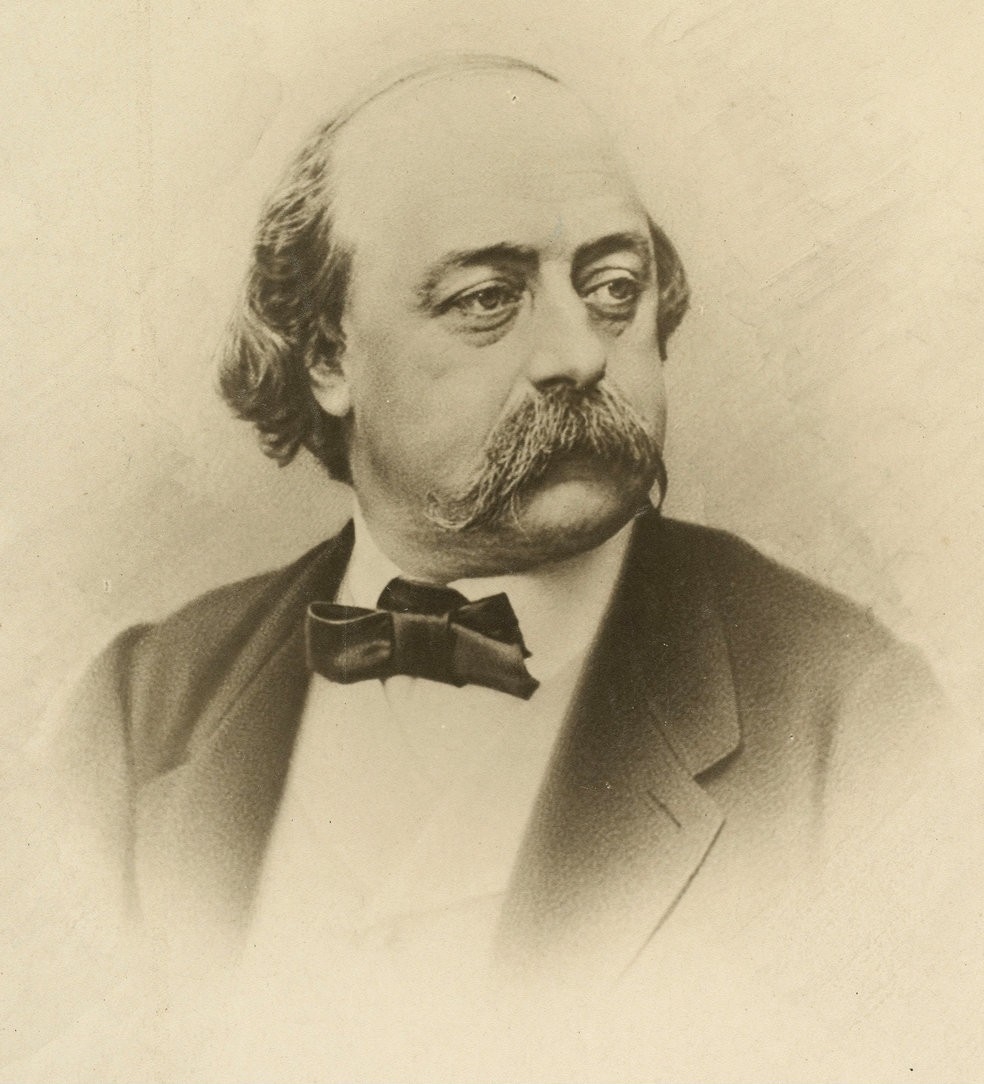
Image context: the cover uses a real archival portrait photograph of Flaubert by Nadar from Wikimedia Commons. It suits this essay because Flaubert's writing depends on composed surfaces that hide turbulence rather than confess it directly.[6]
1. He writes characters who want prewritten lives
Emma Bovary is not memorable because she is adulterous in the abstract. She is memorable because Flaubert shows how imagination arrives in her already packaged. Early in the novel he tells us, with devastating economy, "Before marriage she thought herself in love."[1] The sentence matters because it makes feeling look derivative before the plot has even fully unfolded. Emma has learned what love is supposed to feel like before she has learned how to live it. Later, in one of the novel's most famous summaries of restless hunger, she "wished at the same time to die and to live in Paris."[1] Death and Paris are both fantasies of elsewhere, and Flaubert places them on the same line as if they belonged to one marketplace of desire.
That is one reason Madame Bovary mattered so much to the history of the novel. Britannica describes it as the work that transformed a commonplace adultery story into a new realist standard by examining every psychological nuance of bourgeois frustration.[4] The key word there is "psychological," but in Flaubert psychology is never private purity. Emma's longings are crowded with convent reading, luxury objects, borrowed rhetoric, and visions of distinction she has absorbed from outside herself.[1][4] The tragedy does not come from desire alone. It comes from a desire already written in someone else's hand.
Frédéric Moreau in A Sentimental Education belongs to the same family of yearning, though his register is cooler and more diffuse. The book opens with departure, haze, and self-dramatization: Paris recedes, and the young man "heaved a deep sigh."[2] Soon Madame Arnoux appears on the boat, "gazed vaguely into the distance," and the whole novel begins to organize itself around a posture of deferred fixation.[2] Britannica's summary is useful here because it ties the novel to disillusionment in a changing political and social world, as well as to Flaubert's own youthful infatuation with an older married woman.[5] Frédéric does not simply fall in love. He falls into a style of feeling, one built on distance, postponement, and the prestige of impossible attachment.
2. Cliche in Flaubert is not verbal clutter. It is social weather.
This is where Flaubert's authorial signature becomes unmistakable. He is famous for exact sentences, but the exactness is not there to purify the world into high art. It is there to reveal how saturated the world already is with received language.[1][2][3] Emma reads herself through melodramatic expectation. Frédéric reads himself through romantic vacancy. The surrounding society does not correct them; it feeds them more formulae in the form of taste, ambition, etiquette, gossip, and slogans.
Britannica's Flaubert biography notes both his hostility toward the "bourgeois" and the later continuation of that hostility in works beyond Madame Bovary.[3] That matters because cliche, in Flaubert, is never just a comic defect belonging to stupid side characters. It is the medium in which whole social worlds think. Homais in Madame Bovary is an obvious case, yet Emma is no less trapped by borrowed language just because her language sounds more lyrical.[1][3] Frédéric, likewise, moves through salons, revolutions, affairs, and ambitions without ever escaping prefabricated poses for very long.[2][5]
That is why the books feel harsher than their plots suggest. On paper, Emma's story could have been sentimental scandal, and Frédéric's could have been education-through-disillusion. Flaubert turns both into studies of people who cannot easily distinguish wanting from imitating. The pressure in his fiction lies in that gap. A character feels something at full emotional intensity, yet the available form of that feeling is stale, borrowed, or socially scripted from the start.
3. The sentence does not rescue the fantasy. It records its exposure.
Flaubert's realism therefore has less to do with flat objectivity than with tonal discipline.[3][4] He does not usually step in to sermonize against illusion. He lets the sentence remain cool enough that the illusion exposes itself. Emma's wish to die and to live in Paris is not mocked from above, yet it is not granted tragic grandeur either.[1] The line is exact because the sentence refuses to inflate the dream beyond the scale of the mind producing it. Frédéric's sigh and his boat-borne fixation receive the same treatment: enough lyric pressure to show the seduction, enough distance to show its emptiness.[2][5]
This is the continuity that makes Flaubert feel larger than one movement label. "Realism" can sound like a doctrine of exterior detail. In his case, detail matters because it records the friction between dream and medium.[3][4] Rooms, fabrics, invoices, journeys, speeches, civic tumult, and social rituals are not background. They are the surfaces on which second-hand desire keeps trying and failing to stabilize itself.
That is also why he still feels modern. A great many contemporary lives are lived through templates: branded aspiration, inherited scripts of romance, copied prestige, ready-made political feeling. Flaubert recognized the humiliation in that condition early. He understood that people can suffer sincerely inside borrowed forms, and that sincerity does not make those forms any less second-hand.[1][2][3] His enduring subject is not adultery, nor youthful disappointment, nor even realism in the narrow textbook sense. It is the pain of wanting with words, images, and ambitions that arrived precomposed. The sentence, in Flaubert, is where that pain finally becomes visible.[1][2][4][5]
Sources
- Gustave Flaubert, Madame Bovary (Project Gutenberg full text).
- Gustave Flaubert, A Sentimental Education; Or, The History of a Young Man. Volume 1 (Project Gutenberg ebook).
- Encyclopaedia Britannica, "Gustave Flaubert."
- Encyclopaedia Britannica, "Madame Bovary".
- Encyclopaedia Britannica, "A Sentimental Education".
- Wikimedia Commons, "File:Gustave Flaubert.jpg" (archival portrait source page).