Oroonoko is easiest to praise when it is reduced to a milestone: Aphra Behn, a professional woman writer, publishes in 1688 a short prose narrative about an enslaved African prince in Surinam; later readers recognize an early English fiction that treats a Black hero with tragic dignity.[2][4] That summary is true, but it is too smooth. The novella still matters because its sympathy is not simple. Behn makes readers care about an enslaved man by first making him legible through aristocratic romance, royal rank, European education, and heroic suffering. The result is a text that can expose slavery's violence while still carrying the assumptions of a slave-trading, colonial world.[3][4]
That doubleness begins in the title. Oroonoko; or, The Royal Slave asks the reader to feel the contradiction before the story has even started.[1] "Royal Slave" is not just an ornamental tag. It is the book's moral mechanism. Behn's Oroonoko is not introduced as representative humanity in the abstract. He is a prince, a lover, a commander, and a man repeatedly described through the vocabulary of nobility. The scandal, at first, is that someone so evidently high-born can be converted into property. The harder modern question is whether the text can imagine the wrong of enslavement beyond the special wrong done to a royal man.
That is why a reception dossier suits the book better than a clean verdict. Oroonoko has been read as antislavery testimony, royalist tragedy, early novel, colonial romance, travel narrative, and ideological contradiction.[2][3][4] The text can support these readings because it is built from several forms at once. Newberry's classroom essay places it among aristocratic romance, travel writing, and social criticism at a moment when the Atlantic slave trade and plantation slavery were hardening into a transnational economic system.[4] Cambridge's chapter summary points to the same pressure from another angle: recent criticism has had to untangle the book's political investments because its representation of the English colonial project is itself part of what shaped modernity.[3]
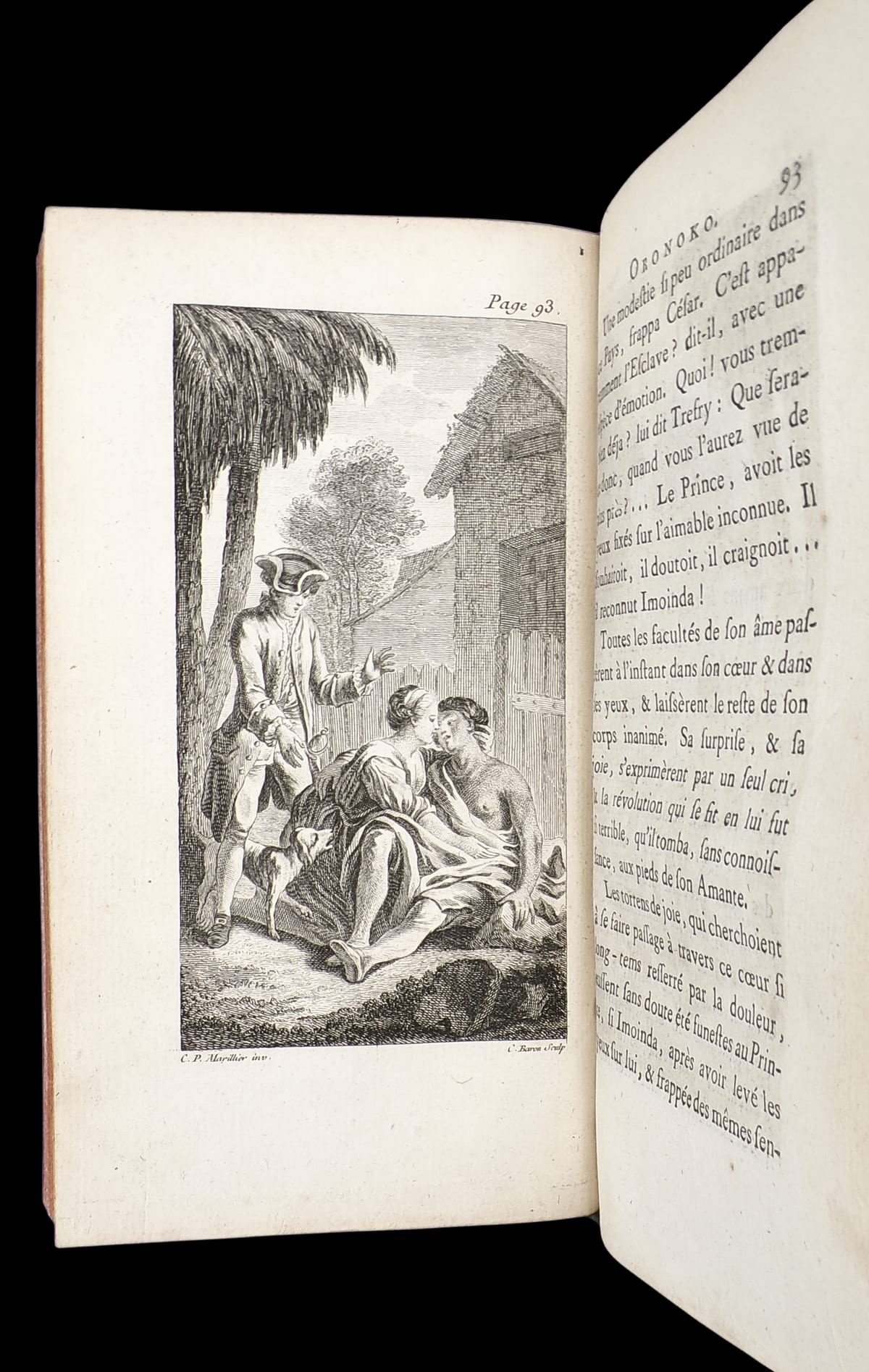
Image context: the article image is not a generic antique book. It shows the 1769 French illustrated adaptation by Pierre-Antoine de La Place, described by Artem Rare Books as the earliest illustrated edition of Oroonoko in any language and as a version that newly expands Imoinda's perspective.[6] That image belongs here because reception is the argument. The story did not stay still; it was translated, softened, illustrated, staged, and repeatedly made to serve new ideas of sentiment and antislavery feeling.
The eyewitness claim is part of the drama
Behn's narrator repeatedly wants authority. She insists that she was an "Eye-witness" to much of the story and presents the narrative as history rather than mere invention.[1] That claim should not be swallowed whole or dismissed too quickly. It matters as a literary act. The narrator's authority depends on proximity: she has been in the colony, she has met the hero, she has seen enough to speak. At the same time, the very insistence on truth makes the book feel unstable, because the romance machinery is obvious. The African courtship plot, the reunion with Imoinda, the heroic speeches, and the final martyr-like suffering all belong to crafted tragedy as much as to report.
That instability is not a defect to edit away. It is the book's operating condition. Behn writes as if firsthand colonial witness, courtly romance, and moral outrage can reinforce one another. Sometimes they do. The narrator's claim to have known Oroonoko gives his death a testimonial charge. But the same claim also raises questions about what she saw, what she chose not to see, and why the story requires a European female witness to certify an African man's nobility for English readers.[1][3]
The result is a narrator who feels both sympathetic and limited. She admires Oroonoko, recoils from betrayal, and cannot save him. She also lives inside the colonial household world that makes his captivity possible. The book's anger at treachery is real; its distance from the enslaved people around Oroonoko is also real. A strong reading has to keep both facts in view.
Nobility makes him visible, and that is the problem
Oroonoko's dignity is never allowed to rest only on shared humanity. Behn gives him rank, bodily grace, courage, military command, and a form of education that European readers are meant to recognize.[1][2] This makes the narrative powerful, because the enslavers' brutality appears obscene against a figure the prose has taught readers to honor. But it also narrows the frame. If the book's first outrage is that a prince has been enslaved, then ordinary enslavement risks remaining background condition rather than total indictment.
Cambridge's summary catches the paradox sharply: Oroonoko is a "royal slave" whom other enslaved people recognize as king, while English colonists also acknowledge his nobility and still keep him confined.[3] The contradiction is devastating because recognition changes nothing. The colonists can admire him and enslave him at the same time. Behn's novella thereby exposes a cruel fact about colonial feeling: sympathy can coexist with domination when it is not joined to structural refusal.
That is one reason the book's afterlife became so charged. Britannica notes that many of Behn's contemporaries took her suggestion of non-European moral superiority as abolitionist, and that Thomas Southerne's stage adaptation followed in 1695.[2] Later readers pushed the work harder toward antislavery meaning. But the original text does not simply announce modern abolitionism. It dramatizes the horror of betrayal and torture while leaving intact enough royalist and colonial hierarchy to keep the reader uneasy.[3][4]
Science, maps, and polite knowledge are not innocent
The novella's colonial world is not only violent through whips, chains, and executions. It is also violent through knowledge. JSTOR Daily's account of Adam Sills's research is useful because it notices how navigation, maps, and mathematical instruments enter the story as attractive European knowledge that helps lure Oroonoko toward captivity.[5] The point is not that science itself is villainous. The point is that supposedly neutral knowledge can become part of the slave-trading machine when it organizes routes, property, distance, and trust.
That reading changes the texture of the opening movement. Oroonoko is not captured because he is unintelligent. He misreads the social meaning of European knowledge. What looks like cultivated exchange is attached to a ship, a market, and a captain who can turn hospitality into abduction.[5] Behn's prose keeps returning to the difference between appearance and transaction: friendship becomes capture, admiration becomes control, promise becomes delay, and noble status becomes a decorative fact inside bondage.
This is also why Surinam matters as more than scenery. Newberry frames the novel within English thinking about racial and cultural difference as colonization and Atlantic slavery expanded.[4] Behn's descriptions of the colony supply sensory richness, but they also participate in colonial sorting: peoples, commodities, lands, animals, and bodies are rendered available to European narration. The book can criticize cruelty while still enjoying the authority of describing a world newly made readable to English readers.
Imoinda shows where the romance both enlarges and fails
Imoinda is central to the emotional force of Oroonoko, yet the history of the book's reception also shows how easily she can be made secondary to the prince's tragedy. Behn gives her beauty, loyalty, endurance, and pathos, but the narrative pressure remains concentrated on Oroonoko's nobility and suffering.[1] The 1769 French illustrated edition is therefore revealing: Artem Rare Books notes that La Place's adaptation includes a separately titled Histoire d'Imoinda, expanding and reimagining the final section from her perspective.[6]
That later expansion does not fix Behn's text, but it exposes one of its gaps. Readers and adapters sensed that Imoinda carried unrealized narrative force. Her body is the site where romance, slavery, sexual vulnerability, and colonial power converge. Yet the original novella repeatedly folds her significance back into Oroonoko's honor. In a modern reading, that is not a reason to discard the work. It is a reason to read its sympathy as unevenly distributed.
The same pattern appears in the book's treatment of enslaved collectivity. Oroonoko's rebellion matters because it briefly turns private betrayal into political action.[1][3] But the prose remains most magnetized by the singular royal hero. The crowd of enslaved people is vital to the event and less fully individuated by the narrative. Again, the book exposes the violence of slavery by choosing an exceptional figure. The exception opens feeling, but it also reveals the limits of the feeling it opens.
Why the contradiction is the afterlife
The temptation with Oroonoko is to rescue it into purity: first antislavery novel, first English novel, heroic feminist milestone, brave exposure of colonial cruelty. Another temptation is to prosecute it into uselessness: compromised romance, royalist hierarchy, colonial gaze, sympathy only for an exceptional prince. The book is stronger, and more troubling, than either simplification.
Its place in literary history comes from the fact that it made later readers argue over what kind of sympathy fiction could produce. Britannica's compact account preserves the milestone case: 1688 publication, Surinam setting, enslaved African prince, early philosophical novel, theatrical afterlife.[2] Newberry and Cambridge help explain why that milestone remains contested: the work belongs to a seventeenth-century Atlantic world in which slavery, race, trade, empire, romance, and moral sentiment were being made legible together.[3][4]
Read honestly, Oroonoko does not let us feel innocent about feeling. It teaches pity through rank, recognizes humanity through exception, and condemns cruelty without fully escaping the structures that made cruelty profitable. That is precisely why it survives. Behn's novella is not valuable because it already thinks like a later abolitionist text. It is valuable because it shows an earlier literary machine trying to make a reader feel the wrong of slavery with the tools it had: royalty, romance, eyewitness claim, theatrical suffering, and the terrible spectacle of admiration that arrives too late to save anyone.
The crown, then, is not incidental. It is the form sympathy first takes. The achievement and the failure of Oroonoko lie in the same gesture: Behn makes an enslaved African hero visible to Restoration readers by making him royal. Four centuries later, the task is to read that visibility without mistaking it for freedom.
Sources
- Aphra Behn, Oroonoko; or, The Royal Slave, in The Works of Aphra Behn, Volume V, Project Gutenberg HTML text.
- Encyclopaedia Britannica, "Oroonoko" - publication date, Surinam setting, philosophical-novel framing, and 1695 stage adaptation.
- Cambridge Core, "Oroonoko: reception, ideology, and narrative strategy," chapter page from The Cambridge Companion to Aphra Behn.
- Newberry Digital Collections for the Classroom, "Aphra Behn's Oroonoko: Slavery and Race in the Atlantic World" (May 14, 2012).
- JSTOR Daily, "Science and Slavery in Aphra Behn's Oroonoko" - accessible discussion of Adam Sills's reading of navigation, mapping, and colonial knowledge.
- Artem Rare Books, "First illustrated edition of Aphra Behn's Oroonoko, expanded with a new tale of the African heroine Imoinda" - source page for the photographed 1769 French edition used as the article image.