Virginia Woolf's Orlando looks like a miracle of motion: one protagonist crosses more than three centuries, changes sex, moves through Elizabethan court culture, Constantinople, country-house inheritance, Victorian weather, modern traffic, and literary fame, yet keeps enough continuity to remain recognizably Orlando.[1] The novel can be read through plot, gender, parody, biography, or modernist experiment. A motif map shows how the book holds those readings together without forcing them into one stable identity.
Four repeated signs do most of the work. Clothes turn gender into a public grammar. The oak tree gives Orlando a long memory that survives costume and century. Portraits expose the comedy and violence of being fixed into an image. The mock-biographical frame makes the whole novel look like evidence while constantly revealing how evidence has been arranged. Together, these motifs make Orlando one of Woolf's lightest books on the surface and one of her sharpest books about historical selfhood underneath.[1][2]
Smith College's Hogarth Press exhibition places the novel in its immediate publishing scene: Woolf began writing it in 1927, completed a first draft by March 1928, revised page proofs heavily, and saw it appear first in the United States on October 2, 1928, before the Hogarth Press edition appeared on October 11, the very day on which the novel ends.[2] That timing matters. Orlando is not a timeless fantasy floating outside print history. It is a book about time that makes its own publication date part of the spell.
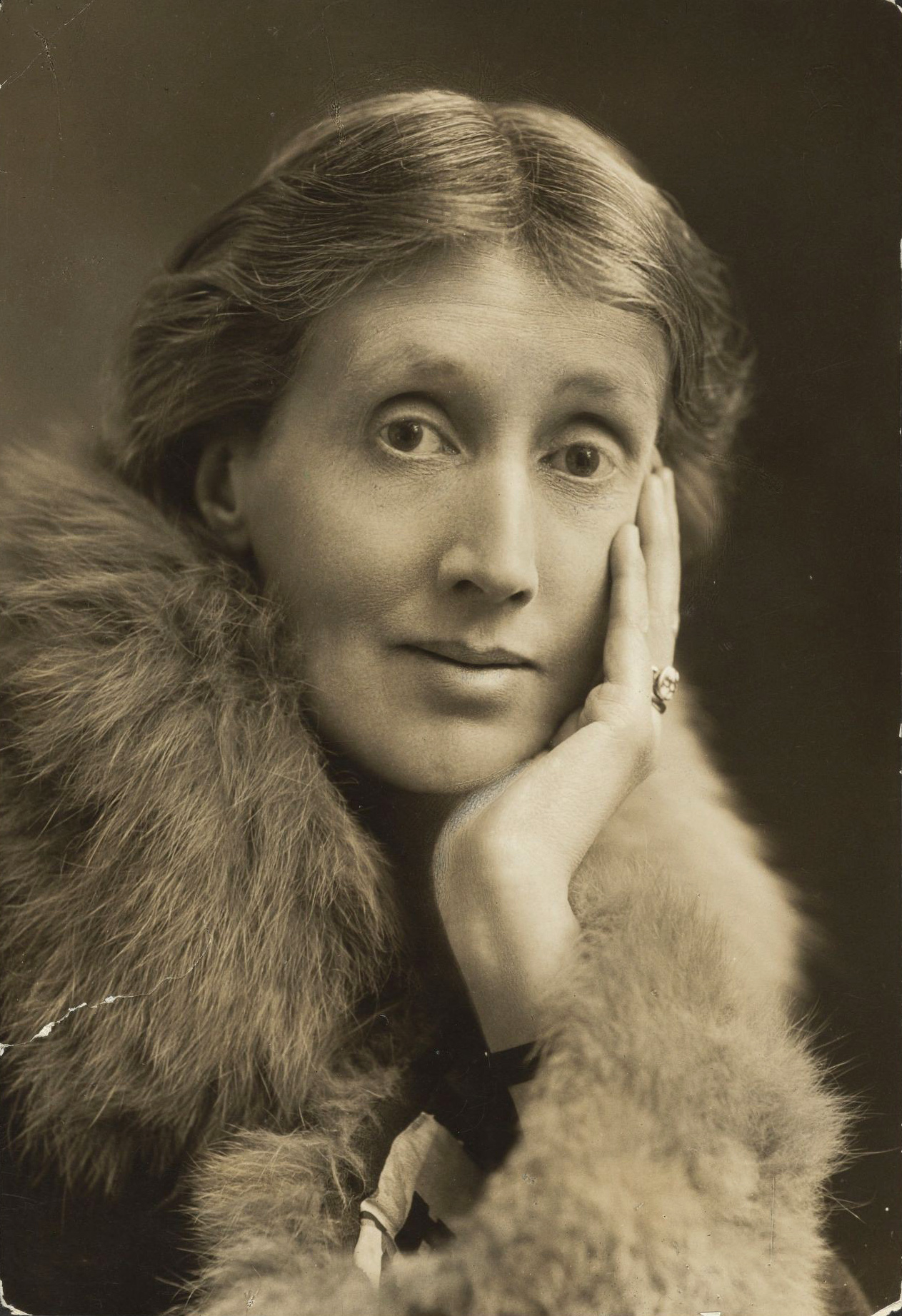
Image context: the cover photograph is a real 1927 studio image of Woolf preserved through the Harvard Theater Collection and reproduced on Wikimedia Commons. A portrait from the year of composition suits this article because Orlando repeatedly treats likeness as unstable evidence: what looks fixed in a picture keeps being revised by clothing, address, memory, and later readers.[2][5]
Clothes: the grammar everyone reads too quickly
The clothing motif is famous because Woolf makes it funny before she makes it philosophical. Orlando's sex changes, but society's reading of Orlando changes even faster. The body matters in the fiction, yet clothing determines how other people approach, desire, police, or misread that body. The line often remembered from the book, "it is clothes that wear us," condenses the joke and the argument at once.[1][3]
The University of Colorado's Genders archive is useful here because it shows how the clothing passages refuse one clean theory. The narrator offers several explanations of sex and gender in quick succession: clothing as social construction, clothing as outward sign of an inward truth, and clothing as a surface that can mask a contrary inward movement.[3] Woolf does not settle the matter by handing the reader a doctrine. She turns doctrine into motion.
That is why clothes in Orlando are never mere costume. They are permissions. They decide who can ride alone, who can inherit, who can move through a city unchallenged, who attracts danger, who is expected to blush, and who may speak with authority. The clothes do not create Orlando out of nothing. They expose how much of "identity" arrives as a social script before it arrives as self-knowledge.
The comedy matters because it keeps the argument from freezing. A solemn version of the same theme might simply announce that gender is constructed. Woolf instead stages a world in which the construction keeps changing its props. Hats, skirts, breeches, ribbons, and uniforms become mobile punctuation marks. Orlando's continuity is real, but it can only be seen through changing fabrics that make other people respond before they understand.
The oak tree: rooted memory without a fixed self
If clothes are the motif of public legibility, the oak tree is the motif of duration. Orlando's poem, "The Oak Tree," travels through the novel as a private project, an inheritance, and a measure of artistic time.[1] The tree anchors the book in a slower register than court fashion or urban modernity. It gives Orlando something that predates the present costume and outlasts the current social role.
Yet the oak tree is not simply a symbol of permanence. Woolf is too alert to history for that. The tree belongs to land, inheritance, country-house memory, and English literary tradition. Smith College notes that Vita Sackville-West's history of Knole and the Sackvilles supplied Woolf with background while she was making Orlando.[2] That background gives the tree its double pressure. It is personal longing, but it is also property, lineage, and exclusion.
The oak tree therefore works as a more complex emblem than "roots." It lets Orlando remain attached to a place and a poem without making place or poem innocent. The tree shelters imagination, but it also stands in a landscape organized by title, gender, and succession. Orlando's desire to write beneath or around it carries a wish for continuity, while the novel's historical sweep keeps reminding the reader that continuity has legal and social machinery behind it.
By the time the modern ending arrives, the oak tree has become less a stable answer than a living test. What can remain faithful across time without becoming rigid? What can be inherited without merely repeating the rules of inheritance? Orlando's poem matters because it keeps being revised. The tree endures, but the writing under its sign has to keep changing.
Portraits: the joke of being made into evidence
Orlando is packed with portrait logic. The Wikisource edition preserves the original illustrated apparatus: Orlando as a boy, the Russian princess as a child, the Archduchess Harriet, Orlando as ambassador, Orlando on returning to England, Orlando about 1840, Shelmerdine, and Orlando at the present time.[1] These images make the mock biography feel documentary. They also make its documentation suspect.
Portraits promise proof. They say: here is the person, here is the face, here is the visible record. Woolf uses that promise with a straight face and a raised eyebrow. If Orlando changes sex, era, dress, social function, and literary reputation, then each portrait is both accurate and incomplete. It captures a version, then immediately becomes a historical misunderstanding of the next version.
This is where the novel's playfulness becomes formally serious. A biography often depends on portraits to steady the reader: the school picture, the wedding photograph, the late-life profile, the author at the desk. Woolf turns that stabilizing habit into comedy. The more visual evidence the book supplies, the less the reader can pretend that evidence explains identity by itself.
The 1927 Woolf photograph used as this post's cover belongs to the same problem. It gives a face, a pose, a period style, and a public authorial aura.[5] It does not give the person entire. Woolf knew that gap intimately. Orlando turns the gap into a method. The portrait is not false; it is partial, and its partiality becomes visible only when time keeps moving around it.
Biography: the frame that keeps betraying itself
The subtitle, A Biography, is the book's most important joke. It announces order, evidence, lineage, and factual authority. Then the novel proceeds to let fantasy, parody, desire, and time travel enter the archive. Smith College calls the book a fanciful biography of a woman writer traced through four centuries and based on Vita Sackville-West.[2] That phrase catches the productive contradiction. The book is fanciful, but its fancifulness is aimed at a real biographical problem.
Britannica's account of Woolf stresses her central place in modernist fiction and in the Bloomsbury circle, along with the formal experiments that made consciousness, time, and perception central to her work.[4] Orlando belongs to that experimental career, but it reaches experiment through mischief. Instead of dissolving the self into pure interiority, it lets the self collide with records: prefaces, portraits, dates, costumes, names, houses, and literary reputation.
The biographer-narrator keeps trying to manage Orlando as a subject. That management is constantly comic because Orlando keeps exceeding the frame. The book asks what biography can know when a life is not reducible to a birth-to-death arc, a stable gender category, a national literary period, or a respectable public record. The answer is not that biography is useless. The answer is that biography is an art of selection, and Orlando makes the selection process visible.
This is why the novel's symbols fit together so neatly. Clothes show how identity is read by others. The oak tree shows how memory seeks roots while history complicates those roots. Portraits show how evidence fixes a moving person into a temporary surface. Biography shows how all these signs get arranged into a life story. Woolf does not discard those signs. She makes them shimmer against one another until fixed identity gives way to historical rhythm.
That rhythm is the pleasure of the novel. Orlando is airy, fast, witty, and extravagant, but its lightness is not evasion. It is a way of letting the reader feel how much weight can hide inside forms that look decorative. A sleeve, a tree, a portrait, a subtitle: each appears simple, then begins to carry centuries. Orlando survives because no single motif is allowed to close the case. The self remains legible only as revision.
Sources
- Virginia Woolf, Orlando: A Biography, Wikisource transcription of the 1928 Harcourt, Brace edition.
- Smith College Libraries, "Woolf in the World: A Pen and a Press of Her Own: Case 11a" (publication history, proofs, Sackville-West context).
- Ann Cvetkovich, "Woolf's Orlando and the Resonances of Trans Studies," Genders archive, University of Colorado Boulder.
- Encyclopaedia Britannica, "Virginia Woolf" (biographical and modernist context).
- Wikimedia Commons, "File:Virginia Woolf 1927.jpg" (lead-image source page).