Charlotte Perkins Gilman's The Yellow Wallpaper keeps adapting because it is already built like a transferable machine. The plot is small: a young wife and mother is taken to a rented house, kept in an upstairs room, told not to work, watched by her physician husband, and left with wallpaper that gradually becomes a whole system of perception.[1] Yet the story's afterlife is large because that room can change institutions without changing its pressure. It can be a sickroom, a marriage, a psychiatric case, a Gothic chamber, a feminist classroom, or an argument about who gets to name another person's mind.
That portability begins at sentence level. Gilman does not need a broad social panorama. She needs the narrator's secret writing, the husband John's medical confidence, and one surface that will not stay decorative. The wallpaper first enters as bad taste and bad color; the narrator calls it "repellent" before she fully understands that the pattern is becoming a form of captivity.[1] Once the paper starts to move under her attention, the story no longer depends on whether a reader approaches it through realism, horror, medical history, or feminist critique. Each path reaches the same room.
This is why the story's afterlife differs from the afterlife of a character-centered literary property. Dracula survives by changing bodies, costumes, lovers, and camera angles. Sherlock Holmes survives by solving fresh cases. The Yellow Wallpaper survives by preserving an arrangement: a woman told that treatment requires silence, a room that turns care into surveillance, and writing that becomes dangerous because it proves she is still interpreting her world.[1][2]
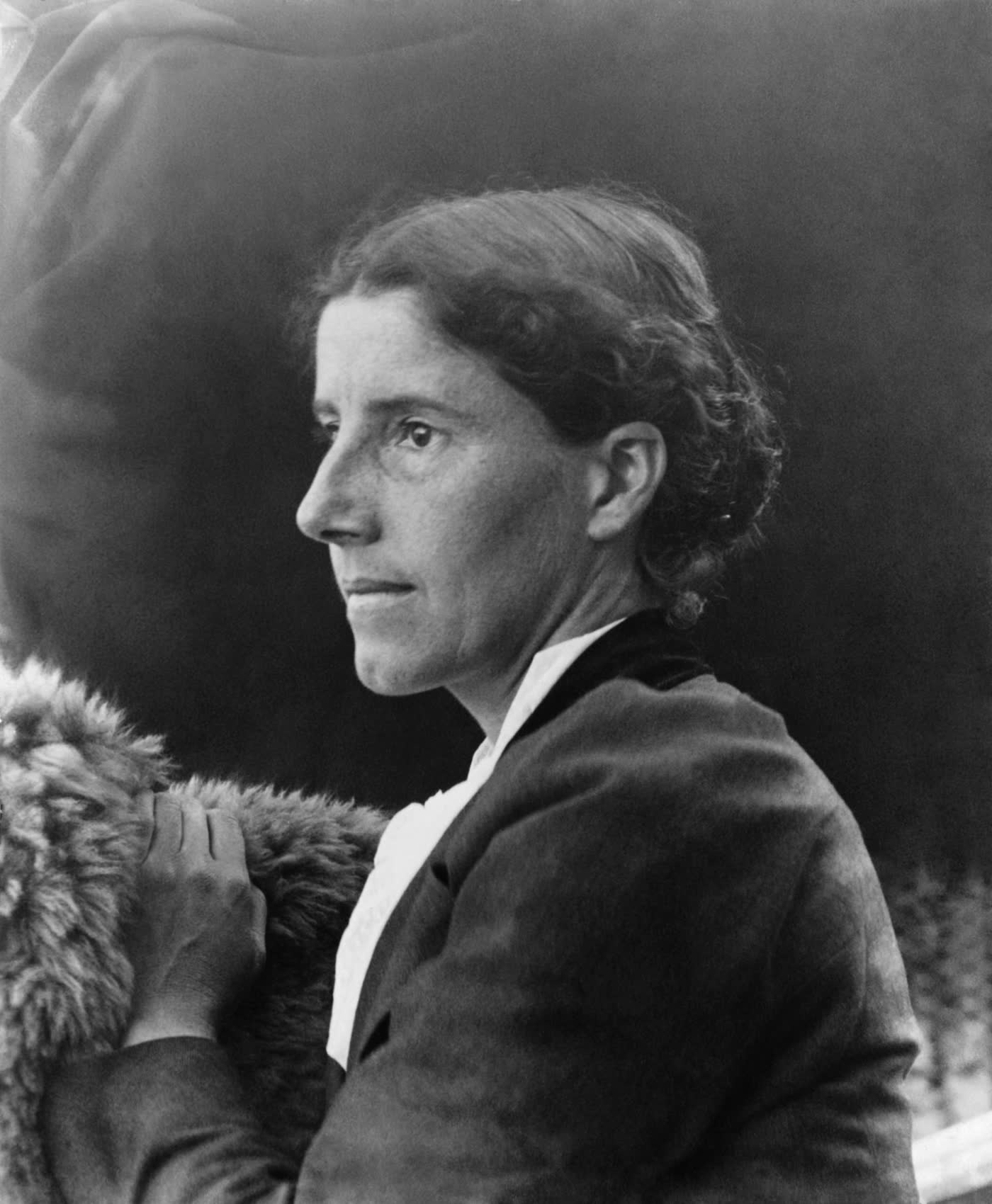
Image context: the cover portrait is a real archival photograph of Gilman from around 1900, preserved on Wikimedia Commons. The date matters because it places the public writer after the 1892 story but near the period when her reputation as a lecturer, feminist thinker, and author was becoming publicly legible.[5][6]
From Gothic shock to medical evidence
The first adaptation was not a film, stage version, or school edition. It was a change in how readers classified the story. The National Library of Medicine notes that William Dean Howells sent the story to The Atlantic Monthly, that editor Horace Scudder rejected it, and that it appeared in The New England Magazine in January 1892 instead.[2] Early readers were not simply impressed. Some were disturbed enough to ask whether such writing should be printed at all.[2]
That response helped build the story's double identity. On one side, it could be read as Gothic terror: an isolated house, barred windows, nursery fixtures, and a narrator whose perception becomes less reliable as the wallpaper becomes more vivid. On the other side, it could be read as evidence about a medical regime. Gilman's own 1913 explanation, "Why I Wrote 'The Yellow Wallpaper'," links the story to her experience with the rest cure and to the command to limit intellectual life and avoid pen, brush, or pencil.[2]
The afterlife starts there, in the gap between symptom and testimony. If the narrator is treated only as a case, her writing confirms illness. If she is read as a witness, her writing exposes the illness of the treatment itself. The story's genius is that it refuses to let those readings separate cleanly. The narrator's breakdown is real inside the fiction, yet the conditions producing it are also real enough to indict a system of domestic and medical authority.[1][2]
The room is the adaptation engine
The wallpaper is adaptable because it behaves like a medium. It is surface, text, screen, maze, and antagonist at once. A film can make it visual; a stage production can make it a surrounding room; a classroom can make it a reading problem; medical humanities can make it a case study in who controls diagnosis. The object is simple enough to travel and strange enough to resist being reduced.
Gilman makes that possible by keeping the narrator's world physically tight. The bed is heavy, the room is high, the windows are constrained, the paper is everywhere, and the writing has to be hidden.[1] The famous final movement, when the narrator says she has "got out at last," lands because the phrase can be heard in two registers at once.[1] It is liberation language and catastrophe language. That double sound is the story's durable horror.
This is also why the story became so teachable. Students can enter it through plot, symbol, medicine, gender, interior design, unreliable narration, postpartum distress, or Gothic convention, and the same scenes keep answering. The National Library of Medicine's education materials explicitly frame the story as social criticism and pair it with late-nineteenth-century medical and primary-source documents.[2] The tale adapts into a classroom not because it becomes simpler there, but because its compressed design supports several kinds of evidence at once.
Feminist recovery changed the frame, not the room
The 1970s rediscovery gave The Yellow Wallpaper one of its decisive modern afterlives. NLM's legacy account notes that the story resonated with the women's movement of that decade and was republished many times after that recovery.[3] Catherine J. Golden's Routledge sourcebook description shows how large the critical apparatus became: early reviews, medical context, Gilman's own explanations, the 1973 Feminist Press afterword, The Madwoman in the Attic, and later debates over form, color, race, and politics all enter the story's modern archive.[4]
The key point is that feminist recovery did not have to invent a new story. It changed the questions readers were licensed to ask. John's authority could now be read not merely as a husband's personal failure, but as a social grammar: diagnosis, marriage, property, domestic taste, and literary permission reinforcing one another. The narrator's secret journal could be read not merely as plot device, but as a survival technology under censorship.
That recovery also made the story more ethically complicated, because Gilman's public legacy cannot be flattened into heroic simplicity. NLM now states plainly that Gilman was both an important feminist thinker and a eugenicist whose racist, xenophobic, and ableist ideas require attention.[3] A strong afterlife reading has to hold that boundary. The story remains powerful as an indictment of confinement and silencing; the authorial archive also contains harms that modern admiration cannot erase.[3][5]
Horror kept what criticism sometimes tidies
Academic recovery can make a text look calmer than it feels. The Yellow Wallpaper resists that fate because it remains unnerving on the page. Its horror does not depend on a monster entering the room. The monster is a pattern that teaches the narrator how to read too intensely, then traps her inside the method of reading. The wallpaper is not just a symbol waiting to be decoded. It is a hostile reading environment.
That matters for adaptations because horror preserves the body's knowledge of the story. The reader feels the repetition, the visual nausea, the secrecy, the humiliation of being corrected, and the momentum by which a room becomes a mind. A purely historical interpretation can explain the rest cure. A purely symbolic interpretation can explain the wallpaper. Horror keeps the experience of enclosure active enough that the argument does not become museum glass.
The best afterlife of The Yellow Wallpaper, then, is not one definitive version. It is the story's ability to keep changing rooms while keeping its pressure system intact. It can sit in a Gothic anthology, a feminist theory course, a medical humanities syllabus, a theater black box, or a film frame, and still ask the same hard question: when care forbids language, what forms of perception become the only remaining speech?
That is why the story has not worn out. It is short, public-domain, and easy to assign, but those practical facts do not explain its endurance by themselves. It lasts because Gilman built a small room with unusually strong walls. Every generation can repaint the room's institutional name. The wallpaper still moves.
Sources
- Charlotte Perkins Gilman, The Yellow Wallpaper, Project Gutenberg eBook no. 1952.
- National Library of Medicine, "The Literature of Prescription: Reading 'The Yellow Wall-Paper'" (publication, rejection, early reception, and Gilman's 1913 explanation).
- National Library of Medicine, "The Literature of Prescription: The Author's Legacy" (1970s rediscovery, republication, and legacy context).
- Catherine J. Golden, ed., Charlotte Perkins Gilman's The Yellow Wall-Paper: A Sourcebook and Critical Edition, Routledge product page.
- Encyclopaedia Britannica, "Charlotte Perkins Gilman" (biographical and publication context).
- Wikimedia Commons, "File:Charlotte Perkins Gilman c. 1900.jpg" (lead-image source page).