Antigone enters Sophocles' play before the city has settled into peace. The brothers Eteocles and Polyneices have killed each other outside Thebes; Creon has taken power; one brother receives burial honors while the other is left exposed as a traitor. The plot can be summarized as a clash between family and state, but that summary makes Antigone smaller than she is. Her first act is not simply familial loyalty. It is a decision to make burial visible as speech, to put a body back into a human order after the new ruler has tried to turn it into a political warning.[1][2]
That is why Antigone is such a difficult character to domesticate. She is tender and severe, lucid and extreme, intimate and theatrical. She speaks for the dead, but she also speaks toward the living city, insisting that grief cannot be administered entirely by decree. Creon thinks the problem is obedience. Antigone understands that the deeper problem is legibility: who gets counted as kin, whose body can be used as a sign, and which laws are old enough to outlast a command issued after a battle.[1][2]
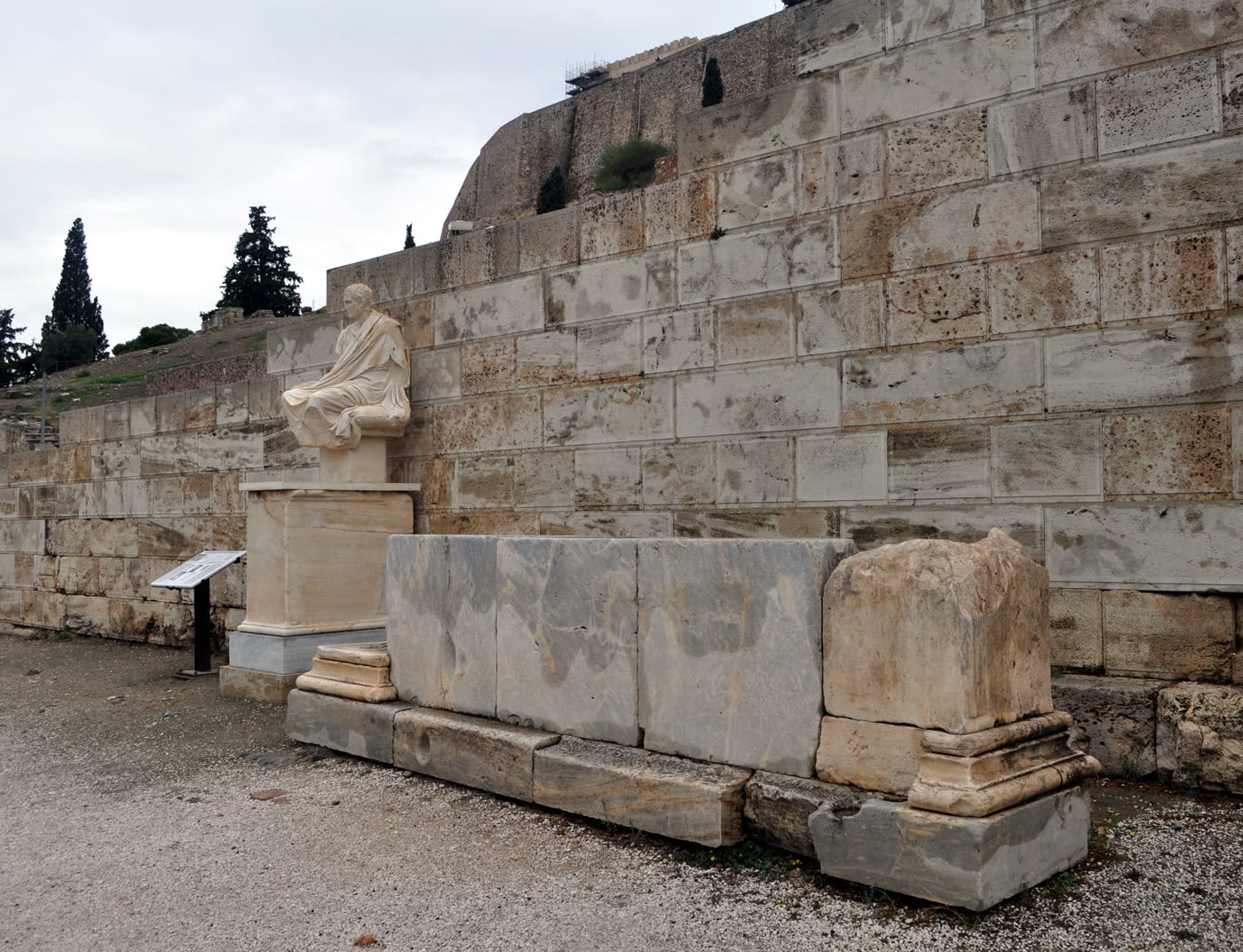
The Theatre of Dionysus gives that conflict its proper scale. The Acropolis Museum describes the sanctuary and theatre on the South Slope as the place where the City Dionysia made drama into a civic art, and where tragedies by Aeschylus, Sophocles, and Euripides were first presented.[4] Antigone is therefore not a chamber argument imported into public space. Its publicness is built into its form. A young woman steps out from the palace at daybreak, and the play turns her private obligation into a question a city audience must watch together.
Image context: the cover photograph shows the Theatre of Dionysus, not a generic classical ruin. It suits this character study because Antigone's force depends on the pressure between house, tomb, law court, and audience: she acts for a brother, but the meaning of that action is produced in public.[4][5]
The Sister Who Refuses Secrecy
Antigone's first scene with Ismene is often read as a clean contrast between courage and caution. It is sharper than that. Ismene is not foolish; she sees power clearly. She reminds Antigone that the sisters are isolated, female, and subject to a king's decree. Her sentence "I have no strength" is not cowardice in decorative form. It is the language of someone measuring the political world as it actually presses on her body.[1]
Antigone's reply does not erase that pressure. She knows it. What separates her from Ismene is not ignorance of danger but an unwillingness to let danger define the moral vocabulary. Her early declaration, "I will bury him," is grammatically simple because it has to be. The sentence has no policy theory inside it, no plan for reforming Thebes, no promise that resistance will succeed. It names the deed before the state can bury it under procedure.[1]
Her refusal of secrecy is equally important. Ismene offers to hide the plan; Antigone rejects that shelter and invites exposure. At first this sounds reckless, even cruel to the sister who cannot join her. Yet dramatically it reveals the character's central instinct. Burial, for her, cannot remain a private correction. If Creon's edict has made Polyneices' exposed body into public theatre, Antigone's counter-rite must also become public. She does not only want the dead covered. She wants the act of covering to be known.
That demand gives her tenderness a hard edge. Antigone loves her brother, but the play never lets that love soften into private sentiment. Kinship becomes a form of testimony. She will not allow Polyneices to be reduced to "the enemy" because that label erases the prior claims of blood, ritual, and the dead. The character's stubbornness begins here: in her refusal to let political vocabulary consume all other names.
A Crime With Ritual Shape
The burial itself is almost minimal. The guard reports that the corpse has been lightly covered with dust, accompanied by rites of piety.[1] That smallness matters. Antigone does not need monumental success. She needs the threshold crossed: unburied becomes touched, exposed becomes ritually addressed, spectacle becomes obligation. The deed is slight enough to be undone by the guards and strong enough to destroy Creon's confidence.
This is one reason the play has survived so many eras of political reading. Britannica's account of Antigone keeps the central situation plain: the conflict turns on Creon's prohibition of burial and Antigone's defiance of that command.[2] Sophocles makes the visible action small so that the symbolic force can expand. A handful of dust becomes a test of sovereignty. A sister's movement toward a corpse becomes a question about whether the city can rule the dead as absolutely as it rules the living.
Antigone's own language sharpens the paradox. She calls herself "sinless in my crime," one of the play's most compressed moral formulas.[1] The phrase does not mean that law is irrelevant. It means there are multiple jurisdictions in the scene, and Creon's new public law is not the only one that can name an act. In his vocabulary, burial is treason. In hers, burial is obligation. The tragedy begins when both vocabularies are coherent enough to act, but only one controls the punishments.
That is also why Antigone is not simply a modern dissident in ancient dress. She is not defending abstract individual freedom. Her claim is older and more ritualized: the dead belong to a sacred order, and the living owe them acts that cannot be cancelled by a ruler's anger. The character's power lies in how little she needs to invent. She acts as if the deepest law is already there, waiting to be recognized.
Creon's Mirror
Character studies of Antigone risk turning Creon into a flat tyrant, which weakens the play. Creon is dangerous because he has arguments. The civil war has just ended. Polyneices returned with an army against his own city. A ruler could reasonably fear that honoring him would blur the distinction between defense and attack. Creon's opening speech frames the city as a vessel saved from storm and insists that public loyalty must come before private attachment.[1]
Antigone exposes the fragility inside that argument. Creon thinks authority becomes stronger when it admits no rival claim. Sophocles shows the opposite. A city that cannot distinguish between punishing a living enemy and dishonoring a dead body has already let fear govern its categories. Creon wants Polyneices to remain politically useful after death, a continuing sign of what happens to traitors. Antigone breaks that use. By giving the corpse ritual attention, she interrupts the ruler's attempt to make the dead body speak only for the state.
The Cambridge Core page for Sir Richard Jebb's Sophocles: The Plays and Fragments notes that Jebb's edition of Antigone remains a landmark because it joins Greek text, translation, critical notes, and explanatory apparatus.[3] That scholarly afterlife fits the play's own pressure. Antigone keeps demanding apparatus because its conflict cannot be reduced to one slogan. The tragedy does not merely ask whether Antigone or Creon is correct. It asks what kind of city results when each claim is driven to its end without listening.
Antigone's greatness and danger sit together there. She hears the dead with absolute clarity, but she gives the living little room to approach her unless they accept that clarity. Creon hears the state with equal absolutism and gradually loses the voices that might save him. They are mirrors in rigidity, yet not moral equivalents. Antigone's rigidity restores a basic human rite; Creon's rigidity multiplies death. The difference matters because the play does not treat all inflexibility as the same.
The Public Shape of Grief
The emotional center of Antigone is grief, but it is grief under civic pressure. She is not granted a normal mourning process. There is no funeral sequence in which feeling can move through ritual and community. Creon's law blocks exactly that passage. Antigone's character forms around the refusal to let mourning be privatized into silence or criminalized into treason.
This is where her theatricality becomes ethical rather than merely dramatic. She wants witnesses. She wants the city to see that a decree has produced a disorder deeper than the disorder it claims to cure. Her grief therefore becomes public speech, but it is not speech in the ordinary argumentative sense. It is gesture, dust, exposure, confession, and willingness to die under the name of the deed. She does not persuade Creon. She makes his refusal visible.
The late scenes intensify the cost. Antigone laments the marriage and children she will not have, and those lines can feel jarring after her earlier certainty. They should not be treated as inconsistency. They reveal what the character has suppressed in order to act. Her commitment to the dead does not cancel her attachment to life. It places that attachment beneath another obligation. The tragedy depends on that loss being real. If Antigone wanted death simply, she would be much easier to contain.
Her final force comes from that mixture. She is not a saint detached from ordinary life, and she is not merely a rebel intoxicated by defiance. She is a young woman who decides that a city becomes unlivable when it asks the living to participate in the degradation of the dead. The decision is narrow, embodied, and irreversible. That is why the play keeps returning. Antigone's act remains legible wherever states, families, religions, and public rituals compete to name what the dead are owed.
The character survives because she turns an apparently small duty into a complete test of civilization. A body must be buried. A sister must be able to say so. A ruler must know that victory in war has not made him lord of every meaning. Sophocles gives Antigone no army, office, or future. He gives her a handful of dust and the nerve to make it public.
Sources
- Sophocles, Antigone, translated by R. C. Jebb, Internet Classics Archive / MIT (public text and line-by-line dramatic context).
- Encyclopaedia Britannica, "Antigone" (plot, approximate performance date, and literary context).
- Cambridge Core, R. C. Jebb, Sophocles: The Plays and Fragments, Volume 3: The Antigone (edition and commentary history).
- Acropolis Museum, "Sanctuary and Theatre of Dionysos" (City Dionysia and theatre context).
- Wikimedia Commons, "File:Athens - Theatre of Dionysus 01.jpg" (lead-image source page).