At the start of Louisiana Channel's 2017 interview, Orhan Pamuk refuses an easy formula. He says his relation to Istanbul is not a "fascination"; it is simply what life gave him.[1] That distinction matters. It removes the city from the category of exotic subject matter and puts it back where Pamuk's novels have always kept it: as the ground on which questions of class, memory, modernity, and inward life are tested. The interview is valuable because he explains this without grand theory. He speaks like a novelist describing working conditions.
That working description sharpens a line already visible in the Nobel committee's 2006 wording. On the Nobel facts page, Pamuk is praised for discovering "new symbols for the clash and interlacing of cultures" while searching the melancholic soul of his native city.[3] On the page, that can sound like a polished summary of a completed career. In the interview, it becomes procedural. Pamuk says literature is first about humanity, and that he happened to come across humanity in Istanbul.[1] The city is neither ornament nor patriotic emblem. It is the scale at which human contradiction became legible to him.
This is also why the video matters now, after Pamuk's reputation has long since hardened into shorthand: Nobel laureate, Istanbul novelist, East-West mediator, chronicler of melancholy.[3][4] The interview loosens those labels. It shows a writer describing how his books widened over time, moving from the westernized middle-class interiors he knew first toward migrants, poor districts, street life, demolition, and the full panoramic spread later visible in works such as The Museum of Innocence and A Strangeness in My Mind.[1][4] What looks from outside like a fixed literary identity turns out, in his own account, to be an expanding method.
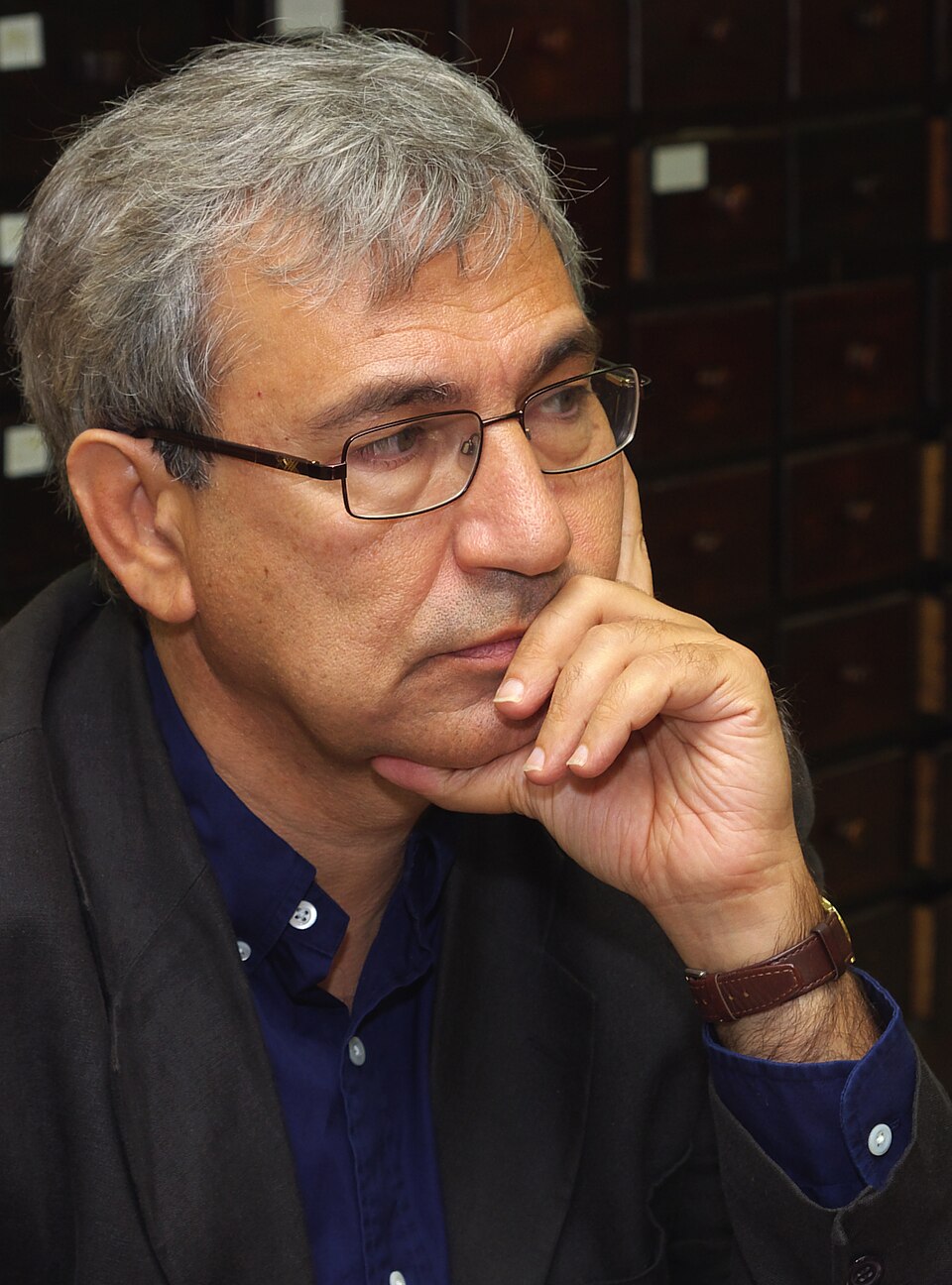
Image context: the cover uses a real 2009 photograph from Wikimedia Commons. That choice suits the article because this is a piece about witness and craft, not about postcard atmosphere. The video and the novels insist on the city as lived duration, and a documentary portrait serves that argument better than any stylized skyline could.[5]
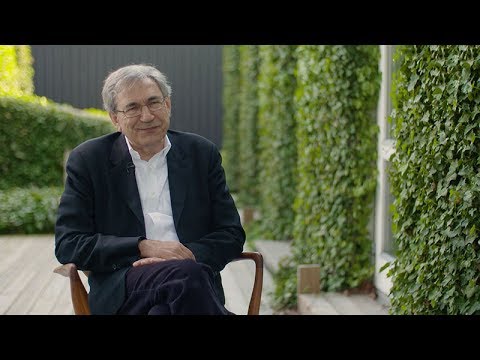
The embedded video is Louisiana Channel's official YouTube upload, published on 7 June 2017. It runs just over twenty minutes and focuses on Pamuk's relation to Istanbul, the widening social range of his fiction, and his sense that novels depend on compassion rather than cultural slogans.[1]
Around the opening minutes, the city stops being local color
The interview's first important turn comes when Pamuk says he did not initially set out to write "about Istanbul" in any branded sense.[1] He says all writers write about friends, people, and humanity, and that he happened to meet those things in the city where he had lived his whole life. That phrasing is easy to miss, but it rearranges the usual reading of urban fiction. Pamuk is not presenting the city as a collectible identity. He is presenting it as a medium of contact. Istanbul becomes literary material because it is dense enough to force the novelist into encounters with social difference, historical layering, and changing scale.
That helps explain why he says he was not self-conscious about being an "Istanbul writer" until his books began circulating internationally.[1] The label arrives from outside, after translation and recognition. The work itself began much closer to habit, memory, and available experience. The same pressure appears in the Nobel interview from October 2006, where Pamuk resists the fashionable language of civilizational clash and instead says culture is mixture.[2] Put beside the 2017 video, the point becomes clearer: Istanbul matters to him not because it stages a clean East-West allegory, but because it spoils clean allegories. It is mixed, damaged, ambitious, layered, and resistant to summary.
Around 1:40 to 4:30, widening circles replace nostalgia
Pamuk's account of his own development is one of the best parts of the interview. He describes his books as circles that keep widening: first upper-middle-class and westernized households, then more politics, then neighborhoods, then poor migrants and self-built settlements, until eventually the city becomes something close to a total social field.[1] That is a much stricter idea than simply "writing what you know." He began with the room nearest to him, but the work's pressure was always outward.
This matters because it keeps his relation to Istanbul from collapsing into sentimentality. Pamuk says he may feel nostalgic about childhood, but not about old Istanbul as a sacred lost object, and he explicitly says he does not want to glamorize or romanticize his relation to the city.[1] The distinction is excellent. Childhood memory has heat; civic myth has haze. He trusts the first and distrusts the second. That distrust keeps the novels alert to expulsions, poverty, ruined buildings, erased minorities, and redevelopment, rather than turning the city into literary perfume.[1][2]
Britannica's career summary supports this larger arc. It places Pamuk's major novels across different formal and historical zones, from My Name Is Red to Snow to The Museum of Innocence and later work, and stresses his repeated concern with identity between Western and Eastern value systems.[4] The interview makes that public description more tactile. You hear a writer explaining how he earned the right, slowly, to move from one social stratum to another without pretending the city was ever one thing.
Around 9:10 to 12:50, melancholy becomes a theory of historical scale
The most revealing stretch arrives when Pamuk describes growing up at what felt like the edge of Europe, with middle-class aspirations toward Europe colliding with poverty, Ottoman afterlife, religion, and the decayed texture of imperial grandeur.[1][2] This is not the touristic melancholy of ruined beauty. It is a social feeling produced by uneven modernity. The Nobel interview page makes a related point when Pamuk says Istanbul's melancholy arose from ruins and poverty together, and that the city had become one of those early modern places where modernity seemed to decay ahead of schedule.[2]
In the video, that diagnosis hardens into a rule: do not hope for continuity.[1] It is one of the strongest lines in the conversation. He does not mean that memory is worthless. He means that cities are not museums designed to preserve our preferred version of ourselves. Neighborhoods disappear, apartment blocks fall, demographics shift, political eras erase what they inherit, and what remains of a life will be partial. This is why Pamuk's city writing has weight. He is not collecting urban atmosphere. He is studying how historical time washes through ordinary attachment.
That rule echoes the deeper logic of his Nobel lecture, My Father's Suitcase. There he describes literature as what happens when a person shuts himself in a room and turns inward with patience, but he also insists that real literature asks us to tell our own stories as if they belonged to others, and others' stories as if they were our own.[6] The room is private, but the task is never private for long. The city teaches the same lesson from the opposite direction: everything intimate is already under demographic, architectural, and political pressure.
Near the end, the city yields a definition of the novel
The interview closes on perhaps its best surprise. Pamuk says the art of the novel rests on compassion, on the human capacity to see the world through another person's point of view.[1] That statement can sound broad in isolation, but after the earlier discussion it lands with force. Compassion here is not a moral slogan. It is the method that lets one move from one circle of the city to a larger one without conquest or sentimentality. It is what allows a writer to begin inside his own room and still speak beyond it.
That is why this interview deserves to be read as more than author commentary. It offers a compact poetics of city-writing. Start with the place life gave you. Refuse to reduce it to scenery or doctrine. Let the circles widen. Accept that buildings, memories, and status claims will not hold still. Then turn that instability into forms through which other people can recognize themselves. Pamuk's Istanbul, in this account, is not a backdrop behind the novels. It is the device that taught him how to make private witness travel outward into human scale.[1][2][6]
Sources
- Louisiana Channel, "Orhan Pamuk Interview: Do Not Hope for Continuity," YouTube video (published June 7, 2017).
- Nobel Prize, "Orhan Pamuk – Interview" (October and December 2006 interview page; includes Pamuk's remarks on cultural mixture and Istanbul's melancholy).
- Nobel Prize, "Orhan Pamuk – Facts" (2006 prize motivation and career summary).
- Encyclopaedia Britannica, "Orhan Pamuk" (biography and major works overview).
- Wikimedia Commons, "File:Pamuk.jpg" (source page for the article image).
- Nobel Prize, "Orhan Pamuk – Nobel Lecture" (My Father's Suitcase, delivered December 7, 2006).