The afterlife of Hedda Gabler has less to do with a single scandalous heroine than with an unusually portable dramatic machine. Ibsen published the play in 1890, and it was produced the following year.[2] Since then, directors have been able to strip it down, modernize it, stylize it, or flood it with period detail without breaking its core design. The play survives because its pressure does not depend on one historically fixed surface. It depends on a room, a few charged objects, and a woman who discovers too late that style is not power.
That distinction matters. Readers often remember Hedda as a destructive personality, and she is that. But what keeps the play alive on stage is the way Ibsen externalizes her psychology. The house is not just a setting, the pistols are not just props, and Løvborg's manuscript is not merely a plot device. Each item carries social meaning, erotic pressure, and theatrical force at once.[1][2] A new production only has to decide what these objects look like in its own period; the trap itself is already built.
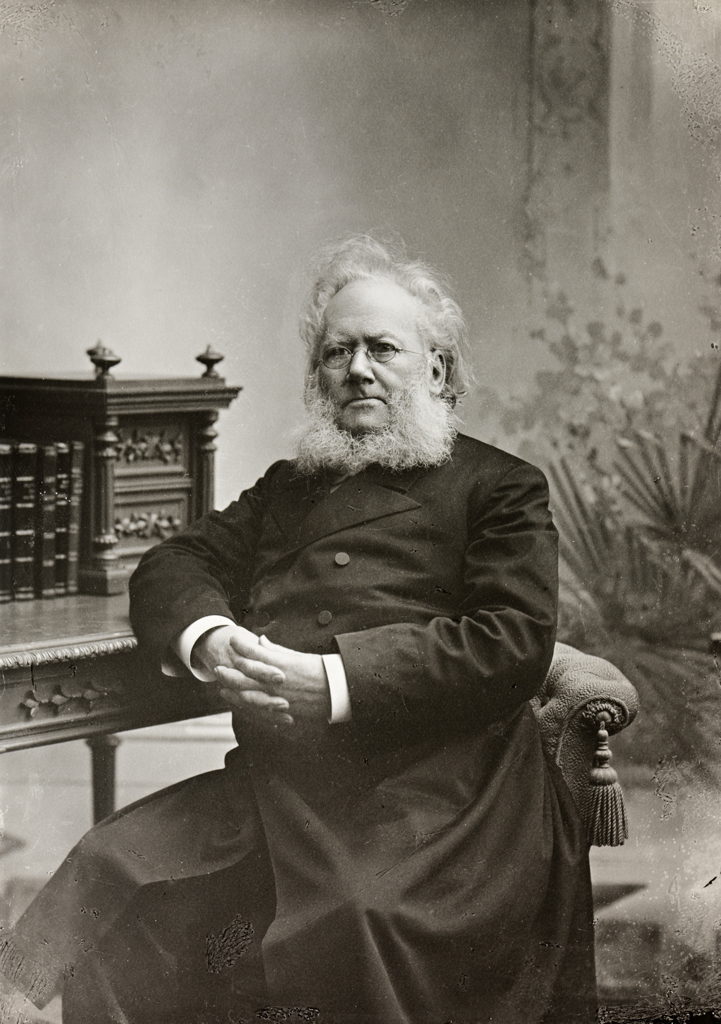
Image context: the cover photograph is not a production still. It is an 1898 archival photograph of Ibsen from the National Library of Norway, accessed through Wikimedia Commons.[4] That choice keeps the article near the playwright's own late career, when this play had already begun to travel beyond its first national setting.
The room is the first adaptation engine
Ibsen begins by giving the stage a house that already feels arranged for scrutiny. The opening directions in the Project Gutenberg text describe interlocking rooms, a glass door, visible autumn foliage, bouquets, lamps, and General Gabler's portrait hanging over the interior space.[1] The room is respectable, newly occupied, slightly overfurnished, and immediately legible as a social container. Hedda has married into it, but the space never feels comfortably hers.
That is one reason the play adapts so well. The room can be rendered in thick bourgeois detail, or it can be reduced until it feels like a psychological cell. The action still works because the real structure is relational: Hedda is on display to Aunt Juliana, cornered by Tesman, measured by Thea, remembered by Løvborg, and finally enclosed by Brack.[1] The house is where those lines of sight cross.
The National Theatre's 2016-17 production, directed by Ivo van Hove in a new version by Patrick Marber, shows how flexible this engine is without changing its purpose. The theatre's background material describes a set based on Hedda's point of view: plasterboard walls, stone floor, stripped furniture, and a window beyond which there is "nothing, just darkness and occasional light."[5] That is far from a museum reconstruction of late nineteenth-century Norway. Yet it remains deeply Ibsenite because the design intensifies the same truth already present in the script: marriage has given Hedda an interior, but not a habitable one.
What travels from production to production is therefore not the exact wallpaper of the Tesman house. It is the room's function as a pressure chamber. Hedda needs an environment that can display taste while withholding freedom. Every strong revival finds a contemporary equivalent for that contradiction. One era plays the room as suffocating domestic realism, another as minimalist prestige architecture, another as chilled luxury. The play keeps holding because the room is a social instrument before it is a period artifact.
The manuscript and the pistols do the heavy lifting
If the room is the container, the manuscript and the pistols are the play's portable engines of fate. Løvborg's manuscript can be staged as pages, notebook, printout, or data in another century, but its dramatic role remains exact. It represents future reputation, intellectual fertility, and the possibility that another pair of lives might cohere where Hedda's own has narrowed.[1] When she destroys it, she is not simply acting out jealousy. She is attacking a form of continuity she cannot bear to watch from the outside.
The line that makes this clearest is brutal because it is so literal. As Hedda feeds the pages into the stove, she tells Thea, "I'm burning your child."[1] Ibsen makes the manuscript carry more than authorship. It becomes a surrogate body, a joint creation, even a rival domestic future. That is why the act survives translation and adaptation so well. A production does not need to modernize the psychology very much; the symbolic pressure is already concentrated in the object.
The pistols work differently. They are relics of General Gabler, tokens of rank and masculine inheritance that Hedda can handle but never truly convert into sovereignty.[1][2] She brandishes them as if style, danger, and command might fuse in her hand. Yet every use of them reveals the opposite. They mark the distance between theatrical gesture and actual control.
Hedda announces her hunger directly when she says she wants "for once in my life to have power to mould a human destiny."[1] The sentence sounds grand, nearly romantic. The play then shows how compromised that dream is. She can provoke, insinuate, shame, and destroy; she cannot shape a world sturdy enough to live in. Even the death she imagines beautifully for Løvborg returns to her in degraded form, reported as accident, wound, and scandal. By the end, Judge Brack understands enough to make the pistols instruments of blackmail rather than freedom.[1][2]
That is a major reason the role keeps attracting modern actresses and directors. The play gives its central figure symbolic objects of enormous clarity, then denies her mastery over them. Performers inherit not a flat "strong woman" but a much harsher design: a woman whose intelligence is acute, whose appetite for form is genuine, and whose available means are corrupt from the start.
The play began traveling almost immediately
The speed of the play's early circulation helps explain its later global durability. The University of Oslo's Henrik Ibsens Skrifter translation introduction notes that, while preparing the Copenhagen publication, Ibsen was already sending proof sheets to authorized translators in England, France, and Germany.[3] The English edition appeared in January 1891; French and German versions followed in the same early phase of the work's public life.[3] Hedda Gabler was not a drama that sat still in one language for long before becoming international. Mobility was part of its reception from the beginning.
That movement has become quantifiable. The IbsenStage database, maintained by the University of Oslo, links Hedda Gabler to 3,149 events across 2,400 venues and records performances in dozens of countries and languages, including 936 English-language events in its current index.[4] Those numbers do not prove artistic greatness by themselves, but they do reveal something about the play's transportability. It moves across theatrical systems because its dramatic grammar is compact and severe. A company does not need epic scale, battle scenes, or elaborate locale to restage it. It needs a room, a few relationships, and the courage to let boredom harden into menace.
The same portability affects translation. Ibsen's dialogue is socially precise yet theatrically usable. The play is full of insinuation, repetition, and shifts in address rather than lavish scenic description.[1][3] That makes it vulnerable to weak versions, but it also helps explain why strong translators and adaptors keep returning to it. The language can be tightened, contemporary idiom can be adjusted, and class codes can be recalibrated without dissolving the underlying geometry of pressure.
Modern versions keep changing the surface, not the wound
The most durable adaptations understand that Hedda Gabler is not preserved by antiquarian loyalty. It is preserved by rediscovering where the wound sits. Van Hove and Marber, in the National Theatre material, did not treat the play as sacred furniture. They treated it as a structure that could be "re-realised" through a new version, new cast, and a design explicitly filtered through Hedda's perception.[5] That instinct is right. The play does not ask each generation to imitate 1891. It asks whether a culture still knows what to do with cultivated frustration, reputational panic, erotic misalignment, and social exposure.
The answer has stayed yes. A modern audience may hear academic competition differently, stage Brack's leverage more explicitly, or read Hedda through newer vocabularies of gender and enclosure. Yet the play does not need those vocabularies to function. Its cruelty is already formal. The staircase of humiliation is built into entrances, interruptions, reports from offstage, and the terrible shrinking of available choices.[1][2]
That is why the ending still lands with such force. Brack's horrified reaction, "People don't do such things!," is both social reflex and epitaph.[1] He means suicide, of course, but the line also exposes the code the play has been anatomizing all along: people are supposed to endure arrangement, endure compromise, endure the room. Hedda's final act does not liberate her into triumph, but it does rupture the social script that has been tightening around her from the first scene.
The play's afterlife rests there. Hedda Gabler keeps returning because it gives later theatre-makers a nearly perfect transfer system. They can refurnish the house, reset the class signals, sharpen the erotic stakes, or drain the stage to bare surfaces. The manuscript will still feel like stolen future, the pistols will still turn heritage into menace, and the room will still discover how little space a cultivated life can contain.[1][4][5]
Sources
- Henrik Ibsen, Hedda Gabler, Project Gutenberg public-domain text.
- Encyclopaedia Britannica, "Hedda Gabler" (publication date, first production, plot, and critical significance).
- Henrik Ibsens Skrifter, "Innledning til Hedda Gabler: Oversettelser i Ibsens levetid" (University of Oslo translation history PDF).
- IbsenStage, "Work: Hedda Gabler" (University of Oslo database of performances, venues, countries, and languages).
- National Theatre, Hedda Gabler rehearsal diaries/background pack (2017 PDF on the van Hove/Marber production concept and set design).