The best way to misread Vanity Fair is to treat it as a long contrast piece: Becky Sharp bad, Amelia Sedley good, the world cruel to both, and Thackeray standing above them with a satirist's grin. That summary catches some of the novel's moral weather, but it misses the engineering. Vanity Fair is built as a show before it becomes a plot. Its full 1848 title page announces A Novel without a Hero, and the prefatory section "Before the Curtain" presents a manager surveying the fair, praising his puppets, and inviting the audience to watch the performance.[1][2] Once that frame is taken seriously, the book stops looking merely sprawling. It starts to look like a deliberately staged machine for circulation, interruption, and belated recognition.
The publication history matters here. Cambridge's edition note records that the novel first appeared in twenty monthly parts from January 1847 to July 1848.[2] Peter Shillingsburg's note on the book's structure then sharpens the point: the title-page illustration and "Before the Curtain" were supplied with the final installment rather than the first.[3] In other words, the book's opening theatrical frame was written from a position of retrospect. Thackeray places the manager at the start, but the manager speaks with end-of-performance knowledge. That single formal fact helps explain why the novel can feel both improvisatory and tightly judged at once.
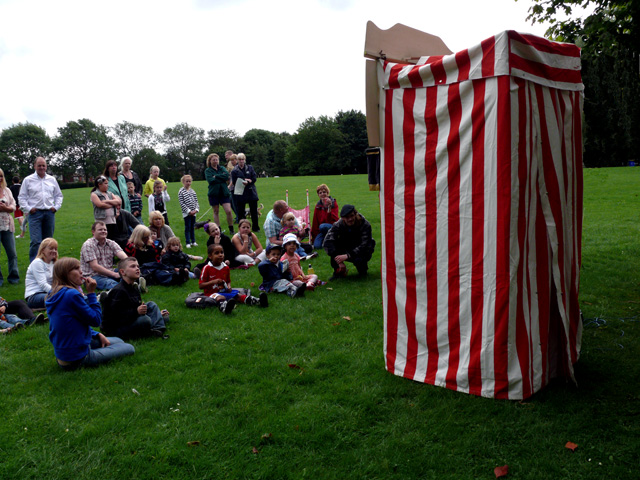
Image context: the cover now uses a real-world photograph of a Punch and Judy show booth rather than a portrait or page scan. That is the right visual register for this essay because the argument keeps returning to staging: the narrator as showman, the puppet strings he refuses to hide, the audience gathered before a booth, and the formal intelligence that turns social circulation into performance.[1][4][6]
1) The fairground frame turns society into a managed show
The prefatory manager does not give readers a serene moral altitude. He gives them a booth, a crowd, noise, appetite, cheating, flirting, painted faces, and tired performers stepping offstage.[1] That matters because it sets the novel's unit of meaning. Thackeray is not promising one sovereign protagonist whose inward growth will organize the whole world around her. He is promising a field of acts, poses, booths, and temporary reputations. The subtitle A Novel without a Hero is not only a joke at the expense of sentimental fiction. It is a structural instruction.[1][2]
The narrator's later intrusions make more sense once the opening manager is remembered. Victorian Web's account of Thackeray's "showman" narrator is useful because it treats the speaking voice as part of the created performance rather than as a clumsy accident outside it.[4] The novel is full of moments when the narrator steps forward, tugs the wire, names an illusion, or comments on a puppet's movement. Readers who want a sealed realist world can find that irritating. Formally, though, the interruptions are part of the design. The fair never lets you forget the stall owner.
2) Becky and Amelia are less opposites than two different traffic systems
Once the frame is in place, the middle mechanism becomes clearer. Becky and Amelia are not simply moral foils. They move through the book at different speeds and by different circuits. Becky is kinetic. She changes households, coaches, patrons, accents, debts, admirers, and tactical positions with astonishing speed.[1] Even when she appears cornered, the form keeps finding another opening for her: a governess post, a marriage, a gaming room, a noble patron, a continental afterlife. She is the novel's great circulation device.
Amelia, by contrast, is built through delay. She waits for George, waits for letters, waits through family decline, waits through mourning, waits for others to understand what readers already know about Dobbin.[1] She is structurally slower not because Thackeray cannot imagine an active good woman, but because the novel needs one character to register the cost of time rather than the opportunities of movement. Becky converts rooms into ladders. Amelia turns rooms into holding patterns.
That is why the book's first large movements feel so alive. Thackeray does not merely alternate between virtue and vice. He alternates between acceleration and drag. Becky's chapters often create forward pressure through schemes, entrances, reversals, and social reinventions. Amelia's chapters absorb news belatedly and convert it into emotional duration.[1] The design allows the reader to feel one world, two tempos. A lesser novel would have made one woman exemplary and the other cautionary. Thackeray makes each woman carry a distinct time-system.
3) Waterloo is the hinge that breaks the marriage-comedy rhythm
The Waterloo sequence is where the book proves it has larger ambitions than social satire alone. Up to Brussels, Vanity Fair can still seem like an enormous marriage-and-money performance, however mordant the tone.[1] Then the campaign chapters arrive, George dies, Jos flees, Amelia's future collapses, and Becky shows her hardest survival instincts under wartime pressure.[1] Waterloo does not merely add historical color. It breaks the rhythm the novel has been teaching readers to expect.
This break is structural because it redistributes consequence. Before the battle, flirtation, rank, inheritance, and matchmaking dominate the field. After the battle, the same social world continues, but it now carries permanent damage inside it. Cambridge's edition description is right to call the book a panoramic tour across English social strata and to emphasize the rise and fall of Becky Sharp.[2] What that description understates, and what the battle chapters reveal, is that Thackeray organizes the panorama around rupture. The fair does not end at Brussels; it learns how to keep running after catastrophe.
That is why Amelia matters more after Waterloo, not less. Her slowness stops reading like mere softness and becomes a structural register of grief. Becky, meanwhile, becomes sharper because survival itself has become more brutal.[1] The novel's second half is not just a continuation of earlier intrigue. It is a study of what happens when the gaming table resumes after history has taken a life from the center of the room.
4) Serial form keeps value in motion and closure deliberately partial
The chapter architecture reinforces all of this. Even in the table of contents, Thackeray names movement, interruption, and return with unusual force: campaigns open, families leave Brighton, readers double the cape, lights are put out, old acquaintances reappear, births and deaths arrive in one bundle.[1] The serial publication history helps explain why this works.[2][3] Monthly parts reward propulsion, but Vanity Fair refuses clean segment-by-segment moral accounting. Characters recur under altered conditions; jokes harden into fate; a passing social surface in one installment becomes a life sentence in another.
That is where the fairground frame pays off again. In a booth, audiences do not expect metaphysical completion; they expect the next act, the next reveal, the next performer brought under light. Thackeray uses that expectation against the reader. He keeps the show moving, but he also lets residue accumulate: debt, gossip, widowhood, compromised children, exhausted loyalties, and damaged prestige.[1][5] The result is a novel whose form is mobile on the surface and sedimentary underneath.
5) The ending returns us to the manager's knowledge
By the end, Vanity Fair has not discovered a hero after all. It has redistributed the cast. Becky remains alive and adaptable, Amelia finally reaches the quieter future readers had long wanted for her, Dobbin is rewarded late, and the fair continues to throw up compromise rather than purification.[1] Shillingsburg's point about the late-added opening frame becomes decisive here: the manager at the beginning already knows that no single life in this world will produce a pure moral center.[3] The show opens from the vantage of aftermath because aftermath is the book's true perspective.
That is why the novel lasts. It is not simply cynical, and it is not secretly sentimental beneath the satire. It is structurally double. The puppet-show frame gives Thackeray distance; the long serial accumulation gives him consequence. Becky Sharp's circulation keeps the machine lively; Amelia's lag keeps it human; Waterloo cracks the comic shell; the ending returns the whole apparatus to a fair in which performance never stops and moral clarity never arrives in one piece. Vanity Fair is built to make readers enjoy the motion and then feel, a beat later, what that motion has cost.[1][2][3][4][5]
Sources
- William Makepeace Thackeray, Vanity Fair, Project Gutenberg ebook 599.
- Cambridge University Press, Vanity Fair: A Novel without a Hero (edition page with publication-format description).
- Peter L. Shillingsburg, "The Structure of Vanity Fair," PMLA / Cambridge Core PDF note on serial order and front matter.
- Victorian Web, "The Retreated Narrator: Thackeray's Showman in Vanity Fair."
- Encyclopaedia Britannica, "William Makepeace Thackeray."
- Wikimedia Commons, "File:Punch and Judy show - geograph.org.uk - 1990370.jpg" (real-world fairground puppet-show photograph used for the article image).