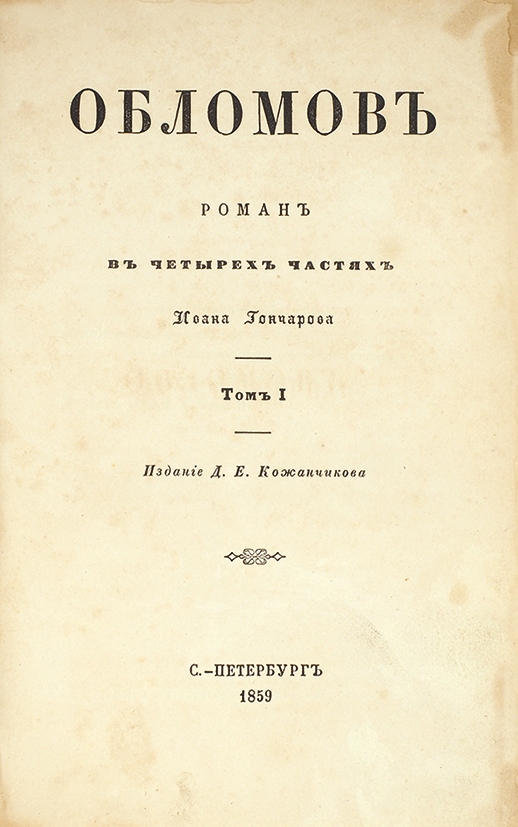
On the first morning of Ivan Goncharov’s Oblomov, Ilya Ilyich has two problems. His landlord wants him to move, and the steward of his country estate has written about poor harvests, arrears, and falling income. Neither problem is mysterious. Both require letters, decisions, and eventually a journey. Oblomov spends the morning calling for his servant.
Zakhar must find the steward’s letter, then the handkerchief on which his master is lying. He must explain the dust, locate the wash things, fetch the account book, summon a joiner, and somehow make the unwanted move happen. Each request is comic by itself. Together they establish the novel’s moral unit of measurement: whenever Oblomov avoids an action, the action does not disappear. It changes owners.[1]
That distinction is easy to miss because Oblomov is so thoroughly gentle. His face, movements, and spirit all seem governed by softness. He dislikes cruelty, distrusts careerist bustle, and never becomes the schemer that his exploitative acquaintance Tarantiev is. His old friends describe a heart that has remained honest when more energetic people have learned to bargain with theirs. The novel does not expose this goodness as a fraud. It asks the more uncomfortable question of whether a good heart is enough when other people must supply its hands.
The first task is always Zakhar’s
Oblomov’s Persian dressing gown is often treated as his emblem, and rightly so. It has no constricting waist, yields to every movement, and lets the body forget that it is wearing anything. Daria Farafonova reads the robe, the dust, and the repeatedly deferred letter as objects that organize a comic world of potentiality rather than completed action.[5] But the robe has a human counterpart. It can feel perfectly obedient because Zakhar remains within shouting distance.
Master and servant are a double act, not a clean opposition. Zakhar is sleepy, evasive, proud of an obsolete livery, and capable of leaving dirt wherever dirt can settle. He has absorbed the household’s habits so completely that his resistance often looks like another form of loyalty. Milton Ehre places the pair in the tradition of Don Quixote and Sancho Panza: master and servant sustain private visions that make them touching as well as absurd.[4]
Their intimacy does not cancel their inequality. Zakhar is not a freely hired servant but Oblomov’s serf; the peasants whose work sustains the estate income belong to the same unfree order. Oblomov wants the rooms cleaned “invisibly, and apart from himself.” He blames Zakhar for the broken sofa, then expects him to arrange the repair. When the wash things are ready, Oblomov says that he would have risen sooner if Zakhar had told him. A task arrives, and he converts it into an accusation that somebody else failed to anticipate the task.[1]
The sharpest quarrel begins when Zakhar compares him with “others.” Oblomov is wounded by the suggestion that he might have to move house like an ordinary person. In the classic 1859 essay that named “Oblomovism,” Nikolay Dobrolyubov makes the class structure explicit: Oblomov has been raised to expect people to fetch, carry, dress, and work for him. His inertia is not merely a private temperament. It is a habit made sustainable by rank and property.[2]
This is why the estate letter matters more than a modern joke about procrastination. The crops, debts, and rents belong to an economy worked by peasants on Oblomov’s land. The estate-reform plan he began three years earlier remains unfinished, but the estate continues producing income and consequences. The work he does not do is still done below his field of vision.
He sees through busy people
Goncharov prevents this argument from becoming easy by making Oblomov a perceptive critic of action. A procession of visitors brings the outside world to his sofa. One races between fashionable calls; another has become an interchangeable cog in the civil service; a third writes punitive social fiction; Tarantiev turns movement itself into parasitism. Their full calendars do not prove that their lives are full.
Oblomov is especially alive when he rebukes the writer Penkin. Literature that displays thieves, “fallen” women, and fools without sympathy, he argues, has intellect but no heart: “the intellect needs love to fertilize it.”[1] This is not empty sentiment. It is the novel stating the best case for its hero. Oblomov can recognize the person whom a moral system has reduced to a specimen. His refusal of contempt is a genuine faculty.
Farafonova’s account of inaction as a form of life helps preserve that insight. Oblomov does not simply fail at the universal goal of maximum productivity; he resists a world in which action validates itself.[5] Cassio de Oliveira likewise argues that the novel cannot be exhausted by treating its hero as a social symptom. Its governing form is the idyll, and Oblomov longs for a restorative past that he cannot recover.[3]
Yet his compassion remains safest at the level of feeling. He can imagine raising the fallen while Zakhar clears the plate. He can deplore bureaucratic dehumanization while postponing decisions about people on his own estate. The novel’s comedy keeps placing beautiful moral intuitions beside the hands that must wash, carry, sew, and write. Oblomov is often right about what a humane life should not become. He cannot make the next move toward what it should be.
Oblomovka turns care into weather
The long dream of Oblomovka explains how tenderness and dependence grew together. Seven-year-old Ilya wakes inside an atmosphere of total solicitude. A nurse pulls on his stockings, his mother inspects his health, relatives cover him with caresses, and every impulse toward sun, ravine, or distant copse is recalled as danger. Love reaches him before effort can.[1]
The estate seems almost outside history. Seasons return on schedule; meals expand into festivals; after dinner the whole household sleeps. De Oliveira calls this an inaccessible restorative past rather than simply a place that the adult hero lacks the will to change.[3] Oblomov does not want nothing. He wants the world to feel again like a sheltering roof.
But Goncharov lets labor sound beneath the dream. Knives clatter in the kitchen. Maids and grooms carry water, meal, eggs, and linen. The old master sits at a window and calls his supervision work; the mistress measures supplies and directs servants; the child is guarded, washed, dressed, fed, and entertained. The gentry experience care as climate because other people provide it as labor.[1]
That is the inheritance Oblomov carries to Saint Petersburg. His softness is not separate from Oblomovka’s affection; it is one of its finest products. So is his incapacity to return care in a form that costs him discomfort. The dream makes him less blameworthy in the narrow sense—he did not design his childhood—and more responsible in the adult one, because the novel shows him repeatedly recognizing the pattern without breaking it.
Olga refuses to become the motive power
Olga Ilyinskaya briefly appears to solve the problem. Her singing draws Oblomov out of his robe and into walks, books, plans, and love. He begins to live by appointments. The change is real, but its source remains external. When separation and practical arrangements interrupt the summer idyll, he tells Olga, “I feel like a machine” and casts her as its fuel and motive power.[1]
The metaphor reveals the hidden job in their romance. Olga must not merely love him; she must keep generating the version of him who can answer letters, inspect property, find a flat, announce an engagement, and tolerate gossip. Her project has its own arrogance: she falls partly in love with a transformation she expects to author. The breakup becomes honest only when both recognize that bargain.
Olga says she loved the “future Oblomov” she wanted him to contain. He does not accuse her of betrayal. He asks her to take him as he is, then admits that her forecast of their marriage is true: she would go on living while he waited for each day to resemble the last.[1] This is one of his most active moral moments. He accepts a painful verdict instead of manufacturing a false promise.
Even here, however, his honesty arrives after Olga has performed the diagnosis. She must turn feeling into a decision for both of them. Oblomov can see that he would make her carry their future; he cannot imagine love except as either rescue or repose.
Agafia builds the life he imagined
Agafia Matvievna does not demand a future Oblomov. In her house in the Vyborg district, meals appear in steady succession, curtains are sewn, silver is redeemed, coffee is exact, and socks are mended. She eventually becomes his wife, and the domestic world around him grows uncannily like the terrace he imagined at Oblomovka.[1]
This relationship is not merely a fall from romantic love into appetite. Agafia’s devotion is practical, intelligent within its sphere, and sincere. When he is ill, she reorganizes the household around his care. After his death, she continues working even when his estate could have supported her. The novel grants her love a weight that its cultivated characters do not always know how to name.
It also makes that love visible as motion. Oblomov watches her bare arms pass back and forth while she sews. He tells her to stop; she answers that God loves those who work, and keeps going. The scene is the entire character study in miniature. He is considerate enough to notice her fatigue and tender enough to wish it relieved. He does not take the needle.
These forms of support are not morally interchangeable. Zakhar’s and the estate peasants’ work is coerced; Olga’s reform project is voluntary and partly controlling; Agafia’s ceaseless domestic care is freely given and sincerely loving. What links them is not their moral status but the practical consequence of Oblomov’s retreat: another person must act.
Late in the novel, Stolz praises Oblomov’s “soul of crystal transparency.”[1] The tribute is moving and incomplete. Stolz manages the estate, protects Oblomov from fraud, and later raises his son. Agafia maintains the home. Zakhar continues serving. Olga does the painful work of refusing an impossible marriage. Oblomov’s purity survives partly because other people handle the compromises, ledgers, confrontations, and repetitions through which care enters time.
A heart still needs a hand
The word Oblomovism can flatten Ilya Ilyich into a diagnosis: laziness, national character, aristocratic decay, fear of life. The novel is more exact. It gives him moral intelligence without follow-through, love without durable reciprocity, self-knowledge without a practice of change. His failure is not that he produces too little. It is that he repeatedly mistakes an intention not to harm for the completed act of care.
That is why the character remains painful rather than merely comic. Oblomov understands gentleness better than the strivers who visit him, and he creates less deliberate misery than the novel’s active cheats. But non-action has a distribution. The letter is answered, the meal cooked, the child raised, the income collected, the room moved, the promise ended. When he does not perform those acts, someone else does.
Goncharov never asks us to stop loving him. He asks us to look past the clean heart to the occupied hands around it. Kindness is a disposition. Care is what happens when that disposition accepts a task.
Sources
- Ivan Goncharov, Oblomov, translated by C. J. Hogarth. George Allen & Unwin, 1915—Wikisource transcription of the abridged first English edition, which restructures Part I; used for scene references and short quoted wording.
- Nikolay Dobrolyubov, “What Is Oblomovism?” (1859), in Leo Wiener, Anthology of Russian Literature: The Nineteenth Century. G. P. Putnam’s Sons, 1903, pp. 272–279—the foundational civic-critical reading of Oblomov’s class position and delegated labor.
- Cassio de Oliveira, “Russian Civic Criticism and the Idyllic Dream in Ivan Goncharov’s Oblomov.” RUS 14, no. 25 (2023)—the idyll, restorative nostalgia, and the limits of reading the hero only as social pathology.
- Milton Ehre, “Oblomov,” Chapter VII of Oblomov and His Creator: The Life and Art of Ivan Goncharov. Princeton University Press, 1973, pp. 154–232—form, irony, and the master-servant pairing of Oblomov and Zakhar.
- Daria Farafonova, “Oblomov. Sybaritism, Entropy, Decadence: Inaction as a Form of Life.” Logos 35, no. 2 (2025), pp. 237–256—potentiality, gesture, and the structural work of the robe, dust, and letter.
- Wikimedia Commons, “Oblomov-russ1859.jpg”—public-domain image and metadata for the title page of the novel’s first separate Russian edition, Saint Petersburg, 1859.