Dorothy Richardson begins Pointed Roofs with a young woman walking upstairs to think. Miriam Henderson is about to leave an anxious household in England for a teaching post at a girls' school in Hanover. The room is familiar, the journey is not, and almost at once the narrator tells us: “There was no escape for her thoughts in this direction.”[1]
The sentence sounds like a promise of interiority. Yet Richardson does not open a sealed chamber and let a solitary self speak. Miriam's mind is already full of other people: her sisters' jokes, a school friend's maxim, her father's performance of gentility, a piano-organ tune, remembered books, the anticipated judgments of women she has not met. Even when no one else is in the room, the prose is crowded.
That crowd is the real innovation of Richardson's voice. Pointed Roofs, published in 1915 as the first of the thirteen “chapter-volumes” that became Pilgrimage, is often introduced through the label later attached to it: stream of consciousness.[2][3] The label is useful, but it can suggest something too smooth and too private. Richardson's sentences behave less like a stream than a switchboard. A phrase arrives in somebody else's accent; a sensation cuts across it; Miriam silently corrects the phrase; memory calls another voice onto the line. Consciousness here is not what remains after society goes quiet. It is society, still talking inside one person.
The Small Word “She”
Richardson keeps the third-person pronoun, but removes most of the narrator's usual privileges. In Chapter I, section 1, the opening shifts from the visible Miriam—walking upstairs, approaching the window, kneeling by the fire—to what she expects, dreads, and remembers. There is no announcement that a passage of thought has begun. The grammar simply moves from room to mind and back again.[1]
That small “she” matters. A first-person narrator could present a finished account: this is what I learned, this is why I left. Richardson's third person preserves a sliver of distance without turning it into supervision. The narrator can name Miriam, but does not reliably know more than she knows. We therefore experience thought before it has become memoir or argument. One moment Miriam treats departure as exile; the next as relief; then as proof of courage; then as evidence that she is unlovable. None of those verdicts is installed as the truth.
The Yale Modernism Lab, citing critic Leon Edel, describes this as an “unswerving adherence” to Miriam's point of view and shows how essential background arrives only when her mind has use for it.[2] On the journey through Rotterdam, for example, the family's financial crisis is not delivered as exposition. It surfaces while Miriam watches her father imply that she is going abroad to finish her education rather than to earn her keep. Her irritation at his performance turns, almost imperceptibly, into complicity. She resents the fiction and enjoys it. The voice catches both reactions without choosing a cleaner one.
This is free indirect discourse with unusually little handrail. Richardson retains “she,” but lets tense, diction, questions, and exclamations belong to Miriam. The result is not the narrator reporting a mind. It is a sentence repeatedly changing ownership.
Other People Supply the Words
Miriam's thoughts often arrive as remembered speech. In the opening room, a former teacher's advice returns: “Make up your mind to be happy.”[1] The maxim is not marked as a formative revelation or dismissed as a cliché. It appears with the woman's brooch, hands, and laugh, as though voice and body were stored together. Miriam can rehear the injunction, but she cannot make it govern what she feels.
The same mechanism works at smaller scale. When her sister Eve uses a phrase Miriam dislikes, the conversation continues while Miriam's mind pauses to correct its wording.[1] This is funny, prickly, and revealing. Miriam's intelligence is not a serene capacity floating above the family. It is partly an ear trained by friction. She discovers herself by noticing where another person's phrase presses against her own sense of how language should go.
Richardson builds whole scenes from that pressure. At the Hanover school, prayers, songs, lessons, gossip, English slang, French endearments, and German instructions overlap. Miriam hears accents before she understands motives. She classifies people by pitch, fluency, hesitation, and verbal habit, then repeatedly discovers that her classifications are incomplete. Her judgments can be ungenerous, but the novel does not ask us to confuse their vividness with their accuracy.
That distinction is central to the pleasure of the book. Miriam is both the instrument and an unreliable interpreter of its music. We hear through her, yet we can sometimes hear more than she does. A supervisor's possessiveness, a pupil's affection, or a sister's fear may become legible in tone before Miriam gives it the right name. The prose makes consciousness intimate without making it sovereign.
An Ellipsis Is a Cut, Not a Fog
The most visible mark of Richardson's method is the ellipsis. Early reviewers noticed the punctuation even when they disliked it. One called its rapid effects à la mitrailleuse—like machine-gun fire—while another complained of “vagrant” impressions without consecutive thought.[4] Those reactions identify the surface but miss the craft. The dots do not merely show that thought is vague. They edit.
In Chapter III, section 20, the phrase “Miriam's mind groped” precedes a quick association among classical antiquity, a decorative Greek key, a school tableau, Ruskin, and a remembered strip of glass.[1] The sequence is not random. Each item offers the next one a verbal or visual hinge. What disappears is the explanatory sentence a retrospective narrator might add between them. The ellipsis lets the reader feel the hinge rather than receive a report about it.
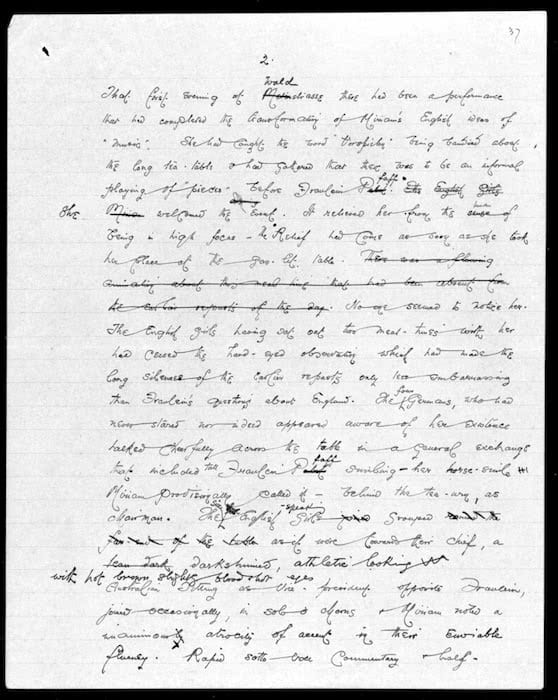
The surviving Pointed Roofs manuscript makes that process unusually concrete. The page reproduced by Yale's Modernism Lab is crowded with insertions, crossings-out, and words fitted into available space.[2] The physical object is a useful corrective to the fantasy of raw consciousness poured directly into type. However immediate the published prose feels, its stops and starts had to be composed.
That matters because “stream” can make the prose sound formless. Richardson is selecting the places where explanation drops out. A conventional novel might state the relation among memory, embarrassment, and desire; she places their verbal residues next to one another. The reader performs the connection and briefly occupies the same uncertain interval as Miriam.
Abroad, English Becomes Audible
The Hanover setting gives this voice experiment an exact social laboratory. Miriam arrives with a literary picture of Germany and almost no practical authority. She is supposed to teach English, yet worries about grammar and discovers that speaking a language is not the same as explaining it. Around her, German pupils speak English, English pupils speak German, a French teacher moves between both, and everyone hears everyone else's mistakes.[1]
Foreignness therefore does more than supply atmosphere. It makes Miriam's native language newly material. Englishness becomes visible in posture and audible in accent only after she has left England. A German phrase may first reach her as sound, then as meaning, then as a judgment about the speaker. Her own words make the reverse journey through other people's ears.
This is why the school scenes feel socially dense even when their events are modest. The plot can be a breakfast, a walk, a music lesson, or an awkward exchange. What changes is the calibration of Miriam's listening. At one breakfast she is astonished simply to be safely inside the new life and privately calls the fact “weird and stupendous.”[1] Later, belonging is no longer a single achievement. She wants intimacy and distance at once: to be recognized by the group without being absorbed into it.
The novel's national setting also shaped its first reception. It appeared in wartime Britain in September 1915. The Dorothy Richardson Society's record of reviews shows that some critics treated Miriam's attraction to German culture as untimely or suspect, while others recognized the book's clarity and originality.[4] Reception became another noisy room around the novel: experiment was heard as feminine triviality, psychological illness, technical daring, or inconvenient sympathy for Germany.
“Stream of Consciousness” Arrives After the Book
May Sinclair's 1918 essay on Richardson supplied the phrase that would dominate the book's afterlife, describing “Miriam's stream of consciousness” as the medium through which Richardson came close to lived reality.[5] The phrase helped make the experiment recognizable. It also encouraged later accounts to place Richardson beside Joyce and Proust as an early architect of modernist interior narration.[2][3]
But Pointed Roofs becomes sharper if the label is treated as a starting point rather than a verdict. A stream is continuous; Richardson's prose is conspicuously cut. A stream belongs to a channel; Miriam's language keeps admitting tributaries from other mouths. A stream moves forward; the novel's crucial facts arrive late, through association, and its ending appears to reverse the journey.
As Miriam prepares to return to England, she judges herself “empty-handed.”[1] The narrator does not step in to correct her. Yet the reader has spent a novel acquiring evidence that her verdict cannot contain: she has worked, listened, misread, revised, desired, recoiled, and learned how unstable a social self can be. The outward plot has brought her home. The style has made return impossible in another sense, because the mind doing the judging now carries an altered company of voices.
The Routledge Encyclopedia of Modernism describes Richardson's larger project as opening a “feminine realism” in which a woman's identity need not be organized by marriage or family.[3] Pointed Roofs begins that work at the level of the sentence. It does not replace public life with a private interior. It shows public life already inside the grammar: commands remembered, accents imitated, judgments anticipated, foreign words tested, and other people's tones surviving after they leave the room.
That is the best way to read Richardson's difficult ease. Follow who seems to own each phrase. Treat the ellipsis as a splice, not an invitation to drift. Notice when “she” stops naming an observed woman and starts carrying Miriam's unannounced idiom. The reward is more than access to one consciousness. It is the discovery that a voice can be singular without ever being alone.
Sources
- Dorothy M. Richardson, Pointed Roofs: Pilgrimage, Volume 1. Duckworth, 1915—Project Gutenberg ebook 3019, the primary text used for chapter and section references and short quotations.
- Sam Alexander, “Pointed Roofs.” Yale Modernism Lab—plot, narrative technique, free indirect discourse, chronology, and the Beinecke manuscript image used for this article.
- Scott McCracken, “Richardson, Dorothy (1873–1957).” Routledge Encyclopedia of Modernism—publication history, the Pilgrimage sequence, narrative method, and Richardson's place in modernist and women's writing.
- Dorothy Richardson Society, “Reviews and Obituaries”—annotated bibliography of the 1915 reception of Pointed Roofs, including positive, anti-German, and gendered responses.
- May Sinclair, “The Novels of Dorothy Richardson.” The Little Review 4, no. 12 (April 1918), pp. 3–11—digitized issue containing the early “stream of consciousness” formulation.