Charles Pooter opens his diary with a challenge: “Why should I not publish my diary?” The obvious comic answer is that nothing worth publishing happens to him. He commutes to a City office, worries about tradesmen, paints household objects, receives friends, quarrels with his son, and records each weak joke as though posterity were waiting. The better answer is the existence of The Diary of a Nobody. Pooter’s ordinary life did become a book, and the book has made his claim impossible to dismiss.[1]
That paradox is the right door into George and Weedon Grossmith’s comedy. Pooter is vain, fussy, status-conscious, and almost supernaturally unable to hear how he sounds. He is also loyal, affectionate, employable, vulnerable to humiliation, and often correct about the people who laugh at him. If you decide before page one that he is merely a snob to be punished, the novel becomes a row of predictable pratfalls. Its real pleasure begins when the joke changes sides: from Pooter to his tormentors, from father to son, from one social class to another, and finally from the page to the reader.
This is a short book, but it improves when read with a little resistance. Choose an edition that keeps Weedon’s illustrations, read in small portions, and postpone the word pooterish until the end. The label is convenient; the man is funnier.
Begin with the scraper, not the social history
The first two chapters teach nearly everything you need to know about the comic mechanism. A metal boot scraper outside the Pooters’ new house catches one visitor, then another, then the curate. Each accident renews the resolution “Must get that scraper removed.” Pooter finally acts only when a butcher threatens legal action. Until then, the obstacle is always urgent in retrospect and somehow optional in advance.[1]
Read this sequence twice. On the first pass, follow the obvious physical joke: entrance, trip, indignation, repeat. On the second, watch Pooter edit causality. He reports every warning faithfully, but his diary turns delay into misfortune, as if the scraper were persecuting him. That gap between an event and the account he gives of it is the novel’s basic unit of comedy.
The red-enamel episode sharpens the pattern. Pooter paints a flowerpot, a coal scuttle, the worn backs of the household Shakespeare, and finally the bath. Carrie objects that he should have consulted her. He insists taste is personal; boiling water then dissolves the paint over his body. The joke is not simply that an amateur decorator makes a mess. Pooter treats shared objects as a stage for unilateral improvement, mistakes objection for poor taste, and receives a bright red verdict from the material world.[1]
So the first reading habit is simple: whenever Pooter announces a principle, keep going. The next object, person, or sentence will test it. His diary is less a fortress of self-deception than a machine that keeps admitting contrary evidence without learning its name.
Let Carrie read over his shoulder
Because every entry says I, it is easy to treat the other characters as props in Pooter’s private theatre. Carrie is the first reason not to. She laughs at him, corrects him, absorbs his social alarms, and sometimes lets silence do what argument cannot. When he tries to cheer her by reading aloud from the diary, she leaves to speak to the laundress. Pooter asks whether his work bored her; she replies that she was not listening. Her answer is gentler and more devastating than the interpretation he offered her.[1]
Do not reduce Carrie to the sensible wife who stands outside the joke. She enjoys status too. She shares the thrill of the Mansion House invitation, participates in séances, worries about appearances, and can be as eager as Charles to read a social occasion correctly. But she is usually better at noticing the practical cost of his performances: the ruined bath, the damaged clothes, the offended guest, the work still waiting downstairs.
That makes the marriage more interesting than a contest between male pomposity and female common sense. A. James Hammerton places Pooter’s failed assertions of household mastery inside a wider history of lower-middle-class masculine insecurity. Yet the scenes also keep showing companionship: Charles and Carrie tease, repair, quarrel, attend, and make up. Authority fails; partnership survives.[4]
While reading, track who gets the last line of a domestic exchange and who performs the action after it. The two are not always the same person. The diary gives Charles grammatical control, but it cannot stop Carrie from becoming its most exact internal reader.
When Lupin arrives, refuse to choose a winner
Lupin, the Pooters’ adult son, seems designed to make his father obsolete. His slang arrives from a faster London; his clothes, courtships, stock tips, and career moves announce that caution is merely another word for stagnation. Charles hears corruption where Lupin hears opportunity. Their arguments tempt the reader to side with youth against fussiness.
Resist that reflex. Lupin is bolder than his father, but not more self-aware. He treats risky speculation as expertise, other people’s money as evidence of his promise, and mockery as an argument. Charles’s suspicion of the City schemes is often sound. His fault is that he packages sound judgment with wounded dignity, generational control, and a near-total inability to speak Lupin’s idiom.[1]
The two men are comic doubles. Each believes his preferred vocabulary proves his importance: Charles has propriety, Lupin has fashionable abbreviations and market talk. Each narrates embarrassment as somebody else’s mistake. Late in the book, when Lupin catches his father ducking away from the window, Charles replies, “What window?” It is a tiny lie, instantly useless—the respectable father’s version of his son’s financial bravado.[1]
The best Lupin scenes therefore keep moving the reader’s allegiance. Laugh at Charles for failing to understand the slang; then notice that the slang conceals a bad bargain. Admire Lupin’s energy; then ask who pays for it. Defend the father’s standards; then watch him confuse love with jurisdiction. Nobody holds the comic high ground for long.
Read at the speed of an installment
The Diary of a Nobody first appeared anonymously in Punch in twenty-five intermittent episodes from May 1888 to May 1889. A surviving 1888 page shows how compactly an installment sat among cartoons, opera notes, and other jokes: Pooter originally arrived as one comic voice in a crowded weekly room.[2][3]
The 1892 book did more than bind those columns. The Grossmiths organized the serial material into seventeen chapters, wrote seven more, revised scenes and dates, replaced the editor’s opening joke with Pooter’s own introduction, and added thirty-three pen-and-ink drawings by Weedon. They even converted a long publication gap into fiction: missing diary pages have been burned. The book remembers the interruptions of its first life while pretending they happened inside the Pooter household.[3]
That history suggests a practical pace: one or two chapters at a sitting. The entries are short, but their effects accumulate by delayed echo. A pun falls flat; days later Pooter congratulates himself on another. A friend behaves badly, disappears, then returns without explanation. Lupin’s newest certainty overwrites his previous one. Read too quickly and these recurrences flatten into plot. Leave a little space and they feel like memory—the exact medium in which irritation becomes affection.
There is no need to annotate every Victorian reference on a first reading. Look up a song, drink, or social custom only when not knowing blocks the scene. Pooter’s deepest anxieties need little translation: the guest who will not leave, the invitation that may signal arrival, the child who treats a parent as obsolete, the home improvement that becomes evidence.
Keep the pictures in the conversation
An illustrated edition is not a luxury. Weedon’s drawings supply a second performance of the diary. Charles controls the wording, but a pictured posture, costume, or collision can expose the scene he thought he had arranged. The images make the book feel less like a sealed manuscript and more like a collaboration between an unreliable monologue and a silent stage director.[1][3]
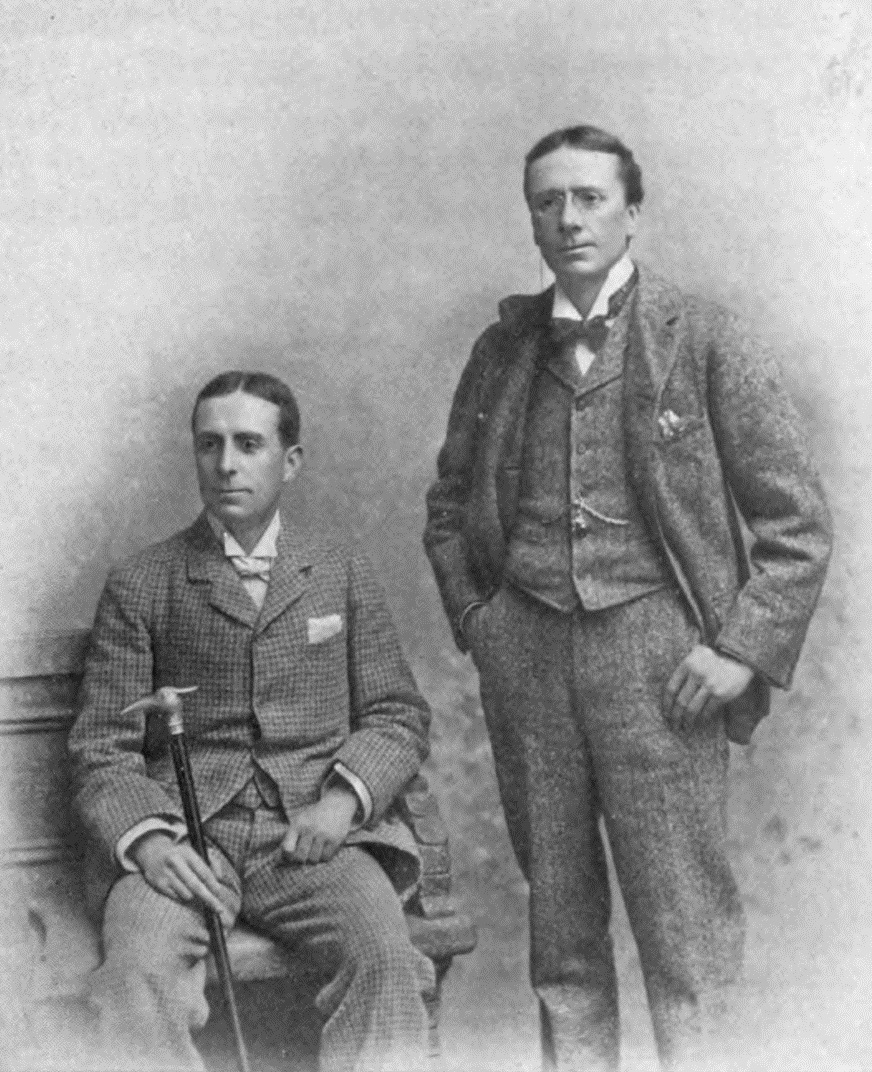
The collaboration was literal. George was a celebrated comic performer as well as a writer; Weedon was an actor and artist. Their period double portrait, used above, belongs to the book’s material afterlife rather than its fiction, but it catches the useful fact that Pooter’s “I” was made by two brothers working across voices and images.[5]
If your edition omits the drawings, the prose still works. But on a reread, restore them. Notice not merely what they depict but when they arrive. They often fix a fleeting humiliation into a tableau, giving the reader time to see what Pooter is already trying to narrate past.
Do not throw away the happy ending
The last chapter risks looking like a reward handed out by a sentimental author. Mr. Perkupp, grateful for Pooter’s faithful service, buys the freehold of the house and gives it to him. The man mocked for caring too much about his suburban address is allowed to own it. Almost immediately, Lupin’s latest romantic news unsettles the celebration.[1]
Take the gift seriously without pretending it settles the book’s class politics. Perkupp’s paternal generosity belongs to a hierarchy Pooter reveres, and the employer’s judgment does not erase every petty assertion at home. But Charles has qualities the comedy never disproves: honesty, constancy, gratitude, and a capacity for joy that survives repeated embarrassment. The house is not proof that he was right about everything. It is proof that being ridiculous does not make him worthless.
This is where the familiar afterlife of “Pooterism” can get in the way. The character became shorthand for lower-middle-class pretension, and scholarship has traced how his domestic authority is repeatedly punctured.[4] That history matters. Yet Peter Morton notes that no contemporary record tells us what the original Punch readers thought of the serial, while the book itself keeps complicating the easy sneer with sympathy.[3] Reception supplied a stable label for a deliberately unstable experience.
On finishing, return to Pooter’s opening question. He believes a diary can make an ordinary man matter; we laugh because the claim is grandiose. Then we close a book that has preserved his dinners, bruises, buttons, quarrels, and small happiness for more than a century. The joke has changed sides one last time. Pooter was wrong about his importance in exactly the way that made him worth reading.
Sources
- George Grossmith and Weedon Grossmith, The Diary of a Nobody. J. W. Arrowsmith—Wikisource transcription of the illustrated 1919 fourth edition, used for chapter, scene, and short quotation references.
- Heidelberg University Library, Punch, vol. 94 (9 June 1888), p. 269—digitized page containing an early installment of “The Diary of a Nobody” in its original periodical setting.
- Peter Morton, “The Diary of a Nobody”—publication history, serial-to-book revisions, calendar notes, illustrations, and reception context from the editor of the 2009 Broadview edition.
- A. James Hammerton, “Pooterism or Partnership? Marriage and Masculine Identity in the Lower Middle Class, 1870–1920.” Journal of British Studies 38, no. 3 (1999), pp. 291–321—class identity, domestic authority, and companionate marriage.
- Wikimedia Commons, “Weedon and George Grossmith.jpg”—public-domain studio photograph, circa 1894, digitized from a period edition of The Diary of a Nobody.